GDS Engineering is pleased to announce its participation in the 2025 Maritime Education and Training (MET) Workshop, jointly organized by the International Association of Maritime Universities (IAMU) and the Maritime Industry Authority (MARINA). The event brought together representatives from 79 Maritime Higher Education Institutions (MHEIs) across the Philippines, including university leaders, deans, program heads, and academic directors, along with international experts from Croatia, India, Japan, Sweden, and Türkiye.
Recognized as one of the region’s most influential platforms for enhancing competence based maritime education, the workshop facilitated meaningful discussions on strengthening training standards, developing academic capacity, and integrating innovative instructional methodologies into MET programs.
Presentation by Dr. Ismail Cicek
During the workshop, Dr. Ismail Cicek, Associate Professor at Istanbul Technical University and General Manager of GDS Engineering, delivered a well-received presentation titled:
“Future-Proofing Marine Engineer Competence: Integrating Objective and Collaborative Assessment through Engine Room Simulation.”
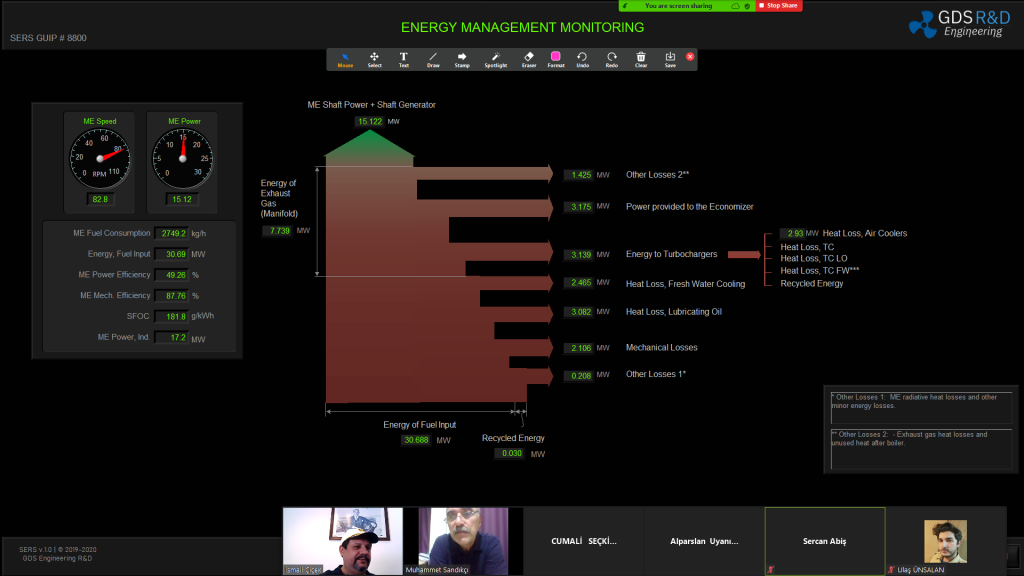
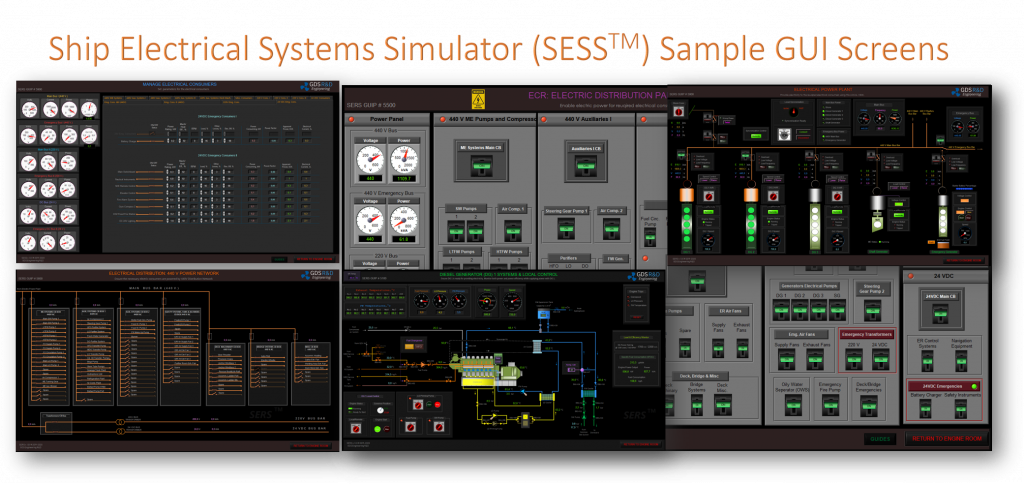
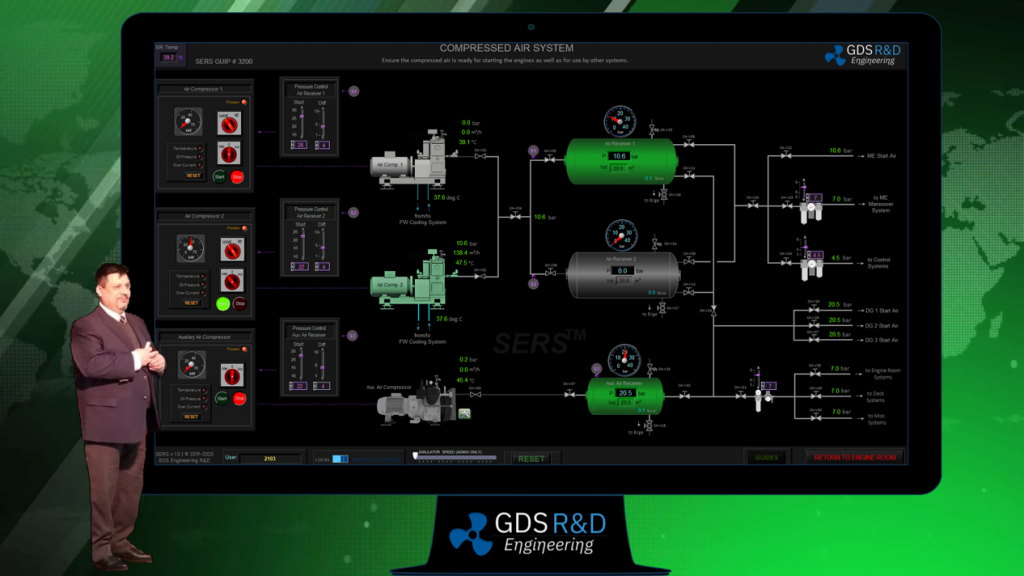
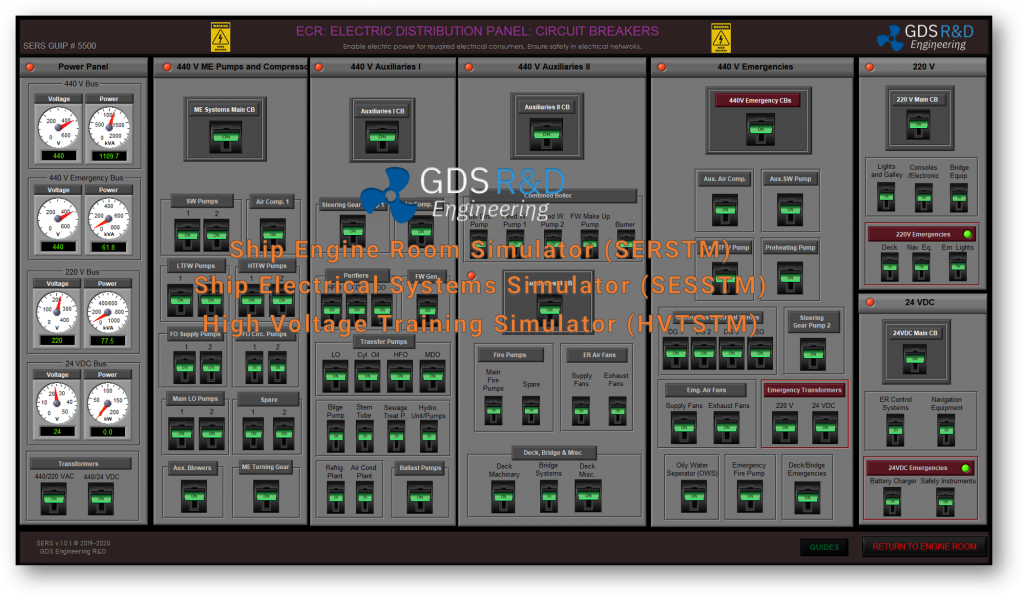
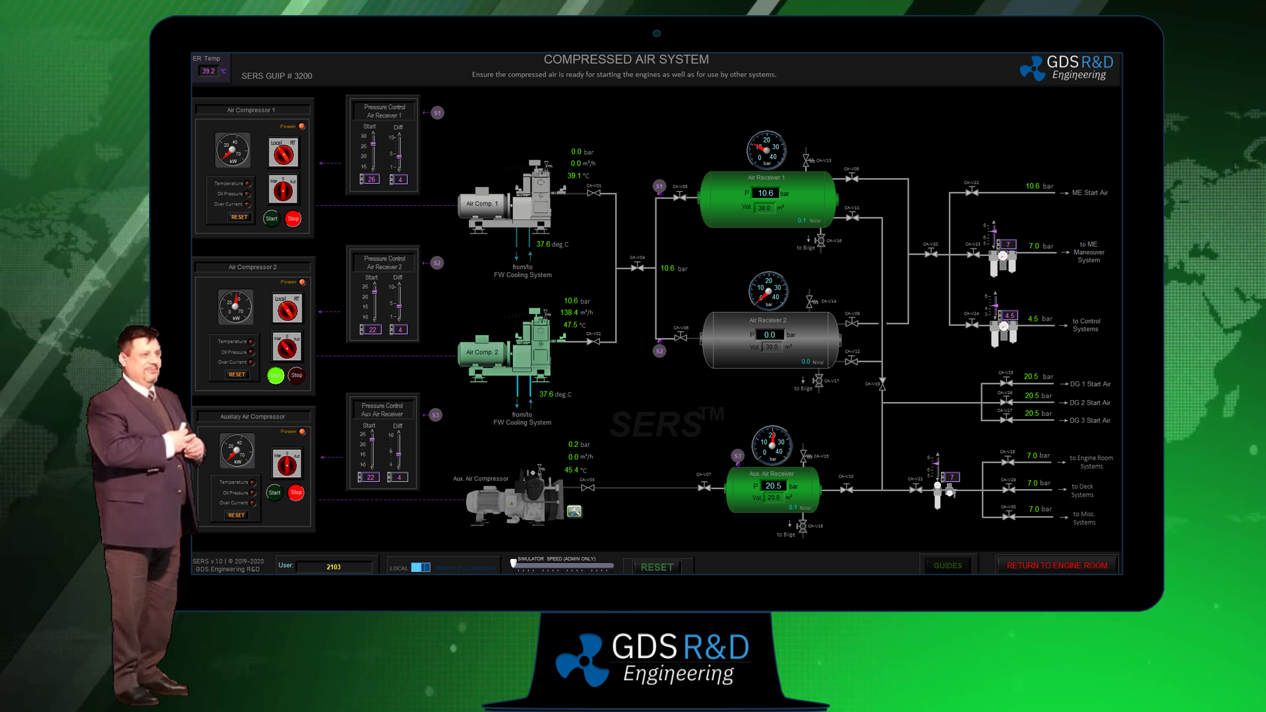
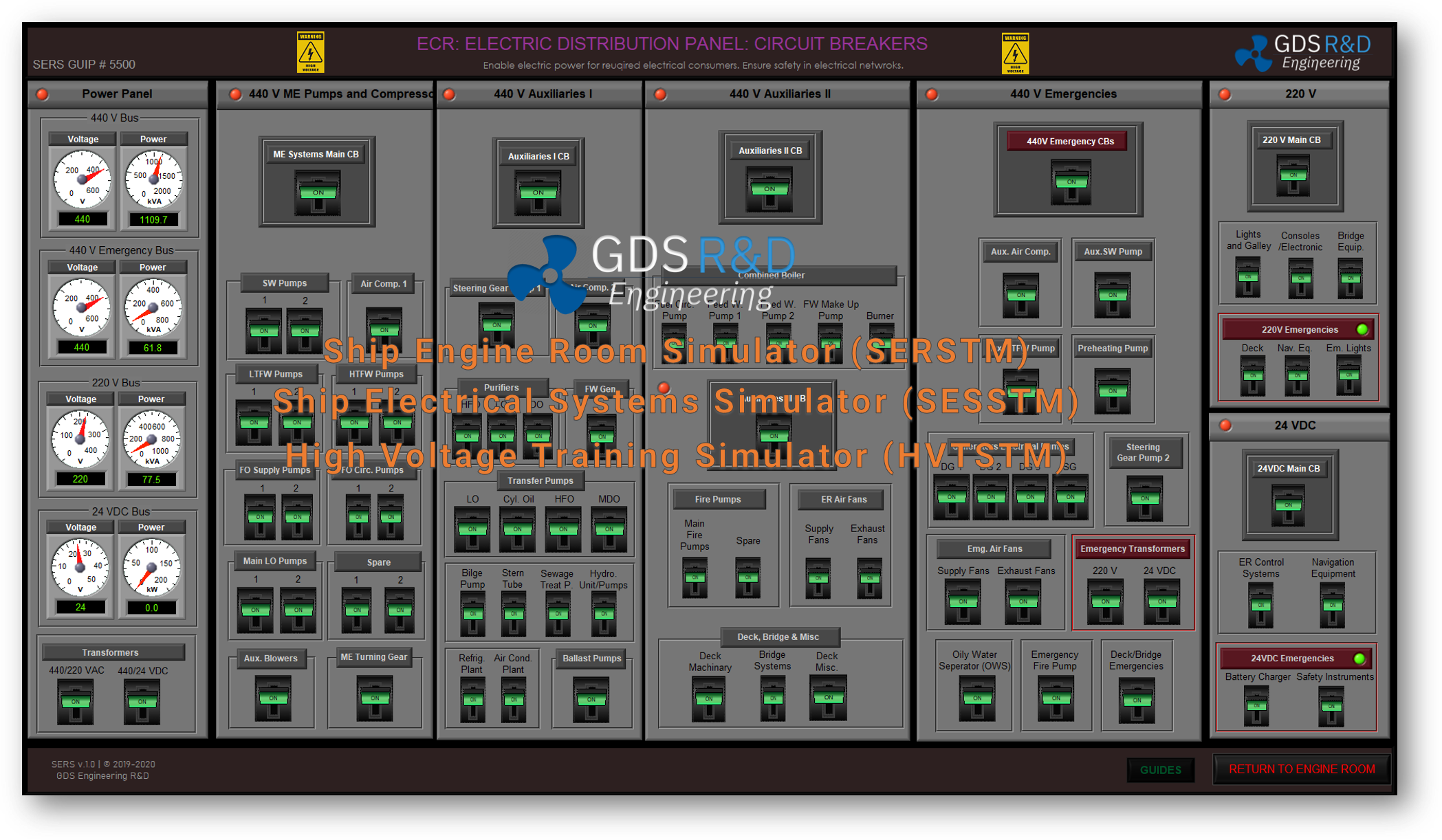
His session highlighted how next-generation training technologies, particularly the SERS™ Engine Room Simulator developed by GDS Engineering, can support MET institutions in:
enhancing individual competence through objective, automated performance assessment;
strengthening team-based skills such as communication, situational awareness, and resource management;
aligning training practices with STCW 2010 and IMO Model Course 2.07 requirements;
providing realistic full-mission environments for collaborative decision-making and emergency response;
expanding technical proficiency via advanced engineering, malfunction, and risk-management exercises.
Global Trends in Simulation Based Maritime Education
The strong interest shown by participants in simulation-based training demonstrated a global rise in digital, data-driven, and collaborative approaches within maritime education. This aligns with the increasing demand for immersive, technology-enhanced learning environments that prepare marine engineers for modern operational challenges.
At GDS Engineering, we value the role of advanced training technologies in strengthening maritime education. We are pleased to contribute to initiatives that help improve training quality, support competence development, and promote safer and more effective engineering operations in the maritime industry.
For further information about our simulation technologies or international collaborations, please contact us.
SIRE 2.0 training is designed to prepare vessel operators, crew members, and shore-side personnel for the Ship Inspection Report Programme (SIRE) 2.0, a new risk-based inspection regime introduced by the Oil Companies International Marine Forum (OCIMF).
Here's a breakdown of key aspects of SIRE 2.0 training:
Objectives:
Understanding SIRE 2.0: Familiarize participants with the structure, methodology, and requirements of the updated inspection program. This includes the five stages of inspection (request, validation, preparation, execution, and reporting), the revised VIQ (Vessel Inspection Questionnaire), and the focus on human factors.
Technical Knowledge: Enhance understanding of the technical aspects of vessel operations, including:
Cargo handling and operations
Mooring operations
Engineering systems and maintenance
Navigation and bridge procedures
Safety and emergency procedures
Environmental protection measures
Human Factors: Develop awareness and skills related to human factors in ship operations, such as:
Communication and teamwork
Situational awareness
Decision-making
Fatigue management
Stress management
Leadership and management
Compliance and Best Practices: Ensure participants are well-versed in relevant regulations and industry best practices, including:
SOLAS (Safety of Life at Sea)
MARPOL (International Convention for the Prevention of Pollution from Ships)
STCW (Standards of Training, Certification and Watchkeepingfor Seafarers)
ISGOTT (International Safety Guide for Oil Tankers and Terminals
SIRE 2.0 Training Providers
Several organizations offer SIRE 2.0 training courses, including:
SQLearn: CBT courses covering various aspects of SIRE 2.0.
Anglo-Eastern Maritime Training Centre: A comprehensive SIRE 2.0 training course.
GDS Training Institute: Developer of the Engine Room Simulator. Training offered by Istanbul Technical University Marine Engineering Department's Experts with Chief Engineering and Academic Expertise. Utilization of the GDS Ship Engine Room Simulator (SERS™) for SIRE 2.0 hands-on training. GDS & ITU Experts Team offers this training either ONLINE or FACE-to-FACE at the Istanbul Technical University Simulators Center, Tuzla, Istanbul.
Lloyd's Register: Provides a Tanker Vetting and Inspection (SIRE 2.0) course.
RINA: Offers a Vetting Inspections as per SIRE 2.0 course.
SIRE 2.0 Training Methods
SIRE 2.0 training can be delivered through various methods, including:
Online Courses: Offer flexibility and convenience, allowing participants to learn at their own pace.
Classroom Training: Provides interactive learning experiences and opportunities for group discussions and exercises.
Simulator Training: Allows participants to practice skills and procedures in a safe and controlled environment.
Onboard Training: Provides practical training and assessment in the actual work environment.
Benefits of the SIRE 2.0 Training using Engine Room Simulator
Improved Safety and Environmental Performance: Enhances knowledge and skills to operate vessels safely and efficiently, minimizing risks to personnel, the environment, and cargo.
Reduced Inspection Deficiencies: Prepares vessels and crew for SIRE inspections, reducing the likelihood of findings and non-conformities.
Enhanced Compliance: Ensures compliance with industry standards and regulations, minimizing the risk of penalties and detentions.
Improved Operational Efficiency: Promotes best practices and efficient operations, leading to cost savings and improved productivity.
Increased Competitiveness: Demonstrates commitment to safety and quality, enhancing reputation and competitiveness in the industry.
By investing in SIRE 2.0 training, vessel operators and crew can ensure they are well-prepared for the new inspection regime and contribute to a safer and more sustainable maritime industry.
The Importance of SIRE 2.0 and GDS Ship Engine Room Simulator in Developing Advanced Skills for Onboard Maritime Personnel
The maritime industry has significantly pushed towards technological advancement and stricter safety and operational standards in recent years. As vessels become more sophisticated and regulations evolve, the role of well-trained onboard maritime personnel becomes increasingly essential. In this context, the SIRE 2.0 program and GDS Ship Engine Room Simulator represent pioneering tools designed to equip maritime crews with deep technical skills necessary to meet new demands and improve the safety and efficiency of maritime operations. These tools provide a more immersive and practical learning experience, allowing crew members to understand ship operations and emergency procedures better, thereby enhancing their ability to respond effectively in real-world situations.
Why You Should Choose GDS SERS™ in Your SIRE 2.0 Training Program?
Choosing GDS SERS (Ship Engine Room Simulator) for your SIRE 2.0 training offers several compelling advantages that can significantly enhance the effectiveness of your training program and better prepare your crew for the challenges of the new inspection regime. Here's why:
1. Enhanced Realism and Immersion:
Realistic Engine Room Environment:SERS replicates a realistic engine room environment, complete with authentic equipment, controls, and systems.This immersive experience allows trainees to interact with the machinery and systems they will encounter onboard, fostering a deeper understanding of their operation and functionality.
Real-Time Simulation: SERS simulates real-time engine room operations, including dynamic responses to changes in parameters, equipment malfunctions, and emergency situations.This dynamic simulation enables trainees to develop critical thinking and problem-solving skills in a safe and controlled environment.
2. Comprehensive Training Coverage:
Technical Skills Development:SERS facilitates the development of essential technical skills required for safe and efficient engine room operations.Trainees can practice routine maintenance, troubleshooting, and emergency procedures, gaining confidence and proficiency in their roles.
Human Factors Integration: SERS integrates human factors principles into the training, allowing trainees to experience the impact of communication, teamwork, and decision-making in a simulated engine room environment. This helps them develop crucial non-technical skills essential for SIRE 2.0 compliance.
3. Alignment with SIRE 2.0 Requirements:
Focus on Critical Operations:SERS training scenarios can be customized to focus on critical operations and systems emphasized in SIRE 2.0, such as cargo handling, mooring operations, and emergency response. This targeted training ensures trainees are well-prepared for the specific challenges of the new inspection regime.
Human Factors Assessment:SERS allows for the assessment of human factors performance in a simulated environment, providing valuable insights into crew behavior and decision-making under pressure.This data can be used to identify areas for improvement and enhance crew performance in line with SIRE 2.0 expectations.
4. Cost-Effectiveness and Efficiency:
Reduced Operational Disruption: SERS training can be conducted without disrupting actual vessel operations, minimizing downtime and associated costs. Trainees can practice and develop their skills in a simulated environment without impacting real-world operations.
Optimized Training Delivery:SERS offers flexible training delivery options, including online and on-site training, allowing for customized training programs that meet specific needs and schedules. This flexibility optimizes training efficiency and minimizes disruption to crew schedules.
5. Continuous Improvement and Performance Monitoring:
Performance Tracking and Analysis:SERS provides detailed performance tracking and analysis, allowing trainers to monitor trainee progress, identify areas for improvement, and provide targeted feedback. This data-driven approach ensures continuous improvement in training effectiveness and crew competency.
Adaptability to Future Requirements: SERS can be easily updated to incorporate new technologies, regulations, and industry best practices, ensuring your training program remains relevant and aligned with evolving SIRE requirements.
By choosing GDS SERS for your SIRE 2.0 training, you invest in a comprehensive and effective training solution that enhances crew competency, improves safety performance, and ensures compliance with the latest industry standards.
Our new paper about SERS™ and ERM Training has been published in the Proceedings of IMLA 29.
Paper Reference Information (APA):
Ismail Cicek and Burak Cavusoglu (2024). An Optimized Ship Engine Room Simulator Configuration for Effective Engine Room Resource Management Training. Proceedings of the International Maritime Lecturers Association (IMLA) Conference. Pages 36-50. Conference held on September 25-28, Istanbul, Turkey.
As part of the IMLA 2024 Conference, the new engine room simulator, called Ship Engine Room Simulator (SERS™) 4Team, SERS™4Team, has been demonstrated by Istanbul Technical University.
There was a great interest in the SERS™4Team demonstrations at the GDS booth and demonstrations at the Istanbul Technical University.
Optimizing Maritime Engineering Training: A Deep Dive into the SERS™4Team Simulator
The International Maritime Lecturers’ Association (IMLA) 2024 Conference provided a compelling platform for showcasing advancements in maritime education and training. Among the highlights was the demonstration of Istanbul Technical University’s latest innovation: the Ship Engine Room Simulator (SERS™) 4Team. This cutting-edge simulator offers a significant leap forward in training maritime engineers, addressing critical challenges and aligning with contemporary industry standards.
The SERS™ 4Team distinguishes itself through its robust capabilities for both research and training, focusing on engine performance management within a collaborative teamwork environment. This emphasis on collaborative teamwork is crucial, reflecting the complex and interdependent nature of modern ship engine rooms. The simulator facilitates training in a full mission training configuration, allowing multiple trainees to interact within a virtual engine room environment, mirroring real-world operational dynamics. This approach directly addresses the need for effective communication, coordination, and shared decision-making in critical situations.
A key strength of the SERS™ 4Team lies in its ability to simulate a wide array of scenarios, including those with potentially catastrophic consequences. Notably, the simulator can recreate events leading to a blackout of the ship, a scenario of paramount concern in maritime safety. By allowing trainees to experience and respond to such high-stakes situations in a controlled environment, the SERS™ 4Team fosters crucial decision-making skills and enhances preparedness for real-world emergencies. This focus on critical scenarios directly supports the development of competencies outlined in the IMO STCW 2010 Convention, ensuring that trainees are equipped to handle complex and challenging operational conditions.
Furthermore, the SERS™ 4Team is designed with cost-effectiveness in mind. By providing a virtual training environment, the simulator reduces the reliance on expensive and potentially hazardous onboard training, offering a more sustainable and accessible approach to maritime education. This cost-effectiveness does not compromise the quality of training; on the contrary, the simulator offers a controlled and repeatable learning experience, allowing trainees to practice complex procedures and respond to critical scenarios multiple times, enhancing their understanding and proficiency.
The simulator’s design explicitly incorporates exercises and scenarios derived from the IMO Model Course 2.07, ensuring that training aligns with internationally recognized standards for marine engineering education. This alignment underscores the simulator’s commitment to delivering high-quality, standardized training that meets the evolving demands of the maritime industry. By integrating the principles of Collaborative Teamwork within a Full Mission Training Configuration, and by addressing critical scenarios such as ship blackouts, the SERS™ 4Team offers a powerful tool for optimizing maritime engineering training and enhancing maritime safety, fully supporting the development of IMO STCW 2010 Competencies. This innovative approach to training promises to significantly contribute to the development of competent and resilient maritime engineers.
Download the Full Proceedings: IMLA 2024 Conference Proceedings held between 25-28 September 2025, Istanbul, Turkey:
The Importance of SIRE 2.0 and GDS Ship Engine Room Simulator in Developing Advanced Skills for Onboard Maritime Personnel
The maritime industry has significantly pushed towards technological advancement and stricter safety and operational standards in recent years. As vessels become more sophisticated and regulations evolve, the role of well-trained onboard maritime personnel becomes increasingly essential. In this context, the SIRE 2.0 program and GDS Ship Engine Room Simulator represent pioneering tools designed to equip maritime crews with deep technical skills necessary to meet new demands and improve the safety and efficiency of maritime operations. These tools provide a more immersive and practical learning experience, allowing crew members to understand ship operations and emergency procedures better, thereby enhancing their ability to respond effectively in real-world situations.
Understanding SIRE 2.0 and Its Impact on Maritime Training
A Team That Loves to Create
The Ship Inspection Report Program (SIRE) has long been a fundamental tool in maintaining safety and operational standards across the maritime industry, particularly for tanker operations. Launched by the Oil Companies International Marine Forum (OCIMF), the program provides a comprehensive inspection system that evaluates the condition and operations of vessels. However, with the growing complexity of modern ships and stricter environmental and safety regulations, the traditional SIRE program required enhancements to address these evolving needs. This led to the development of SIRE 2.0, an upgraded version that integrates data-centric inspection methodologies with a stronger focus on crew competency, operational excellence, and technical skills.
One of SIRE 2.0's key features is its focus on assessing crew members' competency in handling complex equipment and operations. Rather than focusing solely on vessel conditions, SIRE 2.0 evaluates the practical skills, knowledge, and decision-making abilities of onboard personnel. This ensures that crew members are familiar with equipment and operational standards and capable of responding effectively to critical situations.
The emphasis on crew competency in SIRE 2.0 aligns with the industry’s shift toward a human-centered approach to safety and operational excellence. This paradigm shift means that training programs must go beyond traditional instruction and delve into more practical, technology-driven skills, where simulators like the GDS Ship Engine Room Simulator come into play.
The Role of the GDS Ship Engine Room Simulator in Skill Development
Keep It Simple
The GDS Ship Engine Room Simulator is an advanced training tool that replicates the engine room environment of modern vessels, providing maritime personnel with hands-on experience in a controlled setting. This simulator covers many critical systems in ship engine rooms, including propulsion, auxiliary machinery, electrical systems, and emergency protocols. By using the simulator, crew members can practice their skills, refine their decision-making processes, and gain confidence in handling complex systems without the risks associated with real-world errors.
The simulator allows trainees to engage in realistic scenarios, such as equipment failures, power management issues, and environmental challenges. This training is invaluable in helping them develop deep technical skills needed to respond effectively under pressure. Given the increasing complexity of ship machinery, which often integrates digital and automated controls, such simulator-based training ensures that personnel are well-prepared for routine and emergency operations.
Developing Deep Technical Skills with SIRE 2.0 and the GDS Simulator
By integrating SIRE 2.0’s competency standards with the practical capabilities of the GDS Ship Engine Room Simulator, maritime training institutions can foster deep tech skills that are essential in today’s high-stakes maritime environment. Training programs using these tools can address various aspects, including:
Operational Readiness: By simulating real-life engine room conditions, the GDS simulator enables personnel to understand systems and processes intuitively, aligning with SIRE 2.0’s focus on crew readiness and situational awareness.
Crisis Management and Decision-Making: The simulator provides scenarios that replicate emergencies, allowing trainees to practice crisis response, prioritize actions, and make critical decisions under pressure.
Technical Proficiency: The GDS simulator helps personnel develop advanced skills in troubleshooting and maintaining complex machinery, which is crucial for achieving SIRE 2.0’s standards for operational excellence.
Environmental Compliance: With a growing emphasis on environmental regulations, the simulator enables crew members to familiarize themselves with compliance standards and practice procedures that reduce environmental impact, such as optimizing fuel usage and managing waste effectively. The SIRE 2.0 program also plays a crucial role in this aspect, as it evaluates a vessel’s environmental management systems and crew’s awareness of environmental issues, ensuring that the vessel operates in a safe and environmentally responsible manner.
Safety Protocols: The simulator reinforces safety protocols through realistic training scenarios, ensuring that personnel can identify and mitigate risks, a core SIRE 2.0 inspection program component. The SIRE 2.0 program, focusing on crew competency and operational excellence, further enhances safety by ensuring that crew members are well-trained and capable of handling emergencies effectively, thereby reducing the risk of accidents and ensuring the safety of the vessel and its crew.
Enhancing the Future of Maritime Training
Training methodologies must evolve accordingly as the maritime industry continues to advance technologically. SIRE 2.0 and the GDS Ship Engine Room Simulator represent a forward-thinking approach to maritime training that emphasizes deep technical skills, operational competence, and environmental awareness. By embedding these elements into their training programs, maritime institutions can ensure that their personnel are qualified to operate today’s vessels and prepared to meet the challenges of tomorrow’s maritime landscape.
In summary, the combination of SIRE 2.0 standards and the immersive experience of the GDS Ship Engine Room Simulator is a critical step forward for maritime training. Using SERS in SIRE 2.0 training provides a more skilled, adaptable workforce better equipped to operate in a complex, evolving industry, ultimately enhancing global maritime operations’ safety, efficiency, and environmental responsibility.
Engine Room Resource Management (ERM) is a system of achieving safe engineering operations by proactively utilizing and managing personnel, equipment, and information in the machinery space. A review the team roles, human factors, and situational awareness is required to plan and implement a proper ERM program. Remember, good ERM practices can save personnel and vessels from unwanted risks.
The course complies with the standards of Regulation III/1, III/2, III/6 and VIII/2 of STCW Convention, Section A-III/1, III/2, III/6, A-VIII/2 and B-VIII/2 of STCW Code and SIRE requirements.
Topics in a ERM training includes
Learn about effective resource allocation including crew, plant, equipment, and information management
Understand the leadership responsibilities of the Chief Engineer, including staff training and motivation, preventing crew fatigue, and conducting appropriate drills
Review individual and team roles, and how to reduce human error using situational awareness and closed loop communication
See engine room equipment functions and standard operating procedures
Relevance of this Training with existing IMO Model Courses
This course includes the topics using the guidance provided by the following IMO Model Courses.
IMO Model Course 7.02 Chief Engineer Officer and Second Engineer Officer
IMO Model Course 7.04 Officer in Charge of an Engineering Watch
IMO Model Course 2.07 Engine Rooms Simulator. 2017 Ed.
IMO Model Course 1.39 Leadership and Teamwork
IMO Model Course 1.38 Marine Environmental Awareness
Referenced Documents
The following documents must be used along with this document for effectively planning and providing an ERM training.
User Manual Vol I (SERS Software Description) describe the SERS software with the SERS Graphical User Interface (GUI) Panels accessed from the SERS Main Graphical User Interface (GUI) Panel.
User Manual Volume II (Engine Room Operations) includes the operational instructions on how to operate the engine room systems and machinery using the SERS.
User Manual Vol III (Installation & Configuration) describes the installation and the configuration of software and hardware items
This manual, User Manual Volume IV (Instructor’s Manual), includes guides and information for the instructors to utilize SERS in their trainings according to their specific training objectives.
Refer to “SERS Philosophy Document” for selecting the configuration of the SERS for your training objectives. Then use Vol. III for the proper installation of the SERS and reading the configuration guidelines.
Engine Room Resource Management (ERM) is a system of achieving safe engineering operations by proactively utilizing and managing personnel, equipment, and information in the machinery space. A review the team roles, human factors, and situational awareness is required to plan and implement a proper ERM program. Remember, good ERM practices can save personnel and vessels from unwanted risks.
The course complies with the standards of Regulation III/1, III/2, III/6 and VIII/2 of STCW Convention, Section A-III/1, III/2, III/6, A-VIII/2 and B-VIII/2 of STCW Code and SIRE requirements.
The course is aimed at officers of the engineering watch (operational level), 2nd Engineer and Chief Engineer (management level).
The course is a mix of theory case studies and simulation exercise covering topics below. The following are the four main areas to cover in an ERM training:
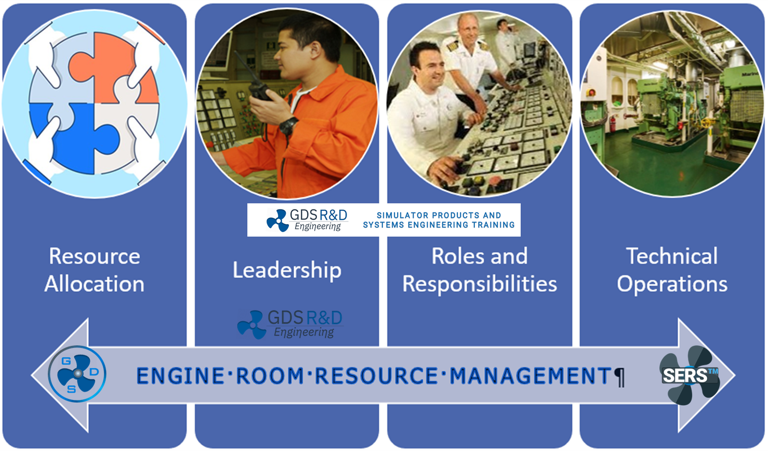
RESOURCE ALLOCATION: Effective resource allocation including crew, plant, equipment, and information management.
LEADERSHIP: The leadership responsibilities of the Chief Engineer, including staff training and motivation, preventing crew fatigue, and conducting appropriate drills
TEAM ROLES AND RESPONSIBILITIES: The roles and responsibilities for both individuals and team. Planning and execution must be reviewed with past experiences with the aim of reducing human error using situational awareness and closed loop communication.
TECHNICAL OPERATIONS MANAGEMENT: A study with a thorough review of equipment functions, standard operating procedures including safety procedures.
Designing your ERM Training with SERS
In this section, we provide a guidance on how to design an IMO ERM training with step by step approach. We hope that it helps you provide an effective training for your cadets or engineers already working onboard.
1. Certification of the Simulator
Certification of the simulator is highly important. You must ensure that it has all capabilities to provide the capabilities training based on STCW 2010. As for the ERM training, the simulator must be capable of demonstrating the IMO Model Course (2.07) exercises.
GDS Ship Engine Room Simulator (SERS™) is a Training Simulator System with a Full Mission (Class A) type approval certificate obtained from ClassNK. ClassNK is an IACS affiliate Classification Organization. Certificate of SERS™ lists the IMO STCW 2010 competencies, as provided in Table 1, which includes the compliance to IMO STCW Tables A-III. The class certification of SERS includes the IMO Model Course 2.07 (207) Ed.). The trainee is able to perform all exercises contained in the IMO Model Course 2.07. All exercises were demonstrated during the Class Type Approval.
Table 1: SERS™ Certification Items for STCW Training Competencies.
IMO STCW-2010 Reference
Competence
Table A-III/1.1
Maintain a safe engineering watch
Table A-III/1.2
Use English in written and oral form
Table A-III/1.3
Use internal communication systems
Table A-III/1.4
Operate main and auxiliary machinery and associated control systems
Table A-III/1.5
Operate fuel, lubrication, ballast and other pumping systems and associated control systems
Table A-III/1.6
Operate electrical, electronic and control systems
Table A-III/1.10
Ensure compliance with pollution prevention requirements
Table A-III/1.11
Maintain seaworthiness of the ship
Table A-III/1.12
Prevent, control and fight fires on board
Table A-III/1.16
Application of leadership and team working skills
Table A-III/2.1
Manage the operation of propulsion plant machinery
Table A-III/2.2
Plan and schedule operations
Table A-III/2.3
Operation, surveillance, performance assessment and maintaining safety of propulsion plant and auxiliary Machinery
Table A-III/2.4
Manage fuel, lubrication and ballast operations
Table A-III/2.5
Manage operation of electrical and electronic control equipment
Table A-III/2.6
Manage troubleshooting restoration of electrical and electronic control equipment to operating condition
Table A-III/2.8
Detect and identify the cause of machinery malfunctions and correct faults
Table A-III/2.10
Control trim, stability and stress
Table A-III/2.11
Monitor and control compliance with legislative requirements and measures to ensure safety of life at sea and protection of the marine environment
Table A-III/2.14
Use leadership and managerial skills
Table A-III/4.2
For keeping a boiler watch: Maintain the correct water levels and steam pressures
Table A-III/6.1
Monitor the operation of electrical, electronic and control systems
Table A-III/6.2
Monitor the operation of automatic control systems of propulsion and auxiliary machinery
Table A-III/6.3
Operate generators and distribution systems
Table A-III/6.4
Operate and maintain power systems in excess of 1,000 volts
Table A-III/6.5
Operate computers and computer networks on ships
Table A-III/6.7
Use internal communication systems
Table A-III/6.9
Maintenance and repair of automation and control systems of main propulsion and auxiliary machinery
Table A-III/6.12
Ensure compliance with pollution-prevention requirements
2. Simulator Detail Specs
This is probably the most tricky part. Some simulators could be cheap (!) and may be simulating the systems at a very high level. Does it have a main engine lubricating oil system? Probably yes. Does it satisfy the IMO competencies. Well this is the tricky part. It must have the LO Temperature Control System appropariately and realistically simulating the systems. We gave a simple example. Most trainers learn the specifics of the simulator after some experience of using it and become aware of the isues that prevent providing an efficient engine room simulator training. This may not be of an issue for a freshman level students; however, it becomes important when trainees are already completed their training onboard a ship and that they completed their marine engine engineering courses (Diesel Engines, Ship Auxiliary Engines, Electrical Systems, Automatic Control Systems, etc.). Additionally, the models and simulated systems has critical importance when the trainees are the personnel already have experience onboard a ship. Usually, the trainees in an ERM course will be watchkeeping officers or even chief engineers and they will probably critisize the training if the simulations are not realistic!
We have written the full specifications list for an engine room simulator, generalized with a focus on how it must help the instructors in the training. We went through each section of both the IMO STCW 2010 and IMO Model Course 2.07 and ensure the full list is at hand with the training in focus. Do not hesitate to request a copy if you are establishing an engine room training facility. We will be glad to help as trainers with ERS training experience of more than 20 years.
We should warn you that you must prepare the requirements for purchasing an Engine Room Simulator not the manufacturer.
3. Simulator Configurations
The training area must be organized with a focus into the training goals and objectives. The number of students to train at once is also an important element.
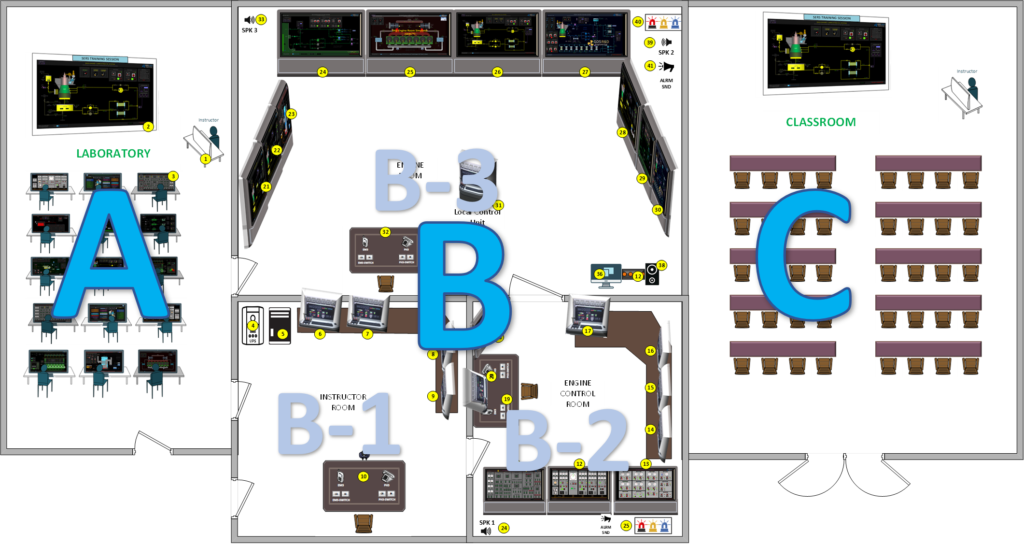
There are two examples of simulator configırations shown with the following figures. You must define your objectives first and ensure that a satisfactory number of stations and area is provided during the training.