GDS Engineering R&D Delivers Hands-On ME-C Main Engine Training to DS Crewing GmbH, Germany

GDS Engineering R&D has successfully completed a three-day Electronically Controlled Main Propulsion Engine (ME-C) Training Program for the marine engineering personnel of DS Crewing GmbH, Germany.

Developed around the MAN B&W 6G60MEC-10.5-HPSCR main engine, the program combined technical system knowledge with hands-on controller practice, fault diagnosis and SERS™ simulator applications.

The key objective was clear: rather than limiting the program to classroom-based theory, participants were given the opportunity to understand the ME-C system and then work with the control interfaces used to operate, monitor and troubleshoot electronically controlled propulsion systems.

Hands-On Training with the Multifunction Controller (MPC)

A key feature of the training was the hands-on use of the Multifunction Controller (MPC).

Participants examined the controller and its relationship with the ME-C control architecture, combining component-level understanding with practical interface experience. The training addressed controller functions, system status information, feedback signals and representative fault conditions, helping participants connect what they see on the control system with what is physically happening on the engine.
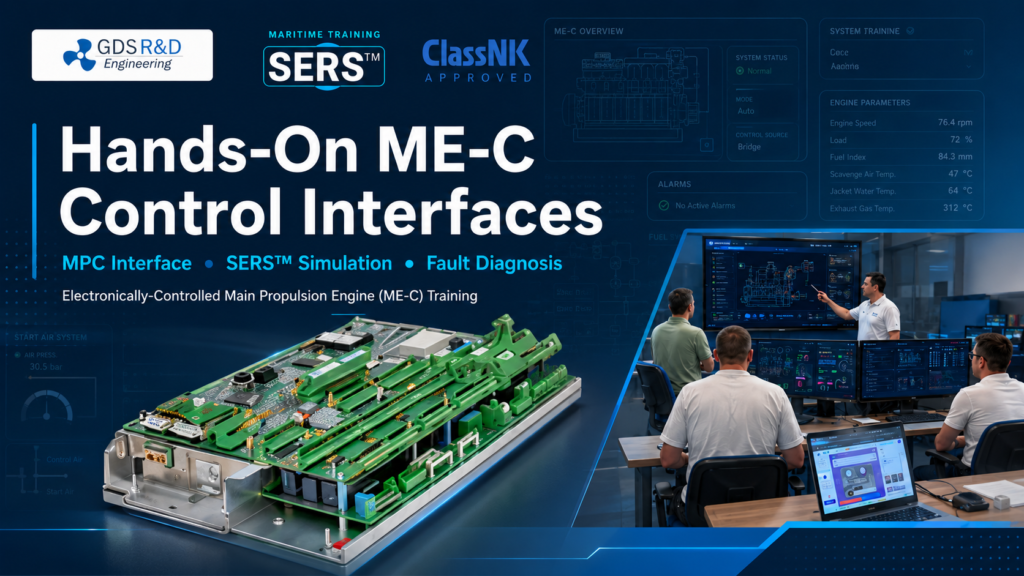
This practical approach is particularly important for modern electronically controlled engines. During an actual fault, engineers need to move beyond acknowledging an alarm and determine which controller, sensor, hydraulic component or subsystem is responsible for the abnormal condition.

The training therefore combined system knowledge with hands-on troubleshooting and operational decision-making.

Understanding the ME-C System

The technical part of the program covered the transition from conventional mechanically controlled engines to electronically controlled ME architecture.

Participants examined the Hydraulic Power Supply (HPS), Hydraulic Cylinder Units (HCU), accumulators and high-pressure system oil distribution, followed by the operating principles of FIVA – Fuel Injection Valve Actuation, fuel pressure boosters, exhaust valve actuation and electronically controlled cylinder lubrication.

The program then moved into the Engine Control System (ECS), including MPC-based control architecture and the functions of the CCU, ECU and EICU, together with Tacho and sensor systems.
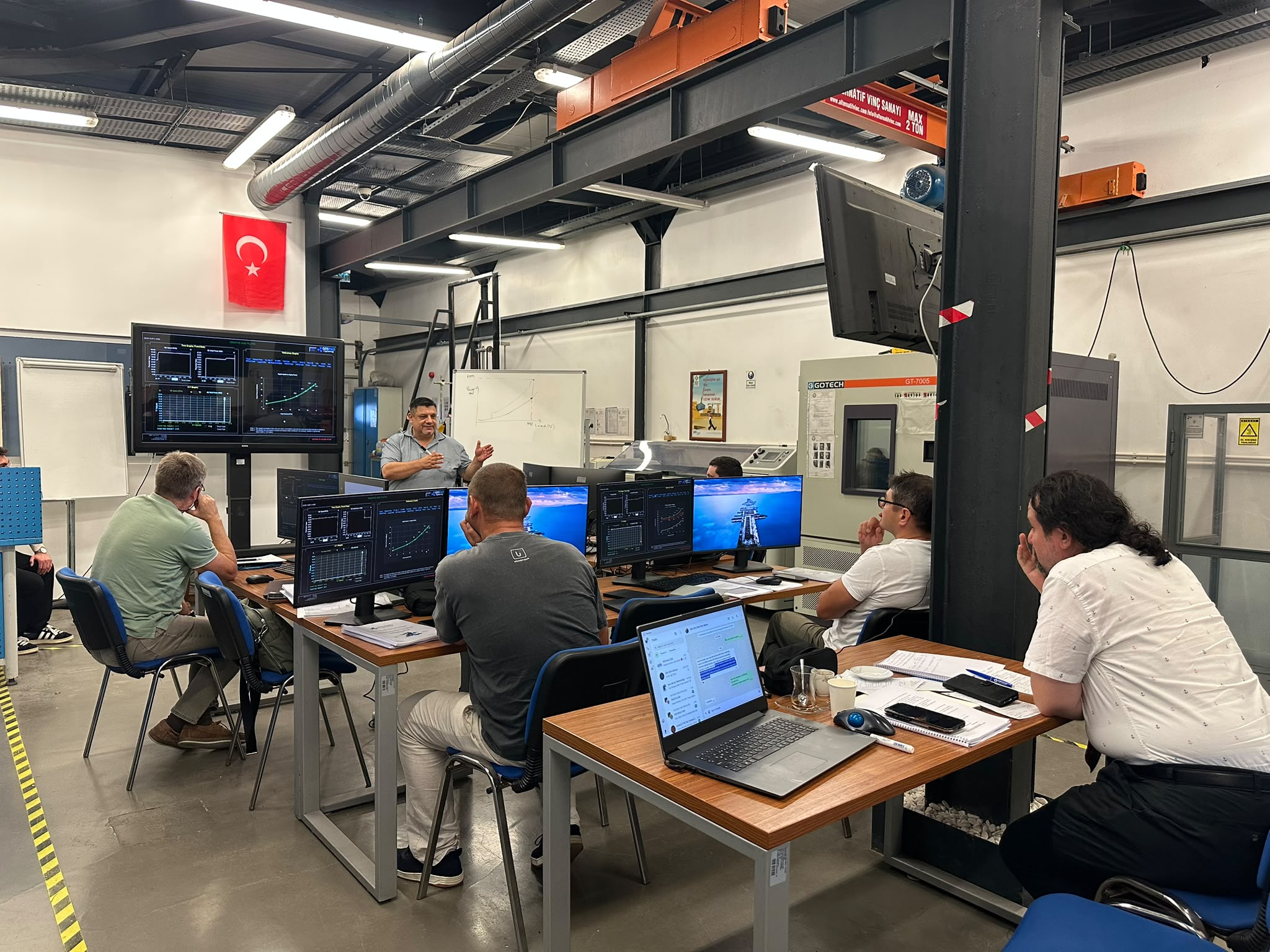
The MOP – Main Operating Panel was also covered to develop a systematic approach to parameter monitoring, system logs and fault information.

For the HPSCR-equipped reference engine, the program additionally addressed High Pressure Selective Catalytic Reduction, including Tier II/Tier III transition logic and the interaction between engine control and emissions-control systems.

Performance evaluation was supported by PMI and CoCoS-EDS, including cylinder-pressure information, Pmax/Pcomp evaluation and performance interpretation.

The overall troubleshooting approach followed a structured sequence:

Alarm → System Information → Fault Diagnosis → Root Cause → Operational Intervention

SERS™ Simulator Applications: From Knowledge to Action

An important part of the program was carried out using the GDS Ship Engine Room Simulator – SERS™.

SERS™ enables participants to experience engine-room operations and abnormal conditions in a controlled environment where faults can be investigated without risk to real machinery or personnel.
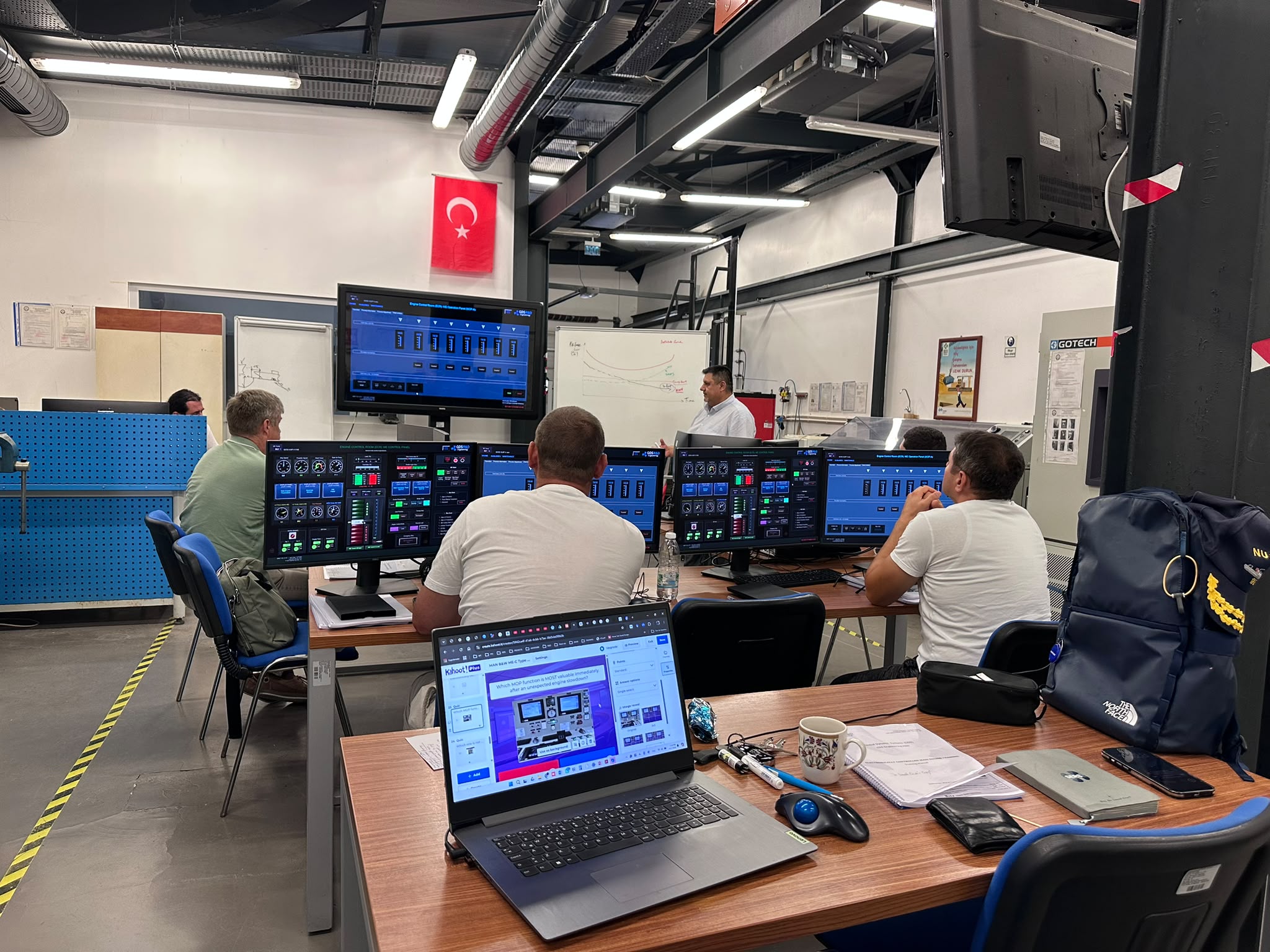
SERS™ simulator applications enable participants to practise fault diagnosis and operational intervention in a controlled environment.

During simulator applications, participants worked with system parameters, alarms, operating conditions and fault scenarios. The objective was to transform the theoretical knowledge gained during the earlier sessions into practical engineering decisions.

SERS™ provides ME-engine-related functions including PMI, MOP A and MOP B panels, together with performance monitoring and plotting tools. This allows trainees to observe how different parameters respond as operating conditions change or faults develop.
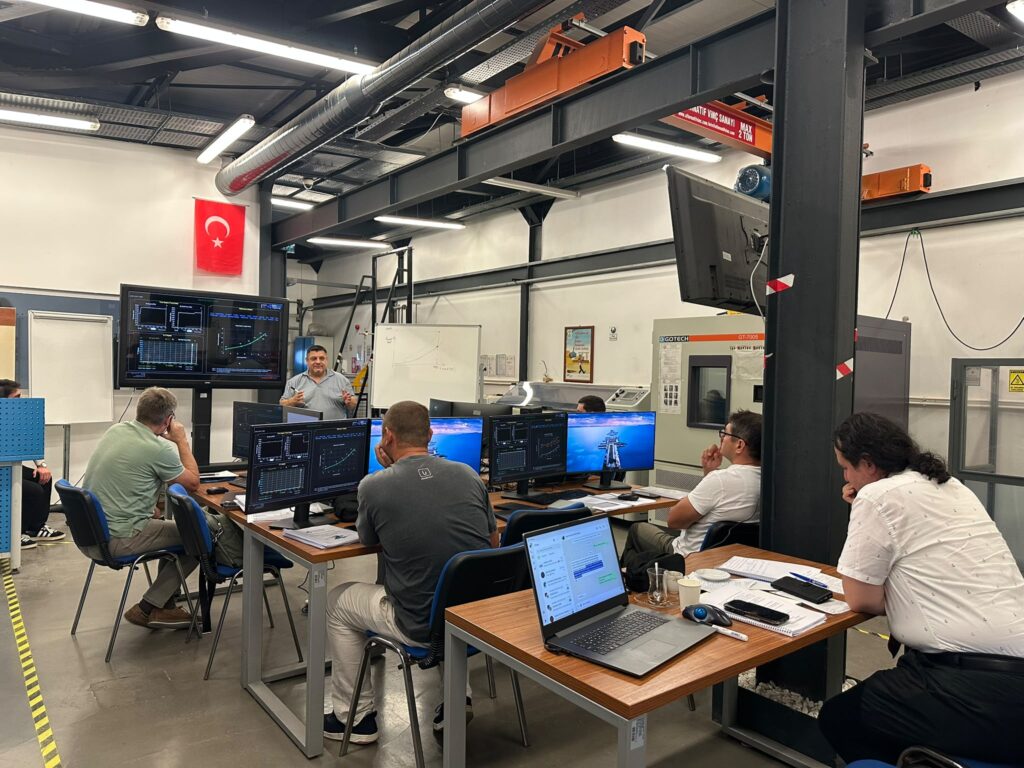
Instead of presenting troubleshooting as a predefined answer, the simulator encourages the engineer to follow the actual diagnostic process:

Observe → Interpret → Diagnose → Intervene → Verify

This combination of SERS™ simulation and hands-on MPC applications is central to the GDS training approach: participants first understand the system, then interact with its controls, and finally apply that knowledge under realistic operational and fault conditions.

Assessment and Completion

The program concluded with simulator applications, an end-of-training examination, technical discussions and evaluation.

The aim was not only to transfer technical knowledge, but also to reinforce the participants’ ability to interpret system information, diagnose problems and make appropriate operational decisions.
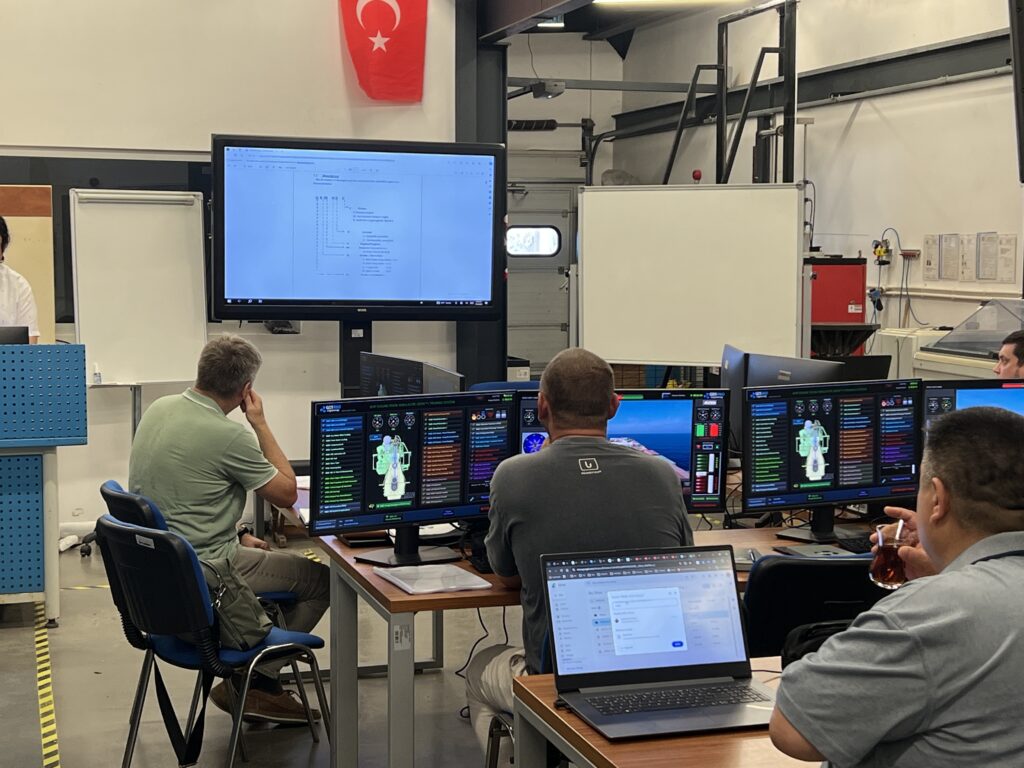
We thank the DS Crewing GmbH team for their active participation, professional cooperation and valuable technical discussions throughout the program.

GDS Engineering R&D Maritime Training Programs

The ME-C program is part of the expanding maritime technical training portfolio developed by GDS Engineering R&D, combining marine engineering expertise with SERS™ simulator applications, hands-on exercises and competency-oriented assessment.

Current GDS maritime training programs include:

  • Electronically-Controlled Main Propulsion Engine (ME-C) Training
  • Main & Auxiliary Engine Performance Assessment & Fault-Finding Techniques
  • Oil Record Book (Part I) – Operational Records & Compliance Awareness
  • Ballast Water Treatment System Operation & Fault-Finding Awareness
  • Bunkering Operations – Safety, Documentation & Environmental Awareness
  • Operational-Level Refreshment Training & Assessment
  • Engine Room Resource Management (ERM) Training using SERS™
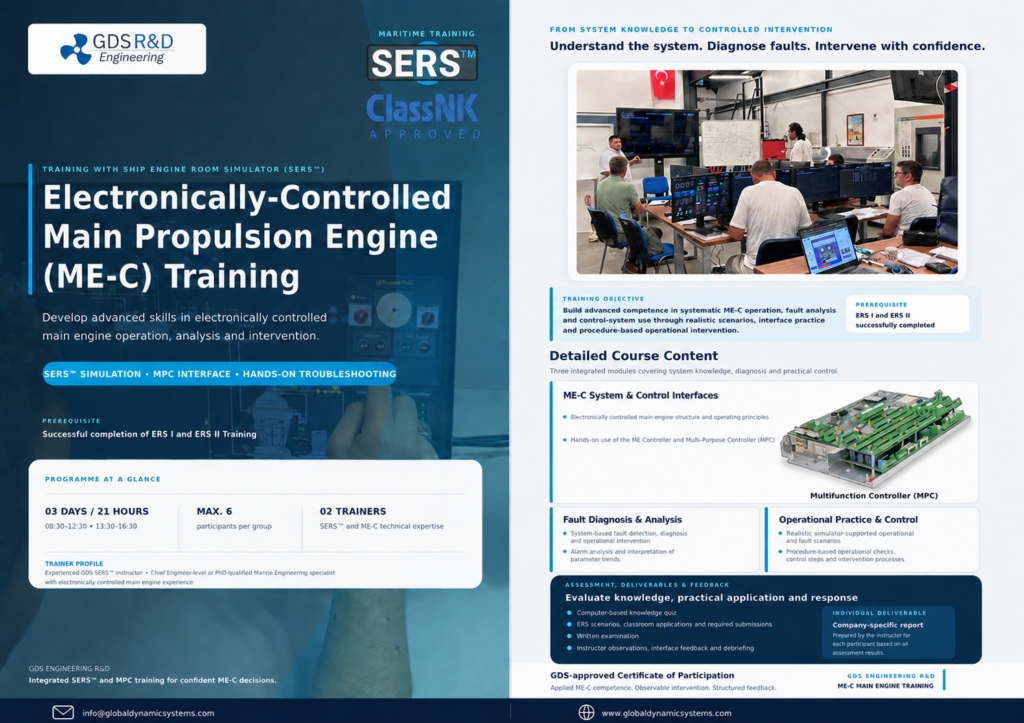
Training programs can also be adapted according to company requirements, vessel machinery and requested technical subjects, allowing organizations to focus the training on their own operational needs.

Contact Us for Maritime Training

For company-specific training, scheduled courses or further information about GDS Engineering R&D maritime training programs, please contact our team.

US Offices:GDS Global Office (EU/TR):
Dayton, OH. | Mountainview, CA
Ph. +1 (937) 912-1220
ITU ARI Teknokent | GTU Teknopark
Ph. +90 546 934 95 99
Email:  info@GlobalDynamicSystems.com
www.GlobalDynamicSystems.com

Bring system knowledge into practice with hands-on training and SERS™ simulation.
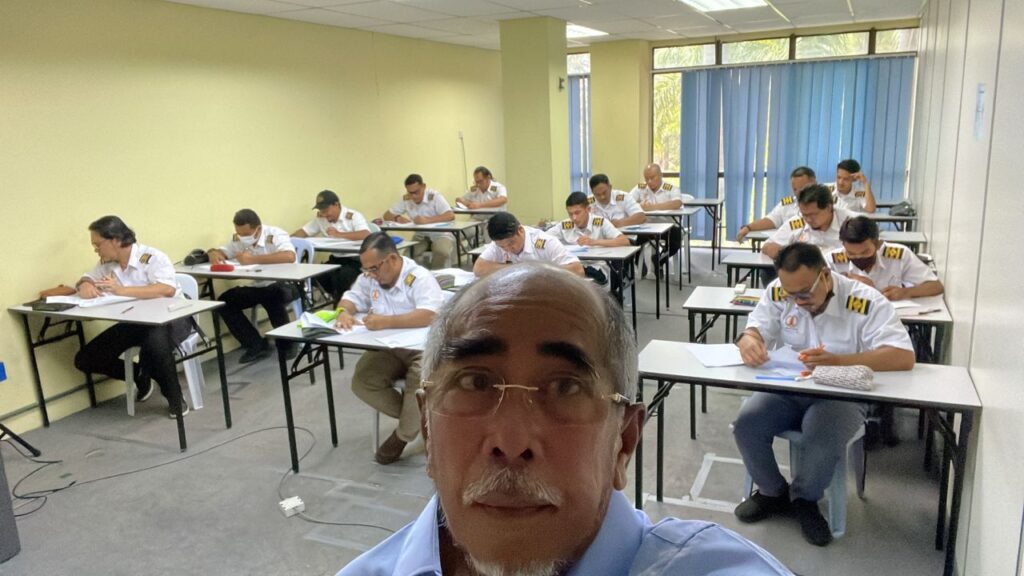
GDS SERS is now in use by a Malasian Maritime Institution

SERS, which is currently being used in both distance and face-to-face training in a training center established in Malta, ITU Northern Cyprus Department of Marine Engineering, and Yıldız Technical University Faculty of Naval Architecture and Maritime Studies in Ship Engine Room Simulator courses, has also started to be used in an educational institution in Malaysia. SERSTM, which will begin being used in the Engine Room Team Management training of personnel currently working on ships in Malaysia this summer, will be used in training 3rd and 4th-year maritime candidates at the beginning of the fall 2022 semester. For SERS, which is planned to be installed in stages, a system was established on June 22, 2022, where six students can receive training, and the installation will continue by increasing the number of students.

Akademi Maritim Penjana ilmu

SERS™, which was successfully installed via remote access to an educational institution in Malaysia, has also become the new favorite of maritime trainers in Malaysia. According to Çağrı Berk Güler, who coordinated the stages during the installation and is part of the group that developed SERS™, one of the biggest reasons for the preference of educational institutions and companies abroad is that remote installation can be carried out and the program is elementary to ensure compatibility with Windows-based systems.

The simulator, made ready for use with full remote access at the educational institution in Malaysia, was installed on the educational computers and then used in training. The institution said they decided to use SERS™ remotely and liked it very much. After the pilot class application, they planned to use the software for all laboratory classes.

Chief Engineer Nazir Hamzah converted the classroom into an Engine Room Team Management Training Lab using SERS™. More components and licenses will be added incrementally. This is a great approach for starting education and training.

About SERS

SERS™ covers all training given using an engine room simulator, as specified in IMO STCW 2010 qualification tables. Also covering IMO Model Course 2.07 (2017) Applications, SERS™ has started to make a name for itself, especially abroad, and has attracted the attention of the maritime sector in the Turkish market, as it offers many academic and practical applications that are not available in simulators currently used in training institutions. The essential features of SERS™, which is developed in a modular structure that can be installed in many different configurations and supplied with various budgets, its advantages and differences from competitor products and application configuration types are explained in detail on the GDS company website.

Ship Engine Room Simulator (ERS) SERS GDS Engineering R&D IMO STCW 2010, Engine Performance, Main Diesel Engine, Marine, Maritime, IMO Model Course 2.07. Certified by ClassNK. ITU Maritime Faculty. Yıldız Technical University. Competencies. Operation and Management Level. Education and Training. Assessment of Marine Engineers. Troubleshooting with Fault Tree Scnearious and Analysis Reporting. Objective Assessment. Nippon Kaiji Kyokai.High Voltage Training Functions 6600 VAC. Ship Propulsion Systems. Maritime Education and Training. Main Engine Performance. Sunken Diagrams. Energy Efficiency. Marine Engineering. Effect of Draft Change in the Ship Main Engine Performance Parameters. Management Level Training Exercices, Marine Engineering Education and Training. SERS Trademark

A Study of the Main Propulsion Engine Performance with Ship’s Draft Change

Purpose: Exercise the weather effect to engine performance using the Ship ERS. Generate a report with capturing the images using SERS GUI panels and tools provided. Note that this exercise is generated as part of the IMO Model Course 2.07 (2017 Edition) exercises. This training exercise was developed as part of the IMO STCW 2010 Management Level objectives using the Model Course 2.07 guidelines ans steps. 

Note: This classroom exercise was provided in this page as an example. Click here to visit the Ship Engine Room Simulator product to read more.

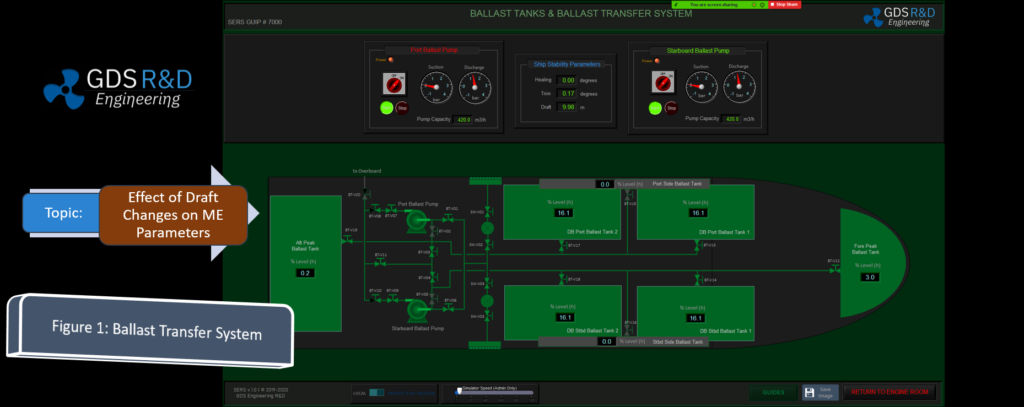
Step 1: ERS is operated in Navigation Mode and Ballast Transfer System is lined up for ballast operations. Draft is Low (i.e. d=9 m.)

Effect of Draft Change in the Ship Main Engine Performance Parameters IMO Model Course 2.07, IMO, STCW 2010, Management Level Training Exercices, Marine Engineering Education and Training, Maritime. GDS Engineering R&D, SERS, Trademark

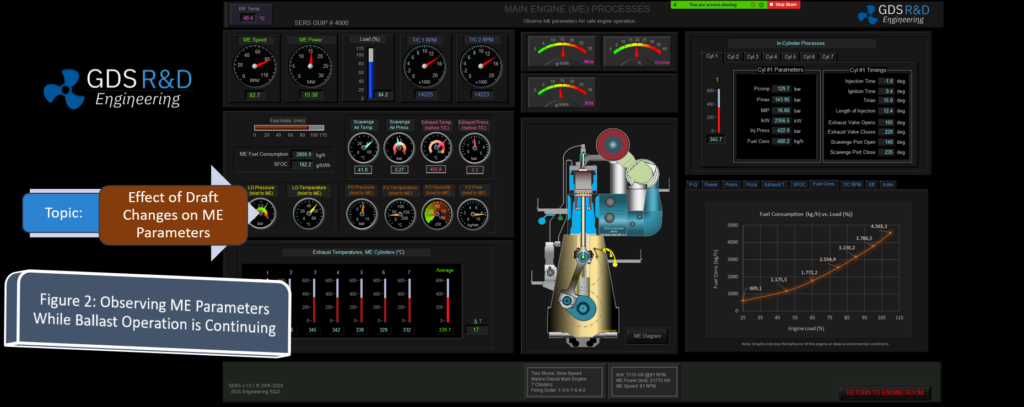
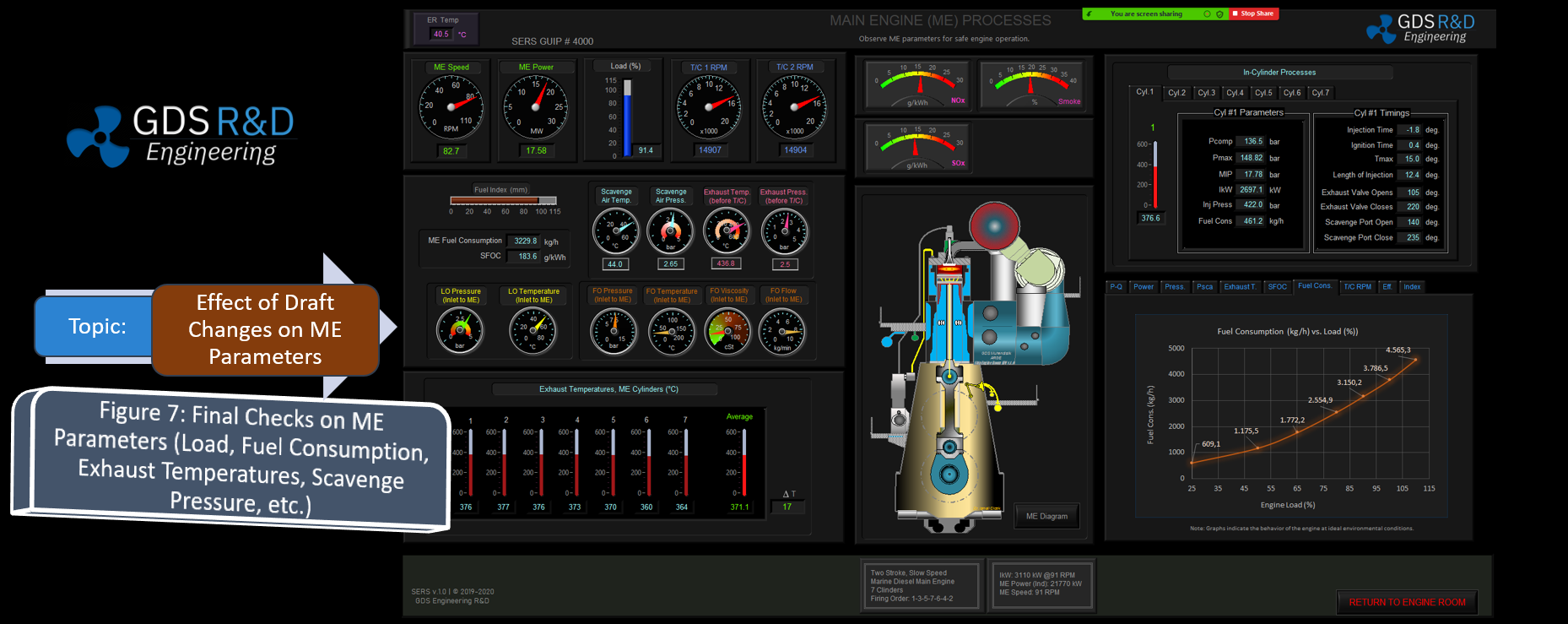
Step 2: ME Processes GUI Panel displays the ME Parameters while the draft is increasing. Check Figure 2 for that the the baseline (sea test) data/graphs are displayed. Being able to understand the ME performance graphs are important in this exercise. 

Effect of Draft Change in the Ship Main Engine Performance Parameters IMO Model Course 2.07, IMO, STCW 2010, Management Level Training Exercices, Marine Engineering Education and Training, Maritime. GDS Engineering R&D, SERS, Trademark

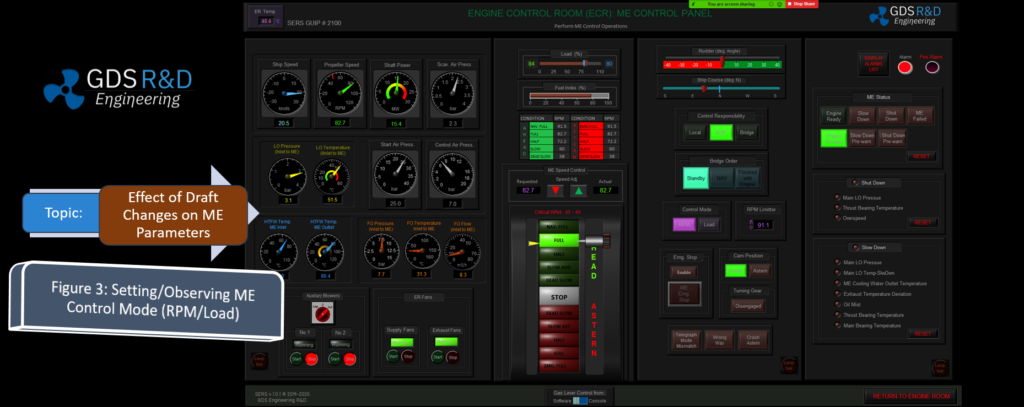
Step 3: Ensure the  control of the main engine is set to “RPM”.

Effect of Draft Change in the Ship Main Engine Performance Parameters IMO Model Course 2.07, IMO, STCW 2010, Management Level Training Exercices, Marine Engineering Education and Training, Maritime. GDS Engineering R&D, SERS, Trademark

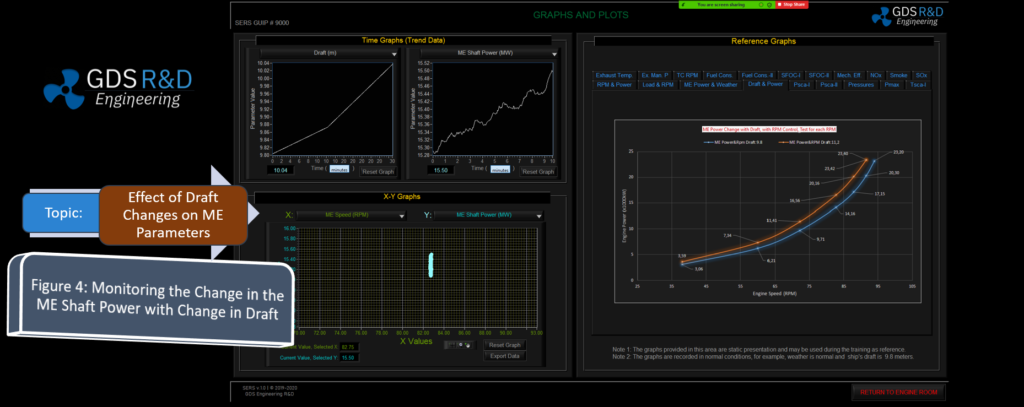
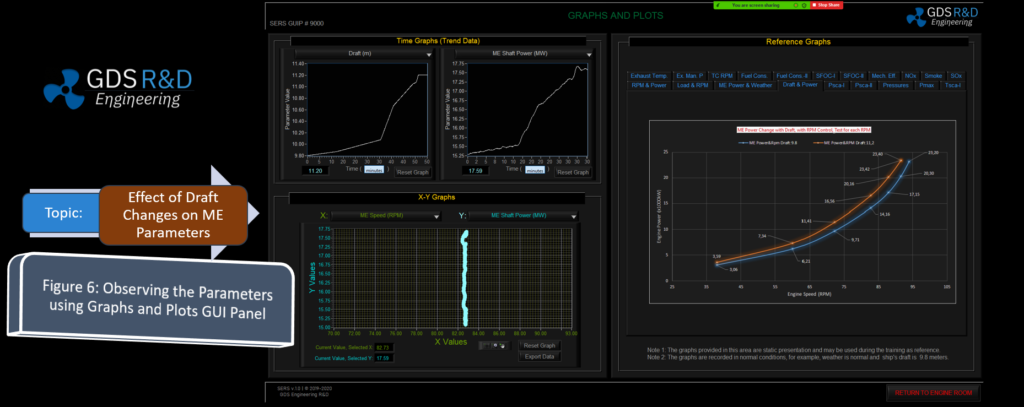
Step 4: Graphs and Plots GUI Panel displays the trend data for the selected parameters. In this exercise, it is important to plot the draft and ME Power. Additionally, it is important to select the ME Power versus ME RPM in the X-Y plot area to see the ME Power change while the RPM is controlled.

Effect of Draft Change in the Ship Main Engine Performance Parameters IMO Model Course 2.07, IMO, STCW 2010, Management Level Training Exercices, Marine Engineering Education and Training, Maritime. GDS Engineering R&D, SERS, Trademark

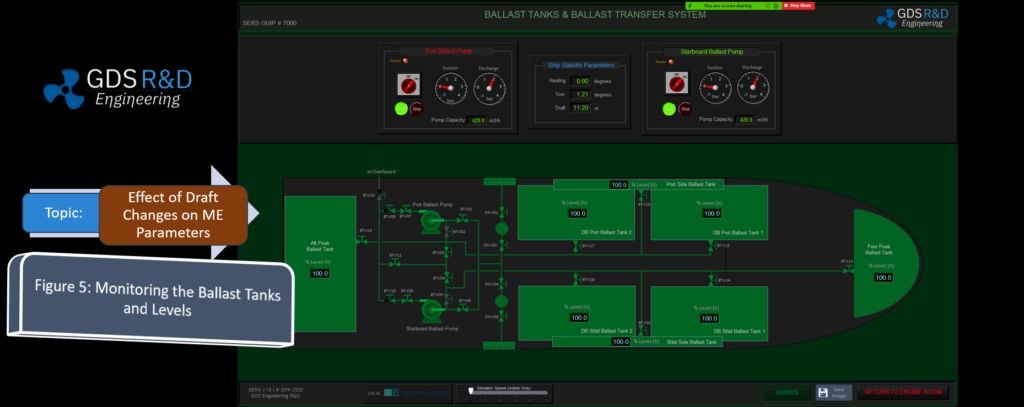
Step 5: Status of the Ballast Tanks and Levels are important to observe.

Effect of Draft Change in the Ship Main Engine Performance Parameters IMO Model Course 2.07, IMO, STCW 2010, Management Level Training Exercices, Marine Engineering Education and Training, Maritime. GDS Engineering R&D, SERS, Trademark

Step 6: Students should be able to interpret time (trend) and X-Y graphs for this operation, as part of the MANAGEMENT LEVEL exercise objectives.

Effect of Draft Change in the Ship Main Engine Performance Parameters IMO Model Course 2.07, IMO, STCW 2010, Management Level Training Exercices, Marine Engineering Education and Training, Maritime. GDS Engineering R&D, SERS, Trademark

Step 7: Complete the exercise with noting the ME parameter changes.

Effect of Draft Change in the Ship Main Engine Performance Parameters IMO Model Course 2.07, IMO, STCW 2010, Management Level Training Exercices, Marine Engineering Education and Training, Maritime. GDS Engineering R&D, SERS, Trademark

Global Dynamic Systems. GDS Systems Engineering Training Programs. Simulators. Engine Room Simulator (ERS). Ship. Electrical Systems Simulator. Physics Lab. UH60. Amphibious. Ground Vehicles. Military Training Programs. MIL-STD-810H Online Training. Environmental Testing of Military Products. Training helps reduce your design and operational risks. We provide MIL-STD-810H, RTCA-DO-160, Vibration and Shock, FAA Requirements Management courses. by Dr Ismail Cicek and a CVE certified by EASA. Ship Engine Room Simulator (ERS) SERS GDS Engineering R&D IMO STCW 2010, Engine Performance, Main Diesel Engine, Marine, Maritime, IMO Model Course 2.07. Certified by Class NK. ITU Maritime Faculty. Yıldız Technical University. Competencies. Operation and Management Level. Education and Training. Assessment of Marine Engineers. Troubleshooting with Fault Tree Scnearious and Analysis Reporting. Maritime. Marine Engineering. San Antonio, Texas, Dayton, OH. WPAFB.

GDS Engine Room Simulator: Our Customers and Collaborations

References of GDS Simulator Users
&
Solution Partners
in
Maritime Training and Research

GDS ERS meets both IMO STCW 2010 Competency/Training Requirements and IMO Model Course 2.07 Exercise Requirements

Click here to read all details…

Highlights of the GDS Engine Room Simulator:
  • Certified for use in training and education of marine engineering cadets.
  • Certified by ClassNK, a Japanese Classification Society. Class NK is an official member of IACS.
  • Certification includes IMO STCW 2010 (with Manila Amendments)
  • Certification type is Full Mission (Class A) type approval.
  • Certification includes IMO Model Course 2.07 (2017 Edition).
  • Applicable for Remote (Online) Training
  • Provides two types of mostly used engine modes.
  • Simulates all engine room machinery and systems with more than 50 GUI Panels.
  • Satisfies the High Voltage Training requirements.
  • Includes Environmental Pollution modules, such as Ballast Water Treamen, Oily Water Separator, ME Denoxification System, and others.
  • Includes Energy Efficiency modules. Students can compare theoretical studies against the simulator instances using Sunken Diagrams.
  • Includes engine performance monitoring tools. Students are able to compare the current values againt the baselined ship’s navigation test as well as main engine’s factory test data. The baselined test data are presented within the software to the students with graphs. This our unique approach is to actually duplicate the real world work environment of wachkeeping engineers checking the parameters against the user manuals and engine books with test data.
  • Provides a realistic environment for emergency operations with all required systems.

Communıcate wıth us
@admin
info@GlobalDynamicSystems.com