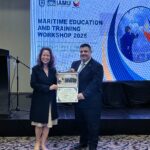
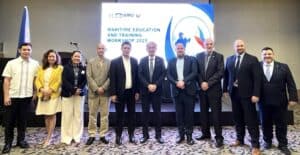
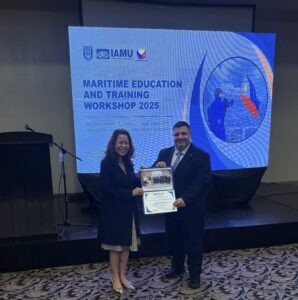
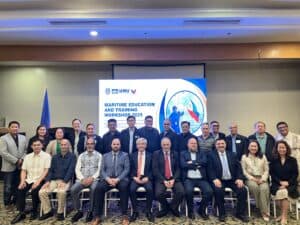
GDS Engineering is pleased to announce its participation in the 2025 Maritime Education and Training (MET) Workshop, jointly organized by the International Association of Maritime Universities (IAMU) and the Maritime Industry Authority (MARINA). The event brought together representatives from 79 Maritime Higher Education Institutions (MHEIs) across the Philippines, including university leaders, deans, program heads, and academic directors, along with international experts from Croatia, India, Japan, Sweden, and Türkiye.
Recognized as one of the region’s most influential platforms for enhancing competence based maritime education, the workshop facilitated meaningful discussions on strengthening training standards, developing academic capacity, and integrating innovative instructional methodologies into MET programs.
Presentation by Dr. Ismail Cicek
During the workshop, Dr. Ismail Cicek, Associate Professor at Istanbul Technical University and General Manager of GDS Engineering, delivered a well-received presentation titled:
“Future-Proofing Marine Engineer Competence: Integrating Objective and Collaborative Assessment through Engine Room Simulation.”
His session highlighted how next-generation training technologies, particularly the SERS™ Engine Room Simulator developed by GDS Engineering, can support MET institutions in:
enhancing individual competence through objective, automated performance assessment;
strengthening team-based skills such as communication, situational awareness, and resource management;
aligning training practices with STCW 2010 and IMO Model Course 2.07 requirements;
providing realistic full-mission environments for collaborative decision-making and emergency response;
expanding technical proficiency via advanced engineering, malfunction, and risk-management exercises.
Global Trends in Simulation Based Maritime Education
The strong interest shown by participants in simulation-based training demonstrated a global rise in digital, data-driven, and collaborative approaches within maritime education. This aligns with the increasing demand for immersive, technology-enhanced learning environments that prepare marine engineers for modern operational challenges.
At GDS Engineering, we value the role of advanced training technologies in strengthening maritime education. We are pleased to contribute to initiatives that help improve training quality, support competence development, and promote safer and more effective engineering operations in the maritime industry.
For further information about our simulation technologies or international collaborations, please contact us.
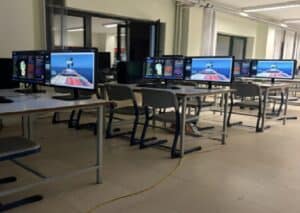
Our SERS™ Ship Engine Room Simulators have now been installed at two distinguished maritime universities in Turkiye: Recep Tayyip Erdogan University (Turgut Kıran Maritime Faculty) and Karadeniz Technical University (Sürmene Faculty of Marine Sciences), empowering the next generation of marine engineers with real-life operational experience.
Each installation includes:
▪️ 8+1 Laboratory Configuration for individual operation and objective performance assessment
▪️ Full Mission Simulator for advanced team coordination and emergency response training
The laboratory configuration allows students to start up and operate systems individually while being objectively assessed through the SERS™ platform, covering multiple competencies defined under IMO STCW 2010.
The full mission simulator recreates an entire engine room and control room environment, supporting realistic team coordination, maneuvering, watchkeeping, and failure response scenarios — fully compliant with IMO Model Course 2.07.
We sincerely appreciate both universities for their cooperation and trust throughout these projects.
At GDS Engineering R&D, we continue to advance maritime education with high-fidelity simulation technologies that bring realism and quality to the next level, expanding the reach of SERS™ across Türkiye and beyond.
If you would like to strengthen your institution’s maritime training infrastructure or learn more about our SERS™ solutions, please contact us for further information or a quotation.
Training on MIL-STD-810H Environmental Testing with Tailoring Examples
This training is important for testing and certifying your military equipment and products following MIL-STD-810H, platform test requirements, and other applicable standards and specifications. The training focuses on the test sections described in the standard document:
MIL-STD-810H US Department of Defense Test Method Standard Environmental Engineering Considerations and Laboratory Tests
The instructors share their experience and knowledge gained by working long years designing products and performing tests, i.e., MIL-STD-810H, RTCA-DO-160G, and MIL-STD-461G. The slides are supported by graphics and test videos for the efficiency and clarity of the information, and each session is planned to follow the test methods described in MIL-STD-810H. Dr. Ismail Cicek is the lead instructor of this training, and several experienced test personnel and design engineers help complete the training sessions efficiently. The following link describes Dr. Cicek’s experiences on the topic in more detail:
The purpose is to have a good understanding of equipment testing by the MIL-STD-810H document. The attendees completing this training are expected to know the following:
Understand MIL-STD-810H test methods and procedures
Understand how to apply tailoring given Life Cycle Environmental and Mission Profiles
Be able to write a list of susceptibilities
Understand the test process goals and activities
Develop test plans and schedule tests
Execute tests
Understand test results
Create test reports
Be able to resolve test results by applying change recommendations or accepting anomalies with risk assessment.
Training Scope
The training sessions cover the following topics with annotated slides, test photos, videos, and additional reference material from standards, specifications, and guides:
Systems Engineering Process Overview and Test & Evaluation (T&E): Important Concepts, such as Product Development and V&V Processes, Test Requirements, Requirements Management, Concepts of Operations (CONOPS) Environmental Profile (LCEP), and Mission Profile/Requirements.
Tailoring Process
MIL-STD-810H Part I, II, and III
Understanding the Purpose of the Test Methods
Test Methods and Procedure Selection based on Equipment Type
Developing a List of Susceptibilities
Test Equipment, Chambers, and other Devices
Test Procedures and Other Technical Details of Running Tests with Tailoring
Scheduling and implementation of the Tests
Review of Test Reports
Design Issues, Discussion of Test Failures, Test Interruptions, and Recommendations
Risk Management Process for Resolving Anomalies
Additional or Alternative Standards (Military and Industrial) and Test Recommendations
Dr. Ismail Cicek mainly provides training, assisted by several GDS personnel experienced in environmental testing and management.
Dr Ismail Cicek provides training with over 20 years of experience in the environmental qualification testing of products such as MIL-STD-810H and RTCA-DO-160G. Dr Cicek led various engineering programs and projects and managed the US Air Force test projects for many years. Dr Cicek worked as the lab chief engineer for five years at the US Air Force Aeromedical Test Lab at WPAFB, OH. Training is also assisted by our personnel, who are experienced in designing and environmental testing military and aerospace equipment.
Read DAU Paper: “A New Process for the Acceleration Test and Evaluation of Aeromedical Equipment for U.S. Air Force Safe-To-Fly Certification.” Click to display this report.
Since 2009, the GDS Team has provided MIL-STD-810, RTCA-DO-160, and MIL-STD-461 training courses to more than five hundred students and over one hundred organizations worldwide. Read more details about the instructors at https://www.GlobalDynamicSystems.com.
Training Schedule and Execution Type
Online training using ZOOM.
Led by two live instructors experienced in the field by testing and lecturing.
Two and a half days of focused online training schedule is typically as follows
1st Day: 08:00 – 16:30 (Lunch Break between 12:00 and 13:00)2nd Day: 08:00 – 16:30 (Lunch Break between 12:00 and 13:00)3rd Day: 08:00 – 12:00
Time zone: Central European Time (CET)
Attendees will receive a Training Certificate.
Training includes knowledge check quizzes, a competition type, a fun way, or learning with prizes.
Training Contents
Training covers each test section of the MIL-STD-810H, and the following items are discussed in each of the individual training sessions:
Purpose of the Test. Potential Environmental Effects to Equipment Under Test (EUT) Fundamental Subjects (that may be of importance for understanding)
Equipment Types and Test Requirements.
Test Equipment, Cabins, or Devices / Test Environment / Test Pass/Fail Criteria
Test Procedures / Evaluation of the Test Results
Potential Failures and Design Recommendations Additional Discussions and Recommendations
It also includes some tests not included in the MIL-STD-810H, yet it may be a requirement.
MIL_STD-810H Test Methods
500.6 Low Pressure (Altitude) 501.7 High Temperature 502.7 Low Temperature 503.7 Temperature Shock 504.3 Contamination by Fluids 505.7 Solar Radiation (Sunshine) 506.6 Rain (IP for Water) 507.6 Humidity 508.8 Fungus 509.7 Salt Fog 510.7 Sand and Dust (IP for Sand/Dust) 511.7 Explosive Atmosphere 512.6 Immersion (IP for Water) 513.8 Acceleration 514.8 Vibration 515.8 Acoustic Noise
516.8 Shock 517.3 Pyroshock 518.2 Acidic Atmosphere 519.8 Gunfire Shock 520.5 Combined Environments 521.4 Icing/Freezing Rain 522.2 Ballistic Shock 523.4 Vibro-Acoustic/Temperature 524.1 Freeze / Thaw 525.2 Time Waveform Replication 526.2 Rail Impact 527.2 Multi-Exciter 528.1 Mechanical Vibrations of Shipboard Equipment (Type I – Environmental and Type II – Internally Excited
Platform and equipment test examples are provided in each test method presentation and discussion, including:
Military aircraft platforms (fixed and rotary wing), ground vehicles, and navy ships
Avionics, electrical and mechanical systems, and structural project applications
Test tailoring examples to include the selection of tests, parameter levels, and durations
Concepts of Operations (CONOPS) document and test curve establishment.
Tailoring and Life Cycle Environmental Profile (LCEP)
Platform Management Certification Training – Week 2: Integrated Product Support (IPS), Integrated Logistics Support (ILS), and Reliability Engineering Training [Online]
July 12
@
8:30 am
–
July 16
@
4:30 pm
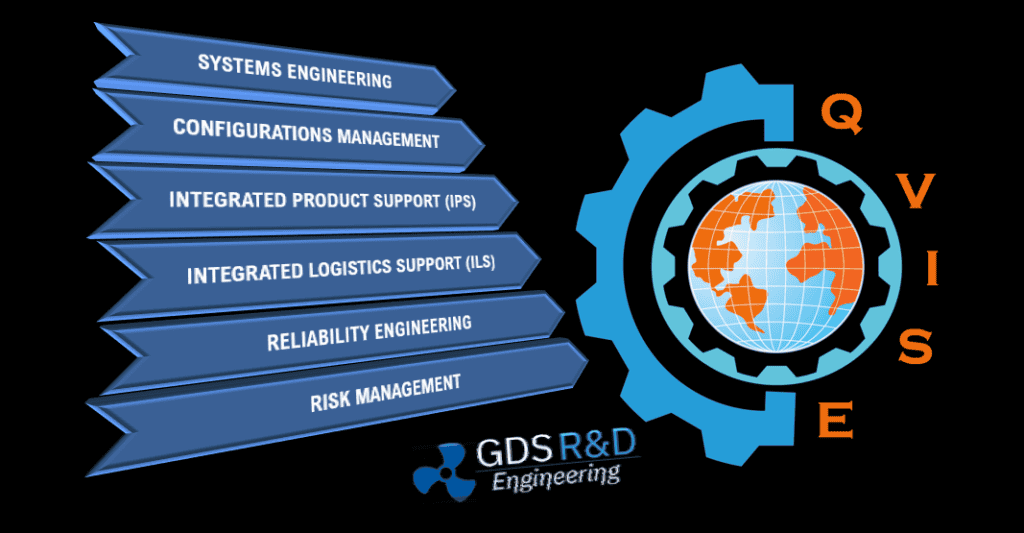
Integrated Product Support (IPS), Integrated Logistics Support (ILS), Systems, Engineering, and Reliability Engineering courses are certification training courses conducted by Quality Vertex Integrated Systems Engineering (QVISE), Global Dynamic Systems, Inc., and GDS Engineering R&D, Inc. through international collaboration. You can register for two weeks for all modules OR register only for the module(s) you have an interest in. All course instructors are international experts, led by Dr Ismail Cicek.
Training Course
Duration
Schedule
IPS and ILS
2.5 days
Day 1: 8:30 – 12:00 | 13:00 – 16:30 Day 2: 8:30 – 12:00 | 13:00 – 16:30 Day 3: 8:30 – 12:00
Reliability Engineering
2.5 days
Day 1: 13:00 – 16:30 Day 2: 8:30 – 12:00 | 13:00 – 16:30 Day 3: 8:30 – 12:00 | 13:00 – 16:30
IPS/ILS Training Modules
Module 1: Introduction to Integrated Product Support (IPS) and Integrated Logistics Support (ILS) Module 2: Product Support Analysis (PSA) Insight Module 3: Life Cycle Costing (LCC), Availability, and Maintainability Analysis Module 4: Logistics Product Data (LPD) Module 5: Synergizing Maintenance Strategies Module 6: Level Of Repair Analysis (LORA), Producibility, and Supportability Assessment Module 7: Supply Support, Provision & Obsolescence Management Module 8: Packaging, Handling, Storage, & Transport (PHS&T Module 9: ILS / IPS Contact Management
$2800 / 1 person registration for 5 days (two courses)
The registration cost for one training session (2.5 days) is 1450 USD. Early bird registrations (earlier than one month before the training) will receive a 10% discount.
QVISE (Quality Vertex Integrated System Engineering)
Platform Management Certification Training – Week 1: Systems Engineering and Configurations Management [Online]
May 5
@
8:30 am
–
May 9
@
4:30 pm
Schedule: Central European Time (CET, UTC+1)
Systems Engineering and Configuration Management training sessions of the Platform Certification Training conducted by Quality Vertex Integrated Systems Engineering (QVISE), Global Dynamic Systems, Inc., and GDS Engineering R&D through international collaboration. Register for all training courses or those you would like to attend. All course instructors are global experts, led by Dr Ismail Cicek.
5 days of certification training in Systems Engineering and Configurations Management. ONLINE TRAINING with Time Schedule: Central European Time (CET, UTC+1)
Training Course
Duration
Schedule
Systems Engineering
2.5 days
Day 1: 8:30 – 12:00 | 13:00 – 16:30 Day 2: 8:30 – 12:00 | 13:00 – 16:30 Day 3: 8:30 – 12:00
Configurations Management
2.5 days
Day 1: 13:00 – 16:30 Day 2: 8:30 – 12:00 | 13:00 – 16:30 Day 3: 8:30 – 12:00 | 13:00 – 16:30
Training Method:
Course Material: English, including presentations and additional reference material.
Communications Language: English
Material: Registration includes all presentations and additional material (English) shared before the class.
Attandance: The link for online class is distributed to registered trainees upon registration.
Trainees will receive a Training Certificate.
Training includes knowledge check quizzes and a competition-type, fun way of learning.
$2800 / 1 person registration for 5 days (two courses)
The registration cost for one training session (2.5 days) is 1450 USD. Early bird registrations (earlier than one month before the training) will receive a 10% discount.
Why Should You Choose “Us,” QVISE & GDS, for your Training?
We offer comprehensive Systems Engineering training to equip professionals with the skills and knowledge necessary to excel in complex project development and management.
Our expert instructors combine in-depth industry experience with academic rigor to deliver engaging and practical training programs.
You can benefit from our hands-on approach, real-world case studies, and tailored curriculum to meet your needs.
By choosing our training, you gain the competitive edge to optimize system design and processes, improve project efficiency, and drive successful outcomes.
QVISE (Quality Vertex Integrated System Engineering)
MIL-STD-810H, US DOD Test Standard, starts with a meaningful phrase at the beginning paragraph of each of the 29 test methods: “Tailoring is Essential.” Understanding what this means and how to tailor the test methods for specific equipment’s specific platform applications is crucial, considering the platform, mission, and environmental requirements.
Develop Your Test Plan Early!
MIL-STD-810H is a huge guide for testing military equipment for military platforms. This means the described tests must be tailored to fit into your equipment’s intended functions and for the targeted platform use. For this reason, tailoring is essential for developing a test plan for 810 testing. And therefore, developing a test plan for testing of your equipment per MIL-STD-810H may take between 1 month to 6 months, easily. We strongly recommend that you don’t wait until the end of the development phase to complete your test plan. Rather, the test plan must be developed as early as possible, in the initial stage of the project, even before design-level efforts start.
There several reasons of completing a test plan early, some of these are:
The specific tests to perform affect your design. Designers must know the test parameters when selecting solutions, such as test type, procedure, limits, and durations.
A test plan should be completed and used for presenting it to the customer and stakeholders. Early agreements on the tests help identify your design limits early.
For developing a MIL-STD-810 environmental qualification test plan, following specific studies must be done:
Selection of test methods and rationale
Selection of procedures and test type
Equipment to use
Identifying the test limits and durations
Developing a detail test procedures and associated forms
We study the Operational Requirements and Life Cycle Environmental Profile for your equipment and develop test requirements. If a Concepts of Operations (CONOPS) document does not exist, we create one or use the available information to establish an operational requirements document. With this study, the tests selected, methods, procedures, and envelopes to use become specific for testing your equipment. Unlike other test plans, developing a test plan for MIL-STD-810 testing may take 1 to 6 months.
For your military equipment, we develop test requirements, environmental test plans and test reports, with a research and study with the followin order:
We first develop test requirements by identifying
equipment characteristics, functions, modes, and other specifics
platform requirements
applicable equipment specs
equipment’s installation zone in the platform
relevant rules and regulations
relevant test standards
other applicable standards
test tailoring considerations: Environmental and Mission Profiles
And develop TEST REQUIREMENTS
Just so you know, the test requirements may include tests from other standards. For example, Fire Flammability testing may be required for your equipment, which is not included in MIL-STD-810.
Test requirements are list of the requirement statements and rationale.
Then, we develop Test Plan accordingly. When test plan is complete, that is when the test budget could be recommended.
Tailoring Considerations
A Generalized Task Statement for Tailoring: Consider the environmental effects. An example list is provided below. Develop exposure curves considering exposure scenarios. Use/develop a CONOPS document and generate a Life Cycle Environmental Profile (LCEP) for this.
Environmental effects (temperature, humidity, icing, etc.) on the equipment in different operational modes: transportation, operation, and stand-by. Consider these effects with scenarios and develop exposure curves.
Equipment vulnarabilities under the environmental/operational conditions.
Effects caused by the platform operations (vibrations, shock, etc.)
The effect due to the platform environment; various conditions in the section the equipment will be operating. For example, the equipment might be exposed to fluid contamination in the section where it will be installed.
Equipment’s effect to the environment and systems (EMI, vibrations, fluid contamination, fire and flammability, etc.)
Consider risks of operational breakdowns with “what if” scenarios.
How does the Life Cycle Environmental Profile (LCEP) affect the test procedures?
LCEP should be developed for selecting the levels and durations of environmental tests, especially those that include climatic data.
For each test method, each state or mode, such as transportation, operation, and storage, should be considered. Transportation can be either logistics or tactical transportation. For example, suppose military equipment will be transported by commercial aircraft. In that case, the vibration test should use the commercial aircraft’s vibration spectrum. In contrast, if the equipment will be transported by a military vehicle in the field, the transportation should consider the vibration spectrum of that vehicle.
Equipment that is directly exposed to the external environment should consider the meteorological data provided in MIL-STD-810H Part I and Part III as well as MIL-STD-310 and AECTPs.
Equipment that is not directly exposed to external environment should consider internal conditions, considering the maximum levels and duration of exposure.
How does Mission Profile affect the test procedures?
Equipment’s modes and the durations to exposures could only be identified with clearly specifying the mission profile for the equipment.
Your equipment, for example, could be a device that must demonstrate the fire resistance. In that case, it is important to understand the aircraft fire zones and applicable procedures. For this, we not only review the test standard but also FAA/EASA documents to fully understand the described requirements and specs to develop a test case and procedure.
Risk analysis is another consideration.
The results are not always pass or fail. We perform risk analysis to demonstrate and recommend alternate methods to pass if the result is negligible. We recommend design changes based on similar equipment tests or results for items that do not pass the tests. MIL-STD-882 provides the basic methodology for implementing risk analysis for this purpose.
Contents of an Environmental Qualification Test Plan
Systems engineering personnel appointed to develop a test plan must include the considerations explained in the paragraphs above. A test plan should be formatted such that it should generally include the following areas:
Purpose statement.
An introduction providing scope and background.
A description of the test article, its components, and how it operates.
A description of test requirements, including information for any deviation from this document due to the applicability of the requirements.
Test setup, functional performance procedures, support equipment and facilities to be used.
Specific safety concerns that the test article may pose during the tests along with risk mitigation plans in accordance with (IAW) organizational safety policies and procedures.
Any planned on-ground or in-flight form, fit, and function checks.
Performance or physical susceptibility criteria.
List of reports to be generated.
A test schedule.
Referenced documents.
Phases of an Environmental Qualification Test Project
Additionally, if the project includes phases of the test and evaluation process, they should be included in a separate section, which may be called “Test Process and Phases.” For example, a test project may be divided into three section:
Planning Stage: Plan to aim to complete the test plan early!
Baseline/Performance Assessment: The baseline assessment also helps the personnel familiarize themselves with the equipment and prepare a test plan and forms while executing the tests.
Verification of the key performance parameters to measure with tolerances
Perform Quick Evaluations – no need to proceed if specific criteria are not met!
If this step is performed with an expert team (Integrated Product Team) and users or user representatives, many potential issues can be solved before starting the physical tests, which can save time, effort, and money.
Ensure the configuration of the item in its actual platform is defined with limitations.
Quickly evaluate the equipment for the test methods, i.e., acceleration, vibration, contamination by fluids, temperature, solar radiation, etc. In many projects, we have identified issues that would happen during the tests.
Identify the human interface items. Those items must be assessed, i.e., per MIL-STD-1472 Human Factor Assessment.
Review the design and ensure that additional test standards are included due to the equipment’s design specifics, i.e., equipment with textile should be evaluated with other mil specs (type “textile” in Assist quick search tool). Although it is a colossal test standard/guide, MIL-STD-810H does not include many tests that may be required based on the equipment’s specific mission and its design specifics. Another example is that equipment must be tested for fire flammability, which is not included in MIL-STD-810H. These examples can be increased to being too many!
Test Phase: The test plan should include the test method, standards to use, a summary of specific procedures tailored to its mission and Life Cycle Environmental Profile (LCEP), test criteria for each test method, test locations, and approximate test schedule. All lab tests are considered verification tests as per the systems engineering processes.
Validation Tests: Any ground or flight, road, or seakeeping tests implemented with the user’s involvement in the operational environment.
Reporting: Test results must be evaluated for risks and limitations. A risk assessment may be accommodated for any unexpected test results using MIL-STD-882. The test report must include
GDS MIL-STD-810H Training (Online or Onsite)
Our team has experienced test managers, Certified Verification Engineers (CVEs), and subject matter experts. If not, we will propose the appropriate team, but we will fully manage the project. In our team, Dr. Ismail Cicek worked in several test locations in the USA and Turkey and is still managing a test facility called the Marine Equipment Test Center (METC) in Tuzla, Istanbul. He has completed over fifty test projects in the USA test labs where he worked and is now more in numbers at METC and the METC personnel.
Why should you take MIL-STD-810H training from Dr Ismail Cicek and his team?
GDS Engineering R&D provides MIL-STD-810H training online or onsite. Performing operations in various parts of the world, we have provided this course to defense industry strategists, leaders, program managers, project managers, designers, and test engineers for over 15 years. With a lengthy background in test projects for DoD platforms, Dr. Cicek, the principal lecturer for this training, explains the tailoring process and concepts with specific application examples.
This course provides information and knowledge of experience on how to develop Concepts of Operations (CONOPS) document and Lice Cycle Environmental Profile (LCEP) to derive operational, therefore, test requirements for the Equipment Under Test (EUT). Understanding the tailoring part of MIL-STD-810H is the most important aspect of this test standard training for the following reasons:
Although labeled as a “standard,” MIL-STD-810H is a “guide.” Therefore, MIL-STD-810 is a standard that is close to a GUIDE, whereas most other standards are close to a SPECIFICATION.
Developing a test plan for MIL-STD-810H equipment testing might be confusing and time-consuming. Understanding the tailoring process helps you narrow down your test requirements rather than just following a standard.
Training will explain why and when the CONOPS document is needed and how test requirements are established. It will also give a good knowledge of the EUT’s Mission and Environmental profiles. These are all covered by presentations and specific product examples discussed during the training sessions.
In test method discussions, the instructor discusses “what items” (i.e., test levels) and “how” they will be tailored with specific examples.
Test methods, such as temperature, humidity, and temperature shock, require the establishment of mission and environmental profiles to successfully determine the test levels, durations, and pass or fail criteria.
GDS Engineering R&D, Inc. is a leading provider of MIL-STD-810H training, offering comprehensive courses designed to equip professionals with the knowledge and skills necessary to navigate the complexities of this crucial military standard. MIL-STD-810H focuses on environmental qualification testing for military platforms and defense equipment, ensuring reliability, durability, and successful product development. Our courses cover a wide range of topics, from fundamental concepts to advanced techniques, including shock, vibration, temperature, humidity, altitude, salt fog, dust, rain, fungus, acceleration, transportation, and operational testing.
A key aspect of our MIL-STD-810H training is the emphasis on Tailoring Methodology for MIL-STD-810. Participants learn how to effectively apply tailoring techniques to develop accurate Life Cycle Environmental Profiles (LCEP) and Mission Profiles for specific equipment and operational scenarios. This ensures that testing is relevant, efficient, and cost-effective. We offer various training on MIL-STD-810H, including MIL-STD-810H training course for engineers, MIL-STD-810H certification online, and hands-on MIL-STD-810H testing workshops. These programs cover the latest revisions to MIL-STD-810H and provide practical guidance on environmental test management, including environmental test sequence development and execution.
GDS Engineering R&D, Inc. provides flexible training options to accommodate diverse needs. Our online training programs offer convenience and accessibility, while our international training programs cater to a global audience. We also provide specialized training, such as the Systems Engineering Training Program, which integrates environmental considerations into the systems engineering process. Our courses are instructor-led, with opportunities for hands-on learning in our accredited lab. We are committed to providing high-quality training that empowers professionals to effectively address environmental effects and environmental considerations throughout the lifecycle of defense equipment.
In response to the challenges posed by COVID-19, GDS Engineering R&D, Inc. has implemented measures to ensure the safety and well-being of our participants. We offer virtual training options and have adapted in-person training to adhere to social distancing guidelines. Our commitment to providing valuable and accessible MIL-STD-810H training remains unwavering, even amidst these challenging times.
Training on MIL-STD-810H Testing: Our online training details are provided. A good training helps your personnel develop better test plans and save time, effort, and money at the project completion.
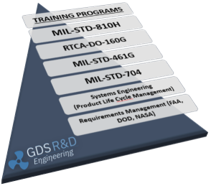
Systems Engineering training courses provided by GDS Engineering R&D, including MIL-STD-810H, RTCA-DO-160G, MIL-STD-461G, Requirements Management, MIL-STD-704F, and EMI/EMC General Training. Information is provided on this page.