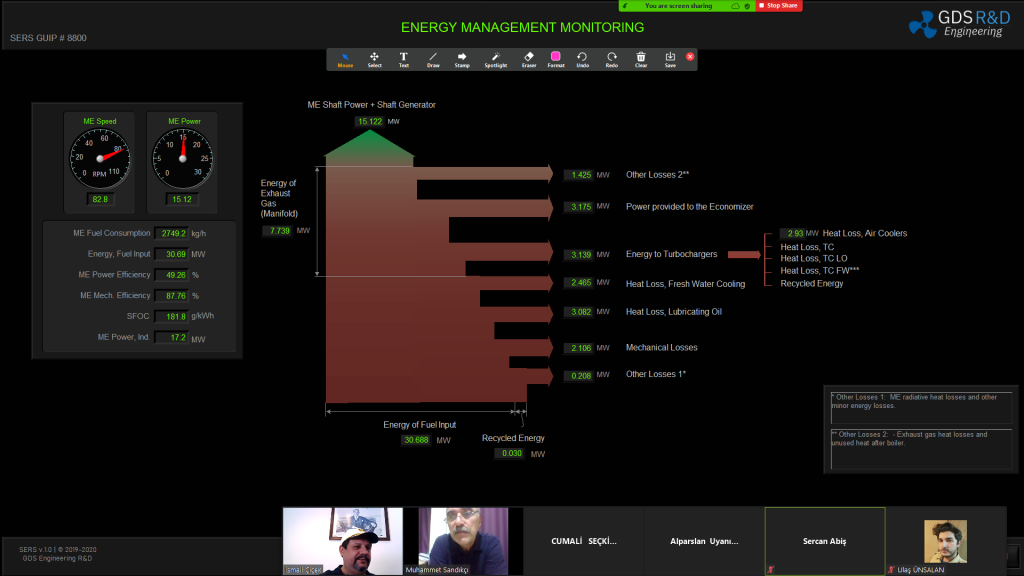
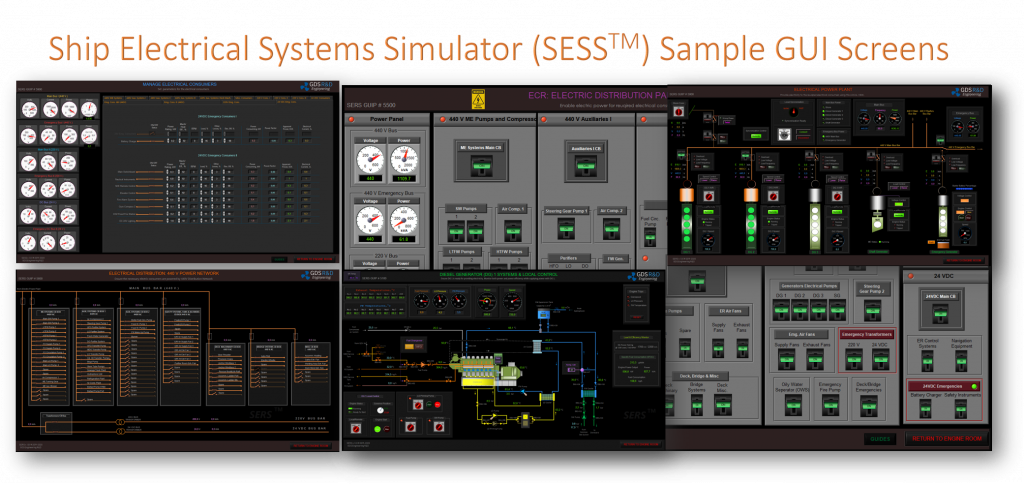
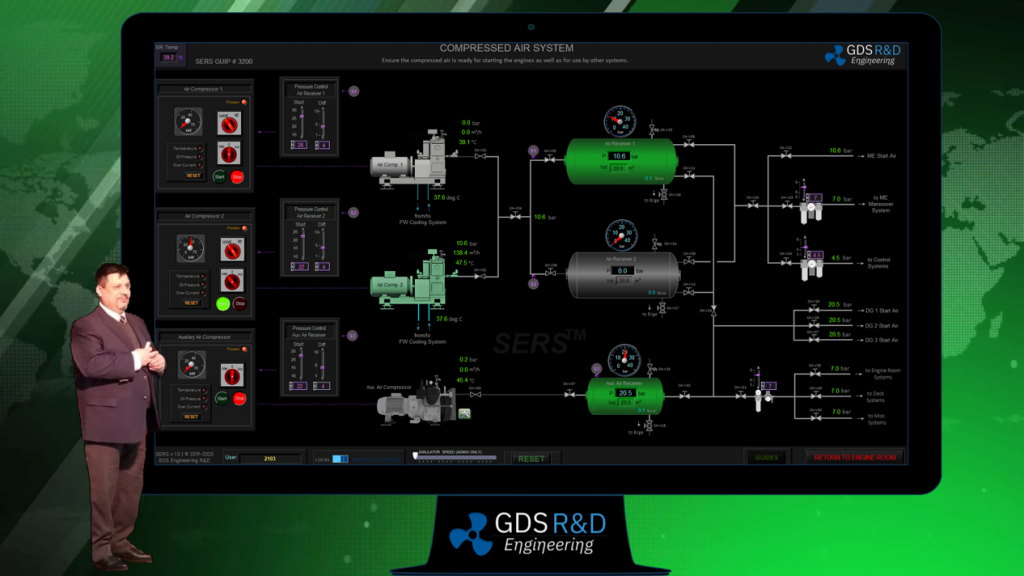
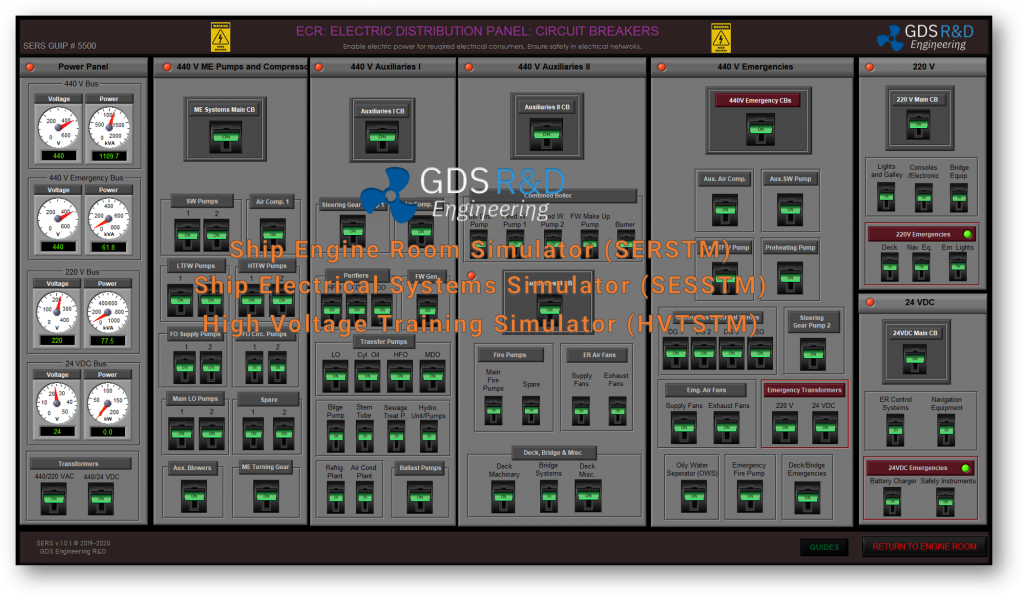
Technical Proficiency: The GDS simulator helps personnel develop advanced skills in troubleshooting and maintaining complex machinery, which is crucial for achieving SIRE 2.0’s standards for operational excellence. Environmental Compliance: With a growing emphasis on environmental regulations, the simulator enables crew members to familiarize themselves with compliance standards and practice procedures that reduce environmental impact, such as optimizing fuel usage and managing waste effectively. Safety Protocols: Through realistic training scenarios, the simulator reinforces safety protocols, ensuring that personnel can identify and mitigate risks, which is a core component of the SIRE 2.0 inspection program.

GDS SERS™ Makes IMO Engine Room Resource Management (ERM) Certificate Trainings Conducted Efficiently and Effectively

Description of an ERM Training

Engine Room Resource Management (ERM) is a system of achieving safe engineering operations by proactively utilizing and managing personnel, equipment, and information in the machinery space. A review the team roles, human factors, and situational awareness is required to plan and implement a proper ERM program. Remember, good ERM practices can save personnel and vessels from unwanted risks.

The course complies with the standards of Regulation III/1, III/2, III/6 and VIII/2 of STCW Convention, Section A-III/1, III/2, III/6, A-VIII/2 and B-VIII/2 of STCW Code and SIRE requirements.

Topics in a ERM training includes

  • Learn about effective resource allocation including crew, plant, equipment, and information management
  • Understand the leadership responsibilities of the Chief Engineer, including staff training and motivation, preventing crew fatigue, and conducting appropriate drills
  • Review individual and team roles, and how to reduce human error using situational awareness and closed loop communication
  • See engine room equipment functions and standard operating procedures

Relevance of this Training with existing IMO Model Courses

This course includes the topics using the guidance provided by the following IMO Model Courses.

  • IMO Model Course 7.02 Chief Engineer Officer and Second Engineer Officer
  • IMO Model Course 7.04 Officer in Charge of an Engineering Watch
  • IMO Model Course 2.07 Engine Rooms Simulator. 2017 Ed.
  • IMO Model Course 1.39 Leadership and Teamwork
  • IMO Model Course 1.38 Marine Environmental Awareness

Referenced Documents

The following documents must be used along with this document for effectively planning and providing an ERM training.

GDS SERS User Manuals and Documents

  • User Manual Vol I (SERS Software Description) describe the SERS software with the SERS Graphical User Interface (GUI) Panels accessed from the SERS Main Graphical User Interface (GUI) Panel.
  • User Manual Volume II (Engine Room Operations) includes the operational instructions on how to operate the engine room systems and machinery using the SERS.
  • User Manual Vol III (Installation & Configuration) describes the installation and the configuration of software and hardware items
  • This manual, User Manual Volume IV (Instructor’s Manual), includes guides and information for the instructors to utilize SERS in their trainings according to their specific training objectives.
  • Refer to “SERS Philosophy Document” for selecting the configuration of the SERS for your training objectives.  Then use Vol. III for the proper installation of the SERS and reading the configuration guidelines.

External Referenced Documens

  • IMO Model Course 7.02 Chief Engineer Officer and Second Engineer Officer
  • IMO Model Course 7.04 Officer in Charge of an Engineering Watch
  • IMO Model Course 2.07 Engine Rooms Simulator. 2017 Ed.
  • IMO Model Course 1.39 Leadership and Teamwork
  • IMO Model Course 1.38 Marine Environmental Awareness

ENGINE ROOM RESOURCE MANAGEMENT TRAINING MODEL

Engine Room Resource Management (ERM) is a system of achieving safe engineering operations by proactively utilizing and managing personnel, equipment, and information in the machinery space. A review the team roles, human factors, and situational awareness is required to plan and implement a proper ERM program. Remember, good ERM practices can save personnel and vessels from unwanted risks.

The course complies with the standards of Regulation III/1, III/2, III/6 and VIII/2 of STCW Convention, Section A-III/1, III/2, III/6, A-VIII/2 and B-VIII/2 of STCW Code and SIRE requirements.

The course is aimed at officers of the engineering watch (operational level), 2nd Engineer and Chief Engineer (management level).

The course is a mix of theory case studies and simulation exercise covering topics below. The following are the four main areas to cover in an ERM training:
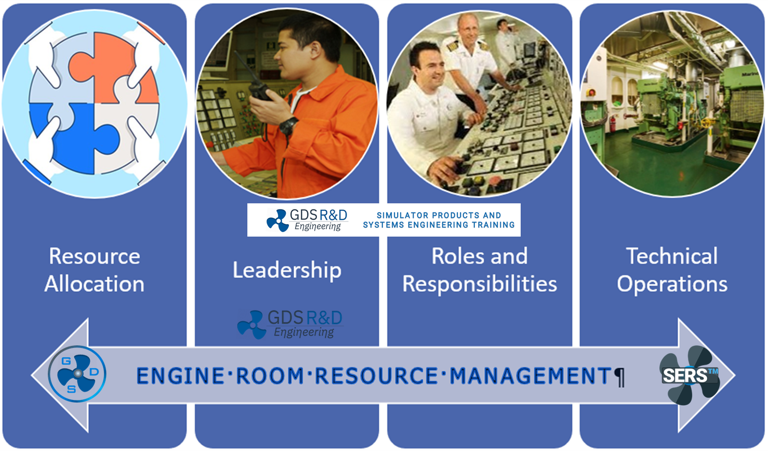
GDS SERS IMO Engine Room Resource Management Course Model 2.07 IMO. Certification Training. Marine Engineering Cadets. Class Regulations.
  • RESOURCE ALLOCATION: Effective resource allocation including crew, plant, equipment, and information management.
  • LEADERSHIP: The leadership responsibilities of the Chief Engineer, including staff training and motivation, preventing crew fatigue, and conducting appropriate drills
  • TEAM ROLES AND RESPONSIBILITIES: The roles and responsibilities for both individuals and team. Planning and execution must be reviewed with past experiences with the aim of reducing human error using situational awareness and closed loop communication.
  • TECHNICAL OPERATIONS MANAGEMENT: A study with a thorough review of equipment functions, standard operating procedures including safety procedures.

Designing your ERM Training with SERS

In this section, we provide a guidance on how to design an IMO ERM training with step by step approach. We hope that it helps you provide an effective training for your cadets or engineers already working onboard.

1. Certification of the Simulator

Certification of the simulator is highly important. You must ensure that it has all capabilities to provide the capabilities training based on STCW 2010. As for the ERM training, the simulator must be capable of demonstrating the IMO Model Course (2.07) exercises.

GDS Ship Engine Room Simulator (SERS™) is a Training Simulator System with a Full Mission (Class A) type approval certificate obtained from ClassNK. ClassNK is an IACS affiliate Classification Organization. Certificate of SERS™ lists the IMO STCW 2010 competencies, as provided in Table 1, which includes the compliance to IMO STCW Tables A-III. The class certification of SERS includes the IMO Model Course 2.07 (207) Ed.). The trainee is able to perform all exercises contained in the IMO Model Course 2.07. All exercises were demonstrated during the Class Type Approval.

Table 1: SERS™ Certification Items for STCW Training Competencies.

IMO STCW-2010 ReferenceCompetence
Table A-III/1.1Maintain a safe engineering watch
Table A-III/1.2Use English in written and oral form
Table A-III/1.3Use internal communication systems
Table A-III/1.4Operate main and auxiliary machinery and associated control systems
Table A-III/1.5Operate fuel, lubrication, ballast and other pumping systems and associated control systems
Table A-III/1.6Operate electrical, electronic and control systems
Table A-III/1.10Ensure compliance with pollution prevention requirements
Table A-III/1.11Maintain seaworthiness of the ship
Table A-III/1.12Prevent, control and fight fires on board
Table A-III/1.16Application of leadership and team working skills
Table A-III/2.1Manage the operation of propulsion plant machinery
Table A-III/2.2Plan and schedule operations
Table A-III/2.3Operation, surveillance, performance assessment and maintaining safety of propulsion plant and auxiliary Machinery
Table A-III/2.4Manage fuel, lubrication and ballast operations
Table A-III/2.5Manage operation of electrical and electronic control equipment
Table A-III/2.6Manage troubleshooting restoration of electrical and electronic control equipment to operating condition
Table A-III/2.8Detect and identify the cause of machinery malfunctions and correct faults
Table A-III/2.10Control trim, stability and stress
Table A-III/2.11Monitor and control compliance with legislative requirements and measures to ensure safety of life at sea and protection of the marine environment
Table A-III/2.14Use leadership and managerial skills
Table A-III/4.2For keeping a boiler watch: Maintain the correct water levels and steam pressures
Table A-III/6.1Monitor the operation of electrical, electronic and control systems
Table A-III/6.2Monitor the operation of automatic control systems of propulsion and auxiliary machinery
Table A-III/6.3Operate generators and distribution systems
Table A-III/6.4Operate and maintain power systems in excess of 1,000 volts
Table A-III/6.5Operate computers and computer networks on ships
Table A-III/6.7Use internal communication systems
Table A-III/6.9Maintenance and repair of automation and control systems of main propulsion and auxiliary machinery
Table A-III/6.12Ensure compliance with pollution-prevention requirements

2. Simulator Detail Specs

This is probably the most tricky part. Some simulators could be cheap (!) and may be simulating the systems at a very high level. Does it have a main engine lubricating oil system? Probably yes. Does it satisfy the IMO competencies. Well this is the tricky part. It must have the LO Temperature Control System appropariately and realistically simulating the systems. We gave a simple example. Most trainers learn the specifics of the simulator after some experience of using it and become aware of the isues that prevent providing an efficient engine room simulator training. This may not be of an issue for a freshman level students; however, it becomes important when trainees are already completed their training onboard a ship and that they completed their marine engine engineering courses (Diesel Engines, Ship Auxiliary Engines, Electrical Systems, Automatic Control Systems, etc.). Additionally, the models and simulated systems has critical importance when the trainees are the personnel already have experience onboard a ship. Usually, the trainees in an ERM course will be watchkeeping officers or even chief engineers and they will probably critisize the training if the simulations are not realistic!

We have written the full specifications list for an engine room simulator, generalized with a focus on how it must help the instructors in the training. We went through each section of both the IMO STCW 2010 and IMO Model Course 2.07 and ensure the full list is at hand with the training in focus. Do not hesitate to request a copy if you are establishing an engine room training facility. We will be glad to help as trainers with ERS training experience of more than 20 years.

We should warn you that you must prepare the requirements for purchasing an Engine Room Simulator not the manufacturer.

3. Simulator Configurations

The training area must be organized with a focus into the training goals and objectives. The number of students to train at once is also an important element.

There are two examples of simulator configırations shown with the following figures. You must define your objectives first and ensure that a satisfactory number of stations and area is provided during the training.
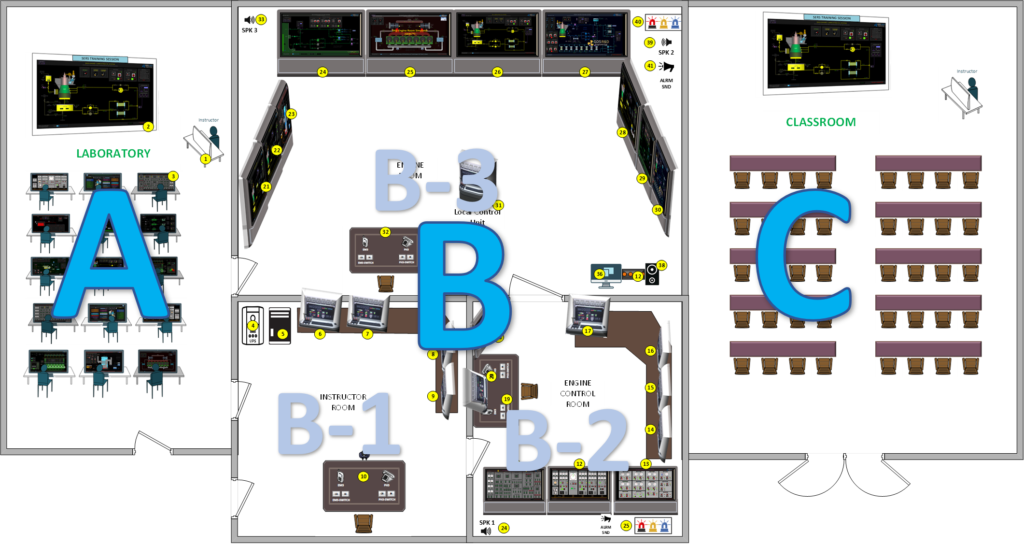
ERS Training Plant GDS Engineering Inc SERS Full Mission Engine Room Simulator Layout and Equipment Arrangement
Underwater Radiated Noise and Sealife. Powerships and noise emittance. maritime studies

Terrestial and Underwater Radiated Noise from Powerships: Testing and Evaluation

The increase in shipping activity globally has resulted in an increased awareness of impacts on the marine environment. Effects of noise pollution, especially on marine life, have become highly prominent. Marine life is extremely sensitive to noise pollution. Due to their extreme reliance on underwater sounds for basic life functions like searching for food and mate and an absence of any mechanism to safeguard them against it, underwater noise pollution disrupts marine life (Singla, 2020). In short, marine animals depend on sound to live, making and listening to it in various ways to perform various life functions (US Bureau of Ocean Energy Management, 2014).

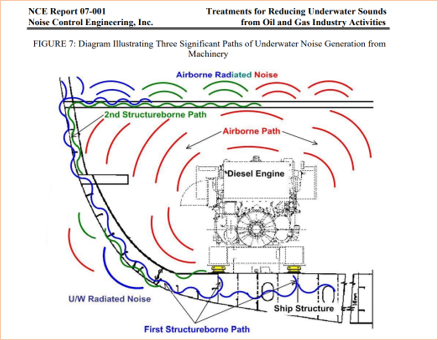
Noise travels much more in water, covering greater distances than it would do on land while travelling through air. Underwater sound has both pressure and particle motion components and hearing can be defined as the relative contribution of each of these sound components to auditory detection (Popper AN, 2011). Sounds radiated from ships are among the underwater noise sources. Among shipborne Underwater Radiated Noise (URN) sources are the following:

  • Propeller’s rotational turn and the blades hitting to water flow lines
  • Propeller’s cavitation
  • Ship hull structure’s interaction water (fluid-structure interaction)
  • Mechanical noises from onboard machinery
Underwater Radiated Noise and Sealife. Powerships and noise emittance. maritime studies
Diagram Illustrating Three Significant Paths of Underwater Noise Generation from Machinery (NCE Report 07-001, 2007).

Click here to read the report generated by NCE (NCE Report 07-001, 2007)

All of these noise sources are radiated to underwater from ships, especially when the ship speed is at higher rates, i.e. above 15 knots.

When a Powership is considered, out of the 4 aforementioned noises, only mechanical noise sources are of concern as there are no noises that emanate from the other three sources because the Powership is docked. Mechanical onboard noises are still of concern and therefore need to be evaluated and tested for the assessment of their potential negative effects to marine life.

GDS Engineering R&D has the capability for measuring the underwater radiated noise and assessment of the results based on the effect to the sealife in the region.

References of GDS Simulator Users
&
Solution Partners
in
Maritime Training and Research

Prevention of Maritime Accidents. Maritime Studies. Man Overboard. Denize Adam Düşmesi. Maritime Accident Investigation Reports. Maritime Research. IMO GISIS. Database. Veritabanı Oluşturulması. EU Project. TUBITAK. ITU Maritime Faculty. İTÜ Denizcilik Fakültesi. Maritime Accident Investigation, Casualty Investigation Code, Man Over Board (MOB), Lessons Learned, Database, Data Format, Report Forms. Root Cause Analysis. Root Cause Flow Charts. Collision Accidents. Analysis and assessment of ship collision accidents using Fault Tree and Multiple Correspondence Analysis. MCA. , Fault tree method, Multiple correspondence analysis, Collision Regulation, CollReg. Human Error. The results represent the cause statistics of the ship-to-ship collision accidents that occurred in the last 43 years. Considering the collision accident reports data, our results show %94,7 of collision accidents are related to human error.

Categories of Maritime (Ship) Accident Types and Research Studies

Categories of Maritime (Ship) Accident Types

Lloyds Maritime Information Services (LMIS) has a casualty database which divides the maritime (ship) accidents into the following categories:

1. Foundered – includes ships which sank as a result of heavy weather, leaks, breaking into two, etc, and not as a consequence of other categories such as collision etc.

2. Missing vessel – includes ships that disappeared without any trace or witnesses knowing exactly what happened in the accident.

3. Fire/explosion – includes ships where fire/explosion is the first event reported, or where fire/explosion results from hull/machinery damage, i.e. this category includes fires due to engine damage, but not fires due to collision etc.

4. Collision – includes ships striking or being struck by another ship, regardless of whether under way, anchored or moored. This category does not include ships striking underwater wrecks.

5. Contact – includes ships striking or being struck by an external object, but not another ship or the sea bottom. This category includes striking drilling rigs/platforms, regardless of whether in fixed position or in tow.

6. Wrecked/stranded – includes ships striking the sea bottom, shore or underwater wrecks.

7. War loss/hostilities – includes ships damaged from all hostile acts.

8. Hull/machinery damage – includes ships where the hull/machinery damage is not due to other categories such as collision etc.

9. Miscellaneous – includes lost or damaged ships which cannot be classified into any of the categories 1 through 8 due to not falling into any of the categories above or due to lack of information (e.g. an accident starting by the cargo shifting would typically be classified as miscellaneous).

Above is also referenced in Wartsila website. Man Over Board (MOB) event, a person falling into water, is not referenced in the above listing.


However;

IMO accidents website, Global Integrated Shipping Information System (GISIS), refers to Man Over Board as another accident type, which may end with a death or injury. We would like to refern the following two of our publications for the details of MOB and Collision accident types:

Title: Maritime Investigation Reports Involving Man-Over-Board (MOB) Casualties: A Methodology for Evaluation Process, Turkish Journal of Maritime and Marine Sciences, Vol: 5 No: 2 (2019) 141-170. Authors: Orhan Gönel and İsmail Çiçek. Click this link for more information...

Title: Analysis and assessment of ship collision accidents using Fault Tree and Multiple Correspondence Analysis, Ocean Engineering, Volume 245, 2022, 110514, ISSN 0029-8018. Authors: Hasan Ugurlu and Ismail Cicek. Click this link for more information...


With these studies, we categorize the maritime investigation reports into the following groups, which is more inline with the  International Maritime Organization (IMO) ‘Casualty Investigation Code’ (CI Code) (2008):

Ship:

  • Grounding/Stranding 
  • Collision/Contact/Allision
  • Fire/Explosion
  • Flooding/Foundering
  • Capsizing/Listing
  • Damage to ship or equipment

Crew:

  • Man-Over-Board (MOB)
  • Injury/Death
Ship Engine Room Simulator (ERS) SERS GDS Engineering R&D IMO STCW 2010, Engine Performance, Main Diesel Engine, Marine, Maritime, IMO Model Course 2.07. Certified by ClassNK. ITU Maritime Faculty. Yıldız Technical University. Competencies. Operation and Management Level. Education and Training. Assessment of Marine Engineers. Troubleshooting with Fault Tree Scnearious and Analysis Reporting. Objective Assessment. Nippon Kaiji Kyokai.High Voltage Training Functions 6600 VAC. Ship Propulsion Systems. Maritime Education and Training. Main Engine Performance. Sunken Diagrams. Energy Efficiency. Marine Engineering. Effect of Draft Change in the Ship Main Engine Performance Parameters. Management Level Training Exercices, Marine Engineering Education and Training. SERS Trademark

Operating Marine Diesel Engines – IMO STCW 2010 Competency Requirements

Operation of the engine room machinary and systems: Watch GDS Engine Room Simulator Demonstration Videos

Watch the videos demonstrated by our students. Operation of the engine room machinary and system in accordance with the IMO Compentency Requirements.

Thanks fr watching and please communicate with us if you would like to have this training system be incorporated in your training programms.

Ship Engine Room Simulator (ERS) SERS GDS Engineering R&D IMO STCW 2010, Engine Performance, Main Diesel Engine, Marine, Maritime, IMO Model Course 2.07. Certified by ClassNK. ITU Maritime Faculty. Yıldız Technical University. Competencies. Operation and Management Level. Education and Training. Assessment of Marine Engineers. Troubleshooting with Fault Tree Scnearious and Analysis Reporting. Objective Assessment. Nippon Kaiji Kyokai.High Voltage Training Functions 6600 VAC. Ship Propulsion Systems. Maritime Education and Training. Main Engine Performance. Sunken Diagrams. Energy Efficiency. Marine Engineering. Effect of Draft Change in the Ship Main Engine Performance Parameters. Management Level Training Exercices, Marine Engineering Education and Training. SERS Trademark

Effect of Weather on the Marine Propulsion Engine Performance Onboard a Ship

IMO Model Course Exercise recommends students learn the weather change effect on engine performance.

GDS Engineering R&D developed a modern Engine Room Simulator (ERS) and it is in use by various research and training institutions. GDS ERS, called SERS, includes all engine room, ship, and environmental paramaters to demonstrate the weather effect to engine performance while onboard systems are maintaining their status with the displayed parameters. This scenario study is a predefined and set in the ERS for instructors to directly apply in their STCW Management Level Exercises. Student Workbooks accomodate this exercise with specficic forms to fill by the trainees.

Ship Engine Room Simulator (ERS) SERS GDS Engineering R&D IMO STCW 2010, Engine Performance, Main Diesel Engine, Marine, Maritime, IMO Model Course 2.07. Certified by ClassNK. ITU Maritime Faculty. Yıldız Technical University. Competencies. Operation and Management Level. Education and Training. Assessment of Marine Engineers. Troubleshooting with Fault Tree Scnearious and Analysis Reporting. Objective Assessment. Nippon Kaiji Kyokai.High Voltage Training Functions 6600 VAC. Ship Propulsion Systems. Maritime Education and Training. Main Engine Performance. Sunken Diagrams. Energy Efficiency. Marine Engineering. Effect of Draft Change in the Ship Main Engine Performance Parameters. Management Level Training Exercices, Marine Engineering Education and Training. SERS Trademark

A Study of the Main Propulsion Engine Performance with Ship’s Draft Change

Purpose: Exercise the weather effect to engine performance using the Ship ERS. Generate a report with capturing the images using SERS GUI panels and tools provided. Note that this exercise is generated as part of the IMO Model Course 2.07 (2017 Edition) exercises. This training exercise was developed as part of the IMO STCW 2010 Management Level objectives using the Model Course 2.07 guidelines ans steps. 

Note: This classroom exercise was provided in this page as an example. Click here to visit the Ship Engine Room Simulator product to read more.

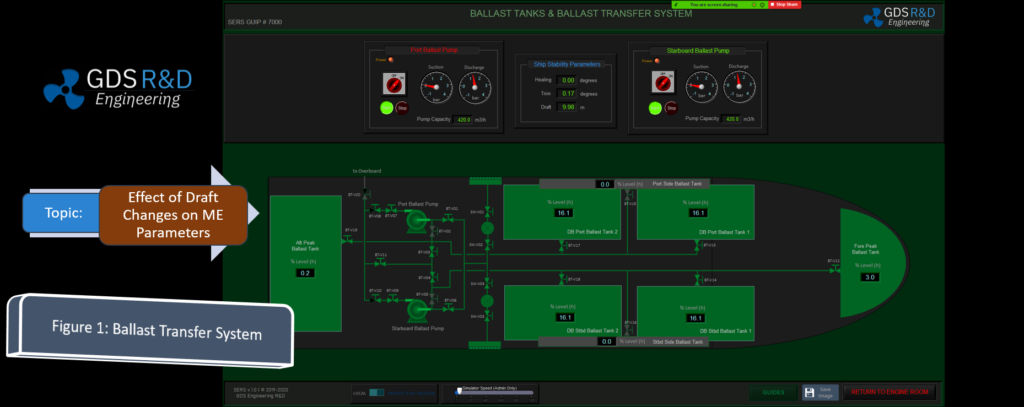
Step 1: ERS is operated in Navigation Mode and Ballast Transfer System is lined up for ballast operations. Draft is Low (i.e. d=9 m.)

Effect of Draft Change in the Ship Main Engine Performance Parameters IMO Model Course 2.07, IMO, STCW 2010, Management Level Training Exercices, Marine Engineering Education and Training, Maritime. GDS Engineering R&D, SERS, Trademark

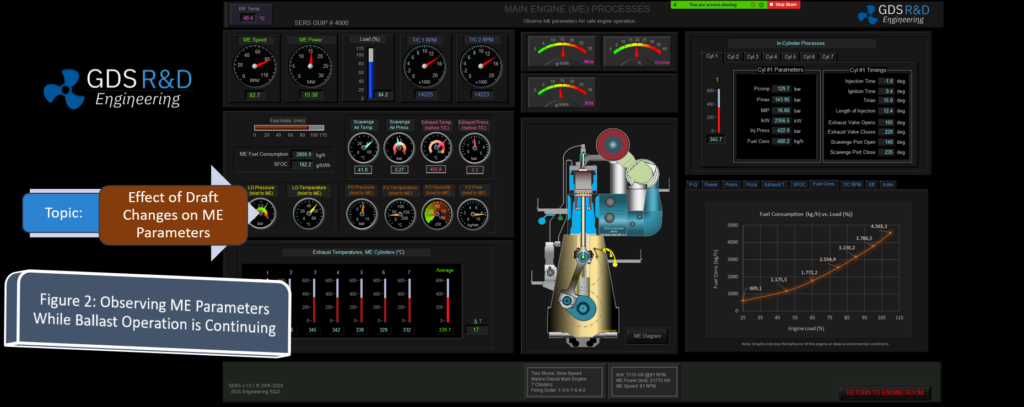
Step 2: ME Processes GUI Panel displays the ME Parameters while the draft is increasing. Check Figure 2 for that the the baseline (sea test) data/graphs are displayed. Being able to understand the ME performance graphs are important in this exercise. 

Effect of Draft Change in the Ship Main Engine Performance Parameters IMO Model Course 2.07, IMO, STCW 2010, Management Level Training Exercices, Marine Engineering Education and Training, Maritime. GDS Engineering R&D, SERS, Trademark

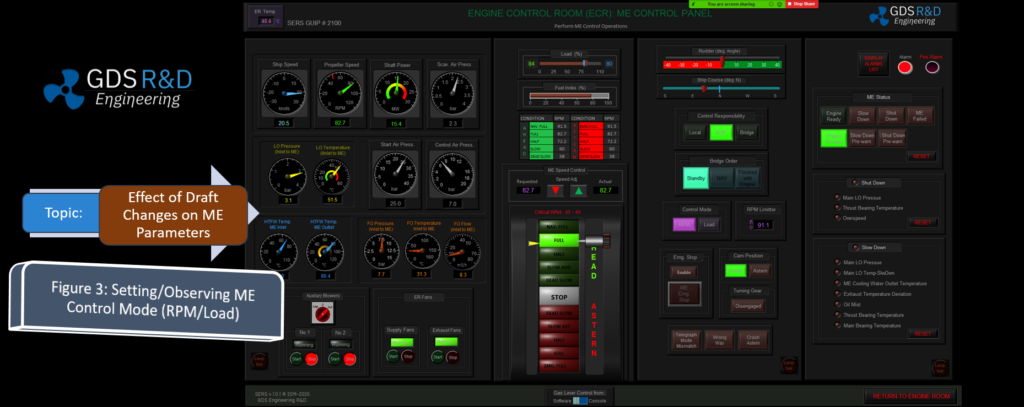
Step 3: Ensure the  control of the main engine is set to “RPM”.

Effect of Draft Change in the Ship Main Engine Performance Parameters IMO Model Course 2.07, IMO, STCW 2010, Management Level Training Exercices, Marine Engineering Education and Training, Maritime. GDS Engineering R&D, SERS, Trademark

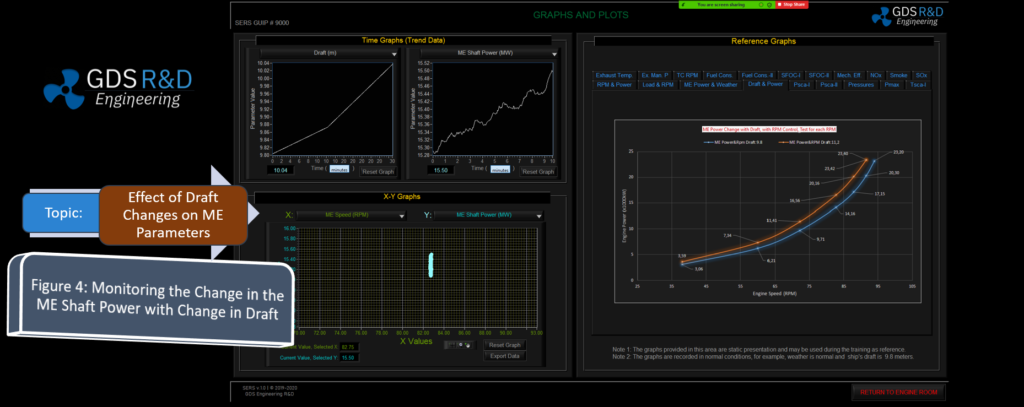
Step 4: Graphs and Plots GUI Panel displays the trend data for the selected parameters. In this exercise, it is important to plot the draft and ME Power. Additionally, it is important to select the ME Power versus ME RPM in the X-Y plot area to see the ME Power change while the RPM is controlled.

Effect of Draft Change in the Ship Main Engine Performance Parameters IMO Model Course 2.07, IMO, STCW 2010, Management Level Training Exercices, Marine Engineering Education and Training, Maritime. GDS Engineering R&D, SERS, Trademark

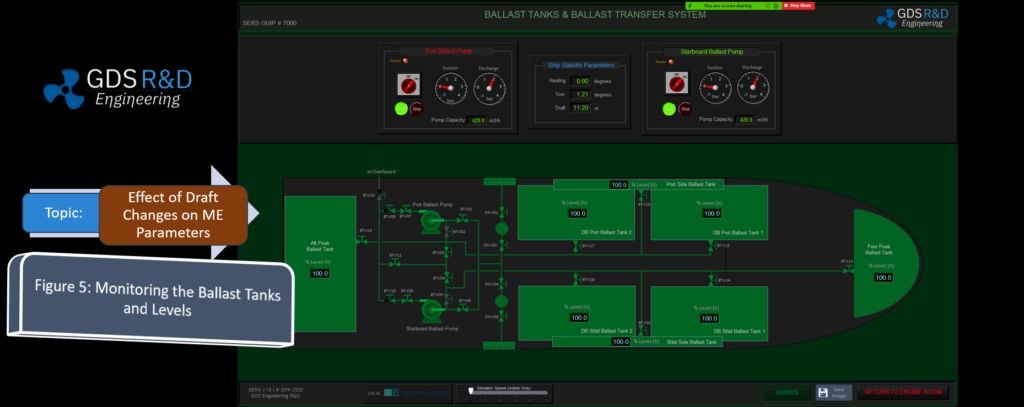
Step 5: Status of the Ballast Tanks and Levels are important to observe.

Effect of Draft Change in the Ship Main Engine Performance Parameters IMO Model Course 2.07, IMO, STCW 2010, Management Level Training Exercices, Marine Engineering Education and Training, Maritime. GDS Engineering R&D, SERS, Trademark

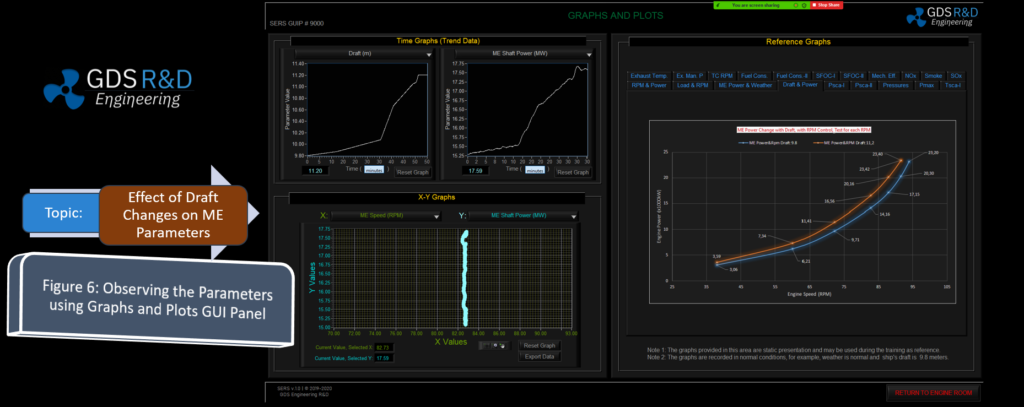
Step 6: Students should be able to interpret time (trend) and X-Y graphs for this operation, as part of the MANAGEMENT LEVEL exercise objectives.

Effect of Draft Change in the Ship Main Engine Performance Parameters IMO Model Course 2.07, IMO, STCW 2010, Management Level Training Exercices, Marine Engineering Education and Training, Maritime. GDS Engineering R&D, SERS, Trademark

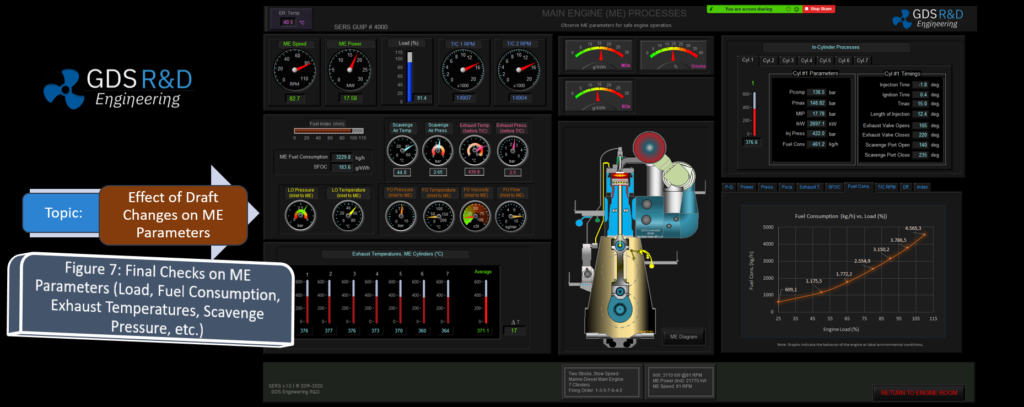
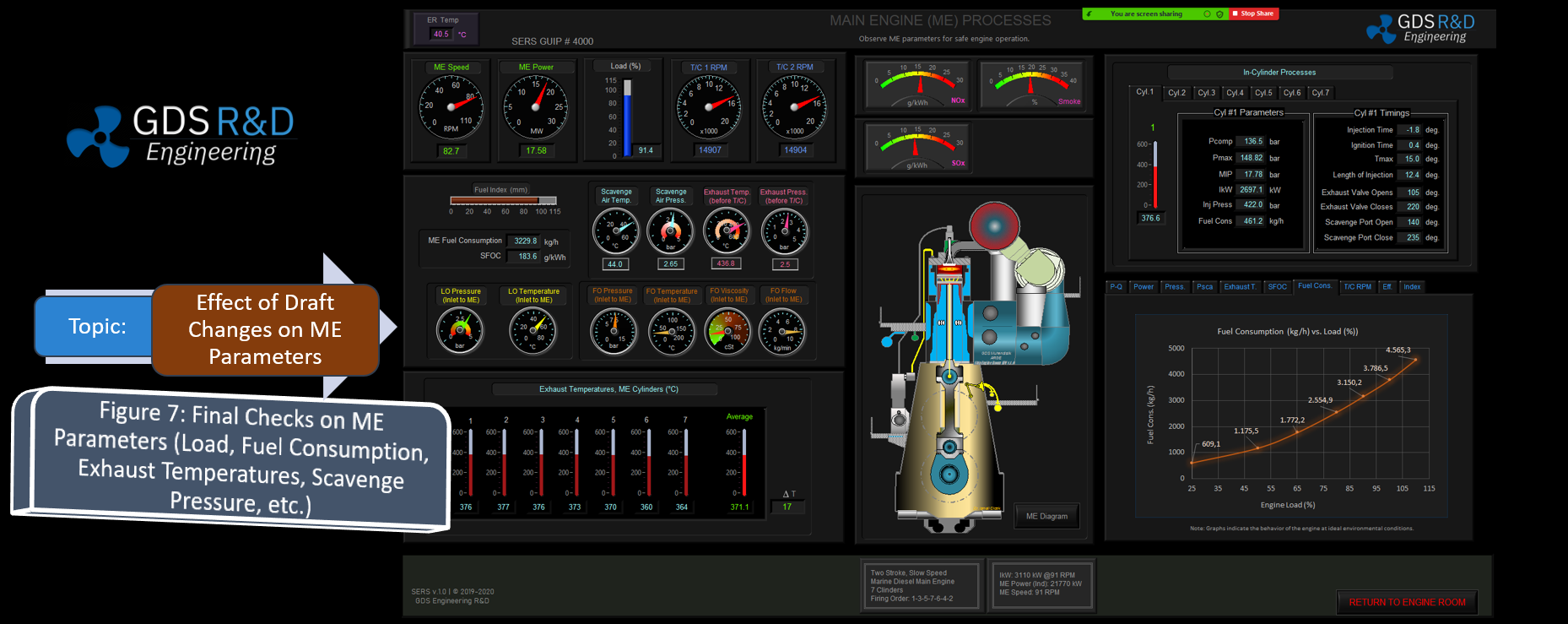
Step 7: Complete the exercise with noting the ME parameter changes.

Effect of Draft Change in the Ship Main Engine Performance Parameters IMO Model Course 2.07, IMO, STCW 2010, Management Level Training Exercices, Marine Engineering Education and Training, Maritime. GDS Engineering R&D, SERS, Trademark