The International Maritime Organization (IMO) is reviewing the International Convention on Standards of Training, Certification and Watchkeeping for Seafarers (STCW) and its associated Code. The revision phase began in February 2026, with the role of modern simulators in seafarer training among the topics under review.
What is the IMO reviewing about simulator training?
The IMO’s HTW 12/6 working document identifies gaps in Regulation I/12 and sections A-I/12 and B-I/12 of the STCW Code. The existing framework addresses simulator performance, training and assessment, including applications such as radar, Automatic Radar Plotting Aid (ARPA) and the Electronic Chart Display and Information System (ECDIS). The review examines how this framework could cover augmented reality (AR), virtual reality (VR), mixed reality (MR) and metaverse-based training environments. It also considers the need for clearer performance standards for modern simulators and whether existing guidance on distance learning and e-learning can be applied to these technologies.
The document also proposes greater use of approved simulators, electronic resources and modern maritime technologies in management-level deck officer training under Table A-II/2. For personnel serving on ships subject to the International Code of Safety for Ships Using Gases or Other Low-flashpoint Fuels (IGF Code), the review raises two practical questions under Regulation V/3. One concerns access to a limited number of ships for training as new fuels are introduced. The other concerns how the basic training certification wording in paragraph 4.2 should be interpreted.
According to The Nautical Institute’s November 2026 report, the IMO discussions planned for February 2027 will address how simulator training could count towards up to three months of the seagoing service required for initial certificates of competency under STCW regulations II/1, III/1 and III/6.
Blackout recovery and practical training with GDS SERS™
One example from the review is the loss of a ship’s main electrical power, known as a blackout. HTW 12/6 proposes adding blackout response and the manual or automatic restoration of power to the main switchboard to the management-level engineering competencies in Table A-III/2.
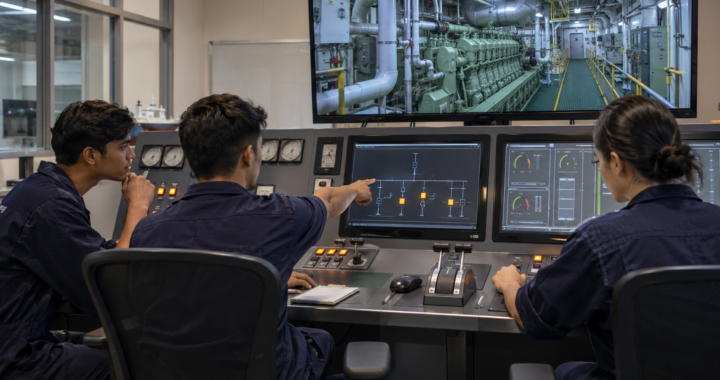
Developed by GDS Engineering R&D, the SERS™ Ship Engine Room Simulator lets marine engineering cadets practise operating propulsion, auxiliary and electrical systems, diagnosing faults and responding to emergencies. SERS™ received Full Mission (Class A) type approval from ClassNK. The approval covers the relevant requirements of STCW 2010, including the Manila Amendments, and IMO Model Course 2.07 (2017 edition).
With SERS™4Team, trainees can repeat a blackout scenario, share responsibilities and review their response with an instructor. Instructors can assign exercises based on specific learning objectives, monitor trainee performance and generate assessment reports. GDS also develops 3D engine room walkthroughs that can be integrated with SERS™, allowing trainees to explore the layout and identify equipment in its onboard location.
Explore the SERS™ Ship Engine Room Simulator