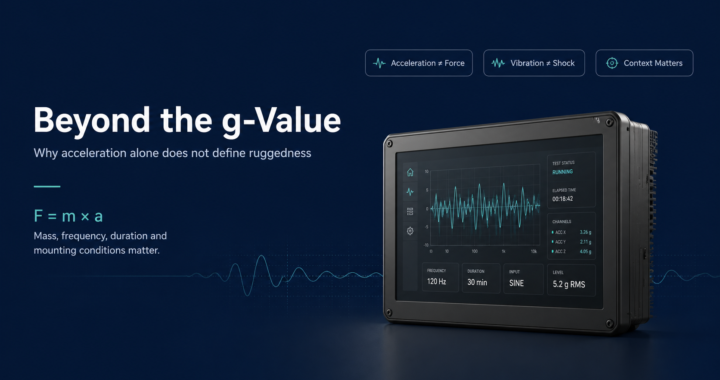
It is increasingly common to see industrial and electronic equipment promoted with statements such as “withstands 7.7 g vibration,” “tested to 9 g,” or “high-g resistant.”
Although such figures may be part of a valid qualification test, a g-value by itself does not describe the mechanical load acting on a product and is not sufficient to compare the ruggedness of two different systems.
The first point is fundamental mechanics: F=m×a
where F is force, m is mass and a is acceleration.
The unit g expresses acceleration relative to gravitational acceleration: 1g≈9.81 m/s2
Therefore, saying that a product experiences 9 g describes its acceleration — not the force acting on its structure.
Mass Changes the Mechanical Load
Consider a simple example.
A 1 gram component exposed to 250 g produces an inertial force of approximately: F=0.001×250×9.81≈2.45 N
Now consider a 10 kg equipment assembly exposed to only 9 g: F=10×9×9.81≈883 N
The acceleration is dramatically lower in the second example, yet the resulting inertial force is hundreds of times greater.
This is why an impressive-looking “high-g” number cannot be interpreted independently of the mass and mechanical configuration of the equipment.
Vibration Is More Than a g-Value
Mass is only the beginning.
For sinusoidal vibration, acceleration is related to displacement and frequency by: a=(2πf)2x
This relationship shows that the same acceleration level can represent completely different mechanical motions at different frequencies.
For example, approximately 7.7 g at 10 Hz corresponds to about 19 mm of displacement amplitude, while the same 7.7 g at 100 Hz corresponds to only about 0.19 mm.
Therefore, a statement such as “tested at 7.7 g” is incomplete unless parameters such as frequency range, vibration spectrum, duration, axis, fixture/mounting configuration and test method are also understood.
Official vibration test methodologies likewise define vibration in terms of both frequency range and amplitude, rather than treating acceleration as an isolated number.
Shock Is Not the Same as Vibration
A very high acceleration can also exist for an extremely short period of time.
For this reason, a short 250 g shock event cannot automatically be described as more severe than a lower-g vibration or shock environment.
Shock severity depends on factors including the pulse duration and waveform, as well as the dynamic response of the equipment. Standardized shock testing therefore specifies pulse forms such as half-sine and sawtooth waveforms rather than defining the test only through its peak-g value.
Resonance is another critical consideration. A structure exposed to a comparatively modest input acceleration near one of its natural frequencies may experience significant dynamic amplification. In other words, the response of the equipment can be considerably more important than the headline acceleration number.
A g-Rating Needs Engineering Context
A vibration or shock rating is meaningful only when the complete test environment is known.
A technically useful statement should answer questions such as: What is the mass of the equipment? What frequency range was tested? Was the test sinusoidal or random? What was the duration? In which axes was the equipment tested? How was it mounted? Was resonance investigated? For shock testing, what was the pulse shape and duration?
This is also why professional environmental qualification standards use defined test profiles and engineering-based test tailoring, rather than relying on a single acceleration number as a universal measure of product durability. MIL-STD-810, for example, explicitly describes an environmental tailoring process intended to produce realistic tests based on the product’s service environment and performance requirements.
The engineering question should therefore not be simply “How many g can it withstand?”
It should be:
“Under what mass, frequency, duration, mounting and dynamic conditions was that g-level demonstrated?”
Learn More About Vibration & Shock Testing
GDS Engineering R&D provides Applied Vibration Testing – Hands-On Training, led by Dr. Ismail Cicek, covering vibration test setup, resonance, periodic and random vibration, mechanical shock profiles, MIL-STD-810H and RTCA-DO-160G applications, together with practical shaker-table exercises.
Training details: Applied Vibration Testing – Hands-On Training