Underwater Radiated Noise and Sealife. Powerships and noise emittance. maritime studies

Terrestial and Underwater Radiated Noise from Powerships: Testing and Evaluation

The increase in shipping activity globally has resulted in an increased awareness of impacts on the marine environment. Effects of noise pollution, especially on marine life, have become highly prominent. Marine life is extremely sensitive to noise pollution. Due to their extreme reliance on underwater sounds for basic life functions like searching for food and mate and an absence of any mechanism to safeguard them against it, underwater noise pollution disrupts marine life (Singla, 2020). In short, marine animals depend on sound to live, making and listening to it in various ways to perform various life functions (US Bureau of Ocean Energy Management, 2014).

Noise travels much more in water, covering greater distances than it would do on land while travelling through air. Underwater sound has both pressure and particle motion components and hearing can be defined as the relative contribution of each of these sound components to auditory detection (Popper AN, 2011). Sounds radiated from ships are among the underwater noise sources. Among shipborne Underwater Radiated Noise (URN) sources are the following:

  • Propeller’s rotational turn and the blades hitting to water flow lines
  • Propeller’s cavitation
  • Ship hull structure’s interaction water (fluid-structure interaction)
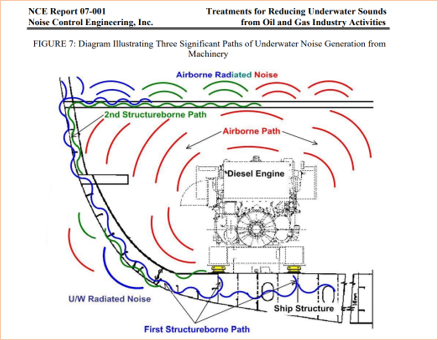
  • Mechanical noises from onboard machinery
Underwater Radiated Noise and Sealife. Powerships and noise emittance. maritime studies
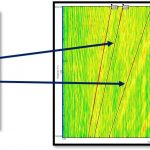
Diagram Illustrating Three Significant Paths of Underwater Noise Generation from Machinery (NCE Report 07-001, 2007).

Click here to read the report generated by NCE (NCE Report 07-001, 2007)

All of these noise sources are radiated to underwater from ships, especially when the ship speed is at higher rates, i.e. above 15 knots.

When a Powership is considered, out of the 4 aforementioned noises, only mechanical noise sources are of concern as there are no noises that emanate from the other three sources because the Powership is docked. Mechanical onboard noises are still of concern and therefore need to be evaluated and tested for the assessment of their potential negative effects to marine life.

GDS Engineering R&D has the capability for measuring the underwater radiated noise and assessment of the results based on the effect to the sealife in the region.
References of GDS Simulator Users
&
Solution Partners
in
Maritime Training and Research

Prevention of Maritime Accidents. Maritime Studies. Man Overboard. Denize Adam Düşmesi. Maritime Accident Investigation Reports. Maritime Research. IMO GISIS. Database. Veritabanı Oluşturulması. EU Project. TUBITAK. ITU Maritime Faculty. İTÜ Denizcilik Fakültesi. Maritime Accident Investigation, Casualty Investigation Code, Man Over Board (MOB), Lessons Learned, Database, Data Format, Report Forms. Root Cause Analysis. Root Cause Flow Charts. Collision Accidents. Analysis and assessment of ship collision accidents using Fault Tree and Multiple Correspondence Analysis. MCA. , Fault tree method, Multiple correspondence analysis, Collision Regulation, CollReg. Human Error. The results represent the cause statistics of the ship-to-ship collision accidents that occurred in the last 43 years. Considering the collision accident reports data, our results show %94,7 of collision accidents are related to human error.

Categories of Maritime (Ship) Accident Types and Research Studies

Categories of Maritime (Ship) Accident Types

Lloyds Maritime Information Services (LMIS) has a casualty database which divides the maritime (ship) accidents into the following categories:

1. Foundered – includes ships which sank as a result of heavy weather, leaks, breaking into two, etc, and not as a consequence of other categories such as collision etc.

2. Missing vessel – includes ships that disappeared without any trace or witnesses knowing exactly what happened in the accident.

3. Fire/explosion – includes ships where fire/explosion is the first event reported, or where fire/explosion results from hull/machinery damage, i.e. this category includes fires due to engine damage, but not fires due to collision etc.

4. Collision – includes ships striking or being struck by another ship, regardless of whether under way, anchored or moored. This category does not include ships striking underwater wrecks.

5. Contact – includes ships striking or being struck by an external object, but not another ship or the sea bottom. This category includes striking drilling rigs/platforms, regardless of whether in fixed position or in tow.

6. Wrecked/stranded – includes ships striking the sea bottom, shore or underwater wrecks.

7. War loss/hostilities – includes ships damaged from all hostile acts.

8. Hull/machinery damage – includes ships where the hull/machinery damage is not due to other categories such as collision etc.

9. Miscellaneous – includes lost or damaged ships which cannot be classified into any of the categories 1 through 8 due to not falling into any of the categories above or due to lack of information (e.g. an accident starting by the cargo shifting would typically be classified as miscellaneous).

Above is also referenced in Wartsila website. Man Over Board (MOB) event, a person falling into water, is not referenced in the above listing.


However;

IMO accidents website, Global Integrated Shipping Information System (GISIS), refers to Man Over Board as another accident type, which may end with a death or injury. We would like to refern the following two of our publications for the details of MOB and Collision accident types:

Title: Maritime Investigation Reports Involving Man-Over-Board (MOB) Casualties: A Methodology for Evaluation Process, Turkish Journal of Maritime and Marine Sciences, Vol: 5 No: 2 (2019) 141-170. Authors: Orhan Gönel and İsmail Çiçek. Click this link for more information...

Title: Analysis and assessment of ship collision accidents using Fault Tree and Multiple Correspondence Analysis, Ocean Engineering, Volume 245, 2022, 110514, ISSN 0029-8018. Authors: Hasan Ugurlu and Ismail Cicek. Click this link for more information...


With these studies, we categorize the maritime investigation reports into the following groups, which is more inline with the  International Maritime Organization (IMO) ‘Casualty Investigation Code’ (CI Code) (2008):

Ship:

  • Grounding/Stranding 
  • Collision/Contact/Allision
  • Fire/Explosion
  • Flooding/Foundering
  • Capsizing/Listing
  • Damage to ship or equipment

Crew:

  • Man-Over-Board (MOB)
  • Injury/Death
Maritime Studies. Man Overboard. Denize Adam Düşmesi. Maritime Accident Investigation Reports. Maritime Research. IMO GISIS. Database. Veritabanı Oluşturulması. EU Project. TUBITAK. ITU Maritime Faculty. İTÜ Denizcilik Fakültesi. Maritime Accident Investigation, Casualty Investigation Code, Man Over Board (MOB), Lessons Learned, Database, Data Format, Report Forms. Root Cause Analysis. Root Cause Flow Charts. Collision Accidents. Analysis and assessment of ship collision accidents using Fault Tree and Multiple Correspondence Analysis. MCA. , Fault tree method, Multiple correspondence analysis, Collision Regulation, CollReg. Human Error. The results represent the cause statistics of the ship-to-ship collision accidents that occurred in the last 43 years. Considering the collision accident reports data, our results show %94,7 of collision accidents are related to human error.

A New Study Published in the Ocean Engineering Journal: “Analysis and assessment of ship collision accidents using Fault Tree and Multiple Correspondence Analysis”

Journal Article:

Ocean Engineering, Volume 245, 1 February 2022, 110514

Hasan Ugurlu, Ismail Cicek, Analysis and assessment of ship collision accidents using Fault Tree and Multiple Correspondence Analysis, Ocean Engineering, Volume 245, 2022, 110514, ISSN 0029-8018,
https://doi.org/10.1016/j.oceaneng.2021.110514.
(https://www.sciencedirect.com/science/article/pii/S0029801821017923)

Authors

Hasan Uğurlu and Ismail Cicek

Highlights

• 513 ship collision accidents for all ship types, dated since 1977, were studied.
• 39 primary causes for collisions were examined with fault tree analysis.
• Importance and probability values for each primary cause are presented.
• Results indicate which COLREG Rules are violated the most.
• Recommendations are provided for reducing the potential collision accidents.

Abstract

Our research study indicates that, over the past few decades, the expected decrease in the number of maritime accidents has not occurred. The statistics show the collision and contact types of marine accidents have always been the most frequent. Primary causes that contribute to ship collisions were collected from 513 collision accidents reported since 1977, which is the date the Convention on the International Regulations for Preventing Collisions at Sea, 1972 (COLREGs) came into effect. The root causes of ship-to-ship collisions were determined statistically. Qualitative and quantitative analyses were carried out using the Fault Tree Analysis (FTA). This provided the probability and importance of the primary causes contributing to the ship collision accidents and defined minimal cut sets. Results show that the violation of the COLREG Rules is the most important and effective factor for collision accidents. Therefore, further analysis was conducted and the results showed which type of COLREG Rules mostly violated statistically. The primary causes were also examined by Multiple Correspondence Analysis, and it was determined that maneuvering and perception errors were the most effective factors in collision accidents. The results represent the cause statistics of the ship-to-ship collision accidents that occurred in the last 43 years. Considering the collision accident reports data, our results show %94,7 of collision accidents are related to human error.

Read more at Ocean Engieering journal…

Keywords

Maritime accidents, Ship collision, Fault tree method, Multiple correspondence analysis, Collision regulation, Human error

DOI: https://doi.org/10.1016/j.oceaneng.2021.110514

Why is this Paper Important?

The results represent the cause statistics of the ship-to-ship collision accidents that occurred in the last 43 years. Considering the collision accident reports data, our results show %94,7 of collision accidents are related to human error.

  • 513 ship collision accidents for all ship types, dated since 1977, were studied.
  • 39 primary causes for collisions were examined with fault tree analysis.
  • Importance and probability values for each primary cause are presented.
  • Results indicate which COLREG Rules are violated the most.
  • Recommendations are provided for reducing the potential collision accidents.
Ship Engine Room Simulator (ERS) SERS GDS Engineering R&D IMO STCW 2010, Engine Performance, Main Diesel Engine, Marine, Maritime, IMO Model Course 2.07. Certified by ClassNK. ITU Maritime Faculty. Yıldız Technical University. Competencies. Operation and Management Level. Education and Training. Assessment of Marine Engineers. Troubleshooting with Fault Tree Scnearious and Analysis Reporting. Objective Assessment. Nippon Kaiji Kyokai.High Voltage Training Functions 6600 VAC. Ship Propulsion Systems. Maritime Education and Training. Main Engine Performance. Sunken Diagrams. Energy Efficiency. Marine Engineering. Effect of Draft Change in the Ship Main Engine Performance Parameters. Management Level Training Exercices, Marine Engineering Education and Training. SERS Trademark

Operating Marine Diesel Engines – IMO STCW 2010 Competency Requirements

Operation of the engine room machinary and systems: Watch GDS Engine Room Simulator Demonstration Videos

Watch the videos demonstrated by our students. Operation of the engine room machinary and system in accordance with the IMO Compentency Requirements.

Thanks fr watching and please communicate with us if you would like to have this training system be incorporated in your training programms.

GDS Systems Engineering Training Programs. Online Training. Training helps reduce your design and operational risks. We provide MIL-STD-810H, RTCA-DO-160, Vibration and Shock, FAA Requirements Management courses. by Dr Ismail Cicek and a CVE certified by EASA. Tailoring of the MIL-STD-810H test methods and procedures. EUT. Equipment Under Test. Online Classes. US based intructor. US DOD. EASA. FAA. NASA. Miliary Stanrdards. Askeri Test Standartları. Çevresel Test Standart Eğitimi. Eğitim. Acceleration Testing. Aircraft Systems. RTCA-DO-160. Crash Hazard. Korozyon Testleri. Corrosion Tests. Environmental Testing of Products, provided by GDS Engineering R&D, Systems Engineering Products and Solutions. Dr. Ismail Cicek. Product Verification and Validation Courses for Integrated Systems. C-17 Military Aicraft. FAA/EASA. US DoD. Safety First. US Army. US Air Force and US Navy Tailoring Examples for Mission and Environmental Profile. Setting Test Limits and Durations are Explained. How to evaluate test results and mitigate the risk (Risk Assessment Matrix). Aircafft Equipment, Devices, Plugs, Machinary, Engines, Compressors, or Carry-on. European CE Time Schedule.

Electro-Magnetic Compatibility (EMC) of Marine Devices and Electrical Equipment

Devices used onboard a ship are exposed to harsh electromagnetic environments, whether in the propulsion, deck or bridge area of a ship. Testing of such devices for Electro-Magnetic Compatibility (EMC) is therefore very important. Otherwise, manufacturers can face difficulties during the certification and procurement stages.

EMC testing and certification  services to ensure your marine products comply with relevant international standards and regulations is a MUST!

GDS Engineering R&D does not perform these tests yet; however, have the information on design and test knowledge. The requirements include the international conventions as agreed by the International Maritime Organization (IMO) for Safety of Life at Sea (SOLAS).

Currently, we have observed that these tests are conducted by reputable agencies like ELEMENT.

The testing laboratories use the following standards to test the marine electronic, digital or electrical devices for certification to IMO SOLAS requirements, guidance, or recommendations:

  • IEC 60945
  • IEC 60533
  • Lloyds Register Test Spec No 1
  • DNV Certification Notes 2.4
  • IEC 60092

Click this link to read more about ELEMENT’s advertisements.  Element also provides the following additional information in their website:

Support and guidance from the initial design stage

The use of composite materials in ship construction together with new radio technologies and high power electronics are changing the requirements and design goals that need to be achieved to ensure electromagnetic compatibility.  Element is well placed with our knowledge of both standards and the target environment to provide detailed guidance of the best compliance strategies to adopt for your marine products.

CE Marking and Wheel Mark certification

Element performs EMC testing in conjunction with climatic and environmental test requirements to meet dedicated marine standards and be compliant with CE marking legislation. We make sure your marine equipment complies with the relevant EMC standards listed in the Marine Equipment Directive to help you achieve the Wheel Mark certification.

EMC test plans
Online Training on MIL-STD-810H, RTCA-DO-160, MIL-STD-461G, MIL-STD-704 Environmental Testing of Products, provided by GDS Engineering R&D, Systems Engineering Products and Solutions. Training Led by a Live US-based Sr. Instructor: Dr. Ismail Cicek. Product Verification and Validation Courses for Integrated Systems. C-17 Military Aicraft. FAA/EASA. US DoD. Safety First. US Army. US Air Force and US Navy Tailoring Examples for Mission and Environmental Profile. Setting Test Limits and Durations are Explained. How to evaluate test results and mitigate the risk (Risk Assessment Matrix). Aircafft Equipment, Devices, Plugs, Machinary, Engines, Compressors, or Carry-on. European CE Time Schedule. FAA Requirements Management. Efficient way of learning. Continues Education. Class Material.

Our test facilities for both EMC and environmental provide a comprehensive portfolio of tests to ensure that whatever your marine equipment is, and no matter where it’s located, we have a test solution that matches your needs.

Coordinated approach to testing for global market access

Our expertise comes from testing thousands of different products every year, and our industry-leading capacity allows us appropriate coordination of testing, so your marine equipment meets common standards of safety and performance across the EU and is accepted for entry into world markets.

For more information, we currently advice you contact with Element support desk.

Ship Engine Room Simulator (ERS) SERS GDS Engineering R&D IMO STCW 2010, Engine Performance, Main Diesel Engine, Marine, Maritime, IMO Model Course 2.07. Certified by ClassNK. ITU Maritime Faculty. Yıldız Technical University. Competencies. Operation and Management Level. Education and Training. Assessment of Marine Engineers. Troubleshooting with Fault Tree Scnearious and Analysis Reporting. Objective Assessment. Nippon Kaiji Kyokai.High Voltage Training Functions 6600 VAC. Ship Propulsion Systems. Maritime Education and Training. Main Engine Performance. Sunken Diagrams. Energy Efficiency. Marine Engineering. Effect of Draft Change in the Ship Main Engine Performance Parameters. Management Level Training Exercices, Marine Engineering Education and Training. SERS Trademark

Effect of Weather on the Marine Propulsion Engine Performance Onboard a Ship

IMO Model Course Exercise recommends students learn the weather change effect on engine performance.

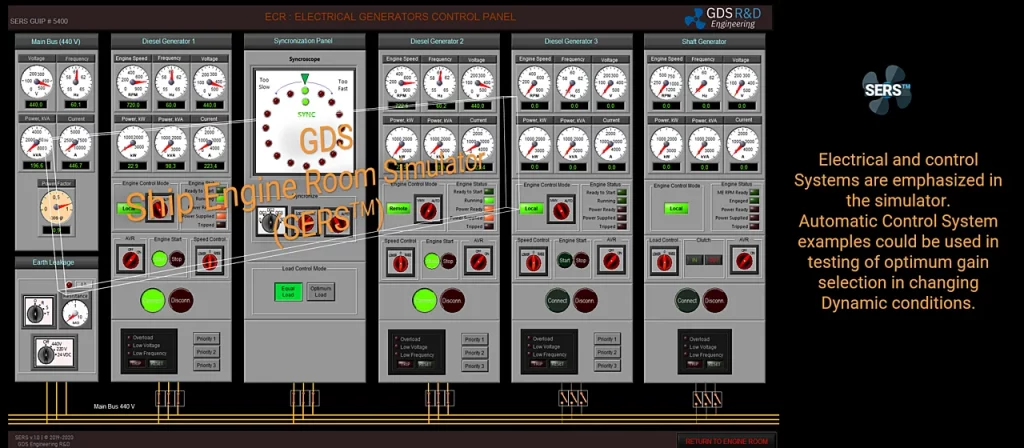
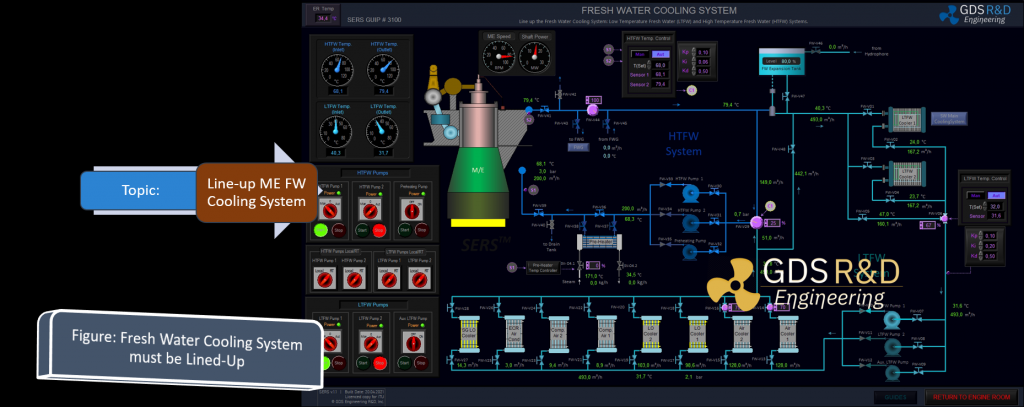
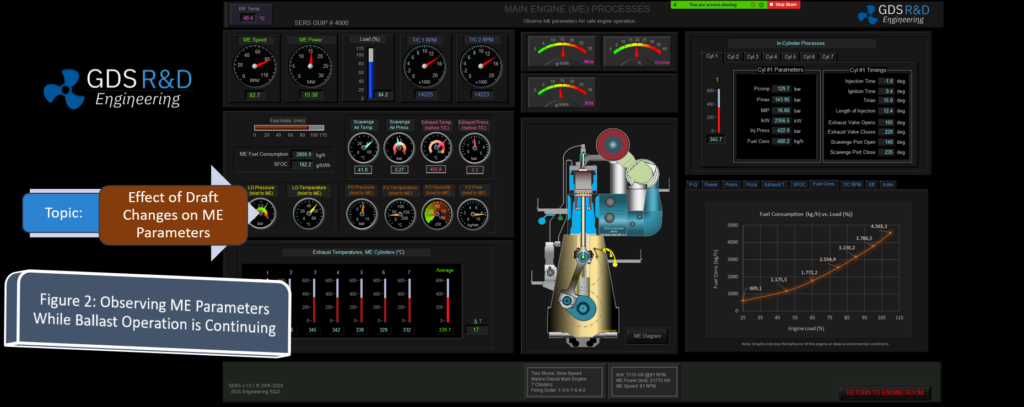
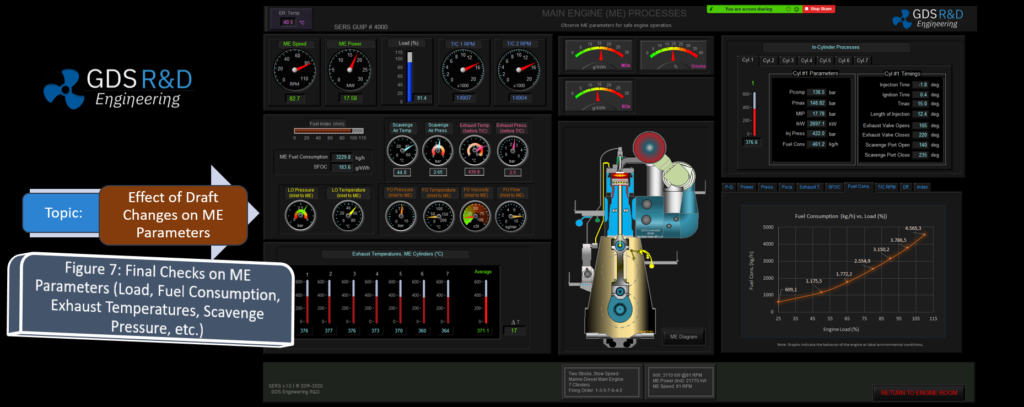
GDS Engineering R&D developed a modern Engine Room Simulator (ERS) and it is in use by various research and training institutions. GDS ERS, called SERS, includes all engine room, ship, and environmental paramaters to demonstrate the weather effect to engine performance while onboard systems are maintaining their status with the displayed parameters. This scenario study is a predefined and set in the ERS for instructors to directly apply in their STCW Management Level Exercises. Student Workbooks accomodate this exercise with specficic forms to fill by the trainees.