GDS Engineering R&D has reached a major development milestone in the “Yacht Engineering Training Enhancement through Engine Room Simulator Integration” (YACHTENGINE-SIM) project, with the new yacht-specific Engine Room Simulator module now approaching the final stage of development.
Developed within the framework of the Erasmus+ KA210-VET Small-scale Partnerships in Vocational Education and Training programme, YACHTENGINE-SIM was launched to introduce a more practical, digital and scenario-based approach to yacht engineering education. The project brings together Foxtrium Limited of Malta, operating through XONE Superyacht Academy, and GDS Engineering R&D of Türkiye, combining yacht-sector vocational training experience with GDS’s maritime simulation and engineering capabilities.
At the centre of the project is the development and integration of a dedicated Yacht Engine Room Simulator, designed to bridge the gap between classroom-based engineering knowledge and the operational decisions that yacht engineers and technical crew are required to make in practice.
The technical development of this simulator has now progressed to its final refinement stage.
From Project Concept to an Operating Yacht Simulation Environment
The original project objective was to develop a high-fidelity, interactive training environment capable of representing yacht engine-room operations, control systems, power generation and distribution, troubleshooting, maintenance and emergency procedures without exposing trainees or real machinery to operational risk.
A large part of that technical scope has now been transformed into an operational simulator module within the GDS Ship Engine Room Simulator – SERS™ environment.
Rather than treating a yacht simply as a smaller version of a commercial vessel, the new module has been structured around the particular machinery, auxiliary systems, electrical architecture and hotel-service systems associated with modern yacht operation.
The simulated vessel developed for the module represents a yacht with a Length Overall of 63 metres, a Length Between Perpendiculars of 54 metres, a waterline length of 55 metres, an 11-metre moulded breadth, a 5.8-metre moulded depth, a 3.7-metre summer draught and a simulated deadweight of 265 tonnes.
This vessel model forms the common operating platform around which propulsion, electrical generation, auxiliary machinery and onboard service systems have been integrated.
Main Propulsion and Machinery Modelling
The propulsion model is based around a four-cycle, high-speed marine diesel engine configured with 12 cylinders.
Within the simulator, the engine is represented with a 135 mm bore, 156 mm stroke and an operating speed of 2,450 rpm at 100% load. The defined firing sequence and machinery characteristics are incorporated into the engine information and training interfaces so that trainees can become familiar with the basic configuration before moving into operational exercises.
This machinery representation is not intended only as a visual reference.
The engine forms part of the wider simulator architecture in which propulsion commands, engine parameters, auxiliary systems and control actions can be approached as connected elements of one operating yacht.
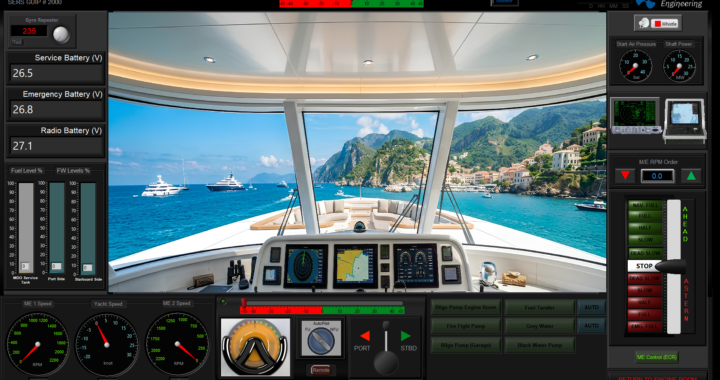
The simulator also incorporates a dedicated bridge control environment, allowing the relationship between bridge propulsion commands and machinery response to be included in training exercises.
This is an important part of yacht engineering education because engineering personnel must understand not only the machinery itself, but also how propulsion demand, control locations and engine-room response interact during vessel operation.
Diesel Generator and Electrical Power Systems
Electrical generation has also been integrated as a major component of the yacht module.
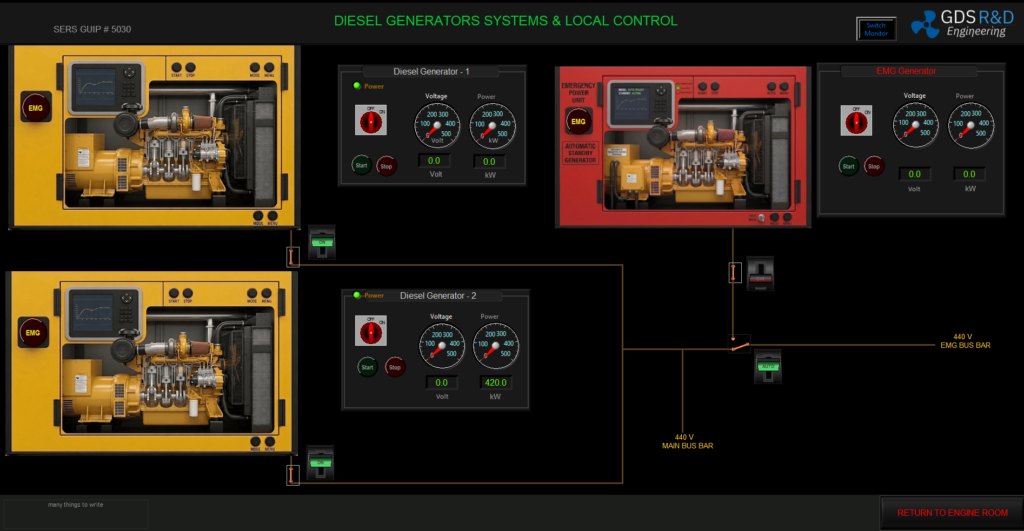
The current configuration includes three high-speed, four-stroke, supercharged diesel generator sets, each represented at 150 kW / 206 kVA at 2,200 rpm and 100% load.
Dedicated local control interfaces have been developed for the diesel generators, enabling trainees to work with generator status, voltage and power indications as part of the simulator environment.
The electrical architecture extends beyond individual generator operation.

The yacht simulator interface includes the 440 V main distribution network, 440 V emergency distribution network, 220 V distribution network and 24 VDC distribution network, together with engine-room electrical panels covering power generation, pumps and compressors, and circuit breakers.
This allows electrical power generation and distribution to be treated as an integrated engineering subject rather than as an isolated theoretical topic.
For yacht engineers, this is particularly important because reliable electrical power is directly connected to propulsion auxiliaries, navigation support systems, hotel services, pumps, safety systems and emergency equipment.
A Yacht Engine Room Extends Beyond Main Machinery
One of the important aspects of the YACHTENGINE-SIM development has been the decision to model the yacht as a complete technical environment.
Modern yacht engineers are responsible for considerably more than propulsion machinery.
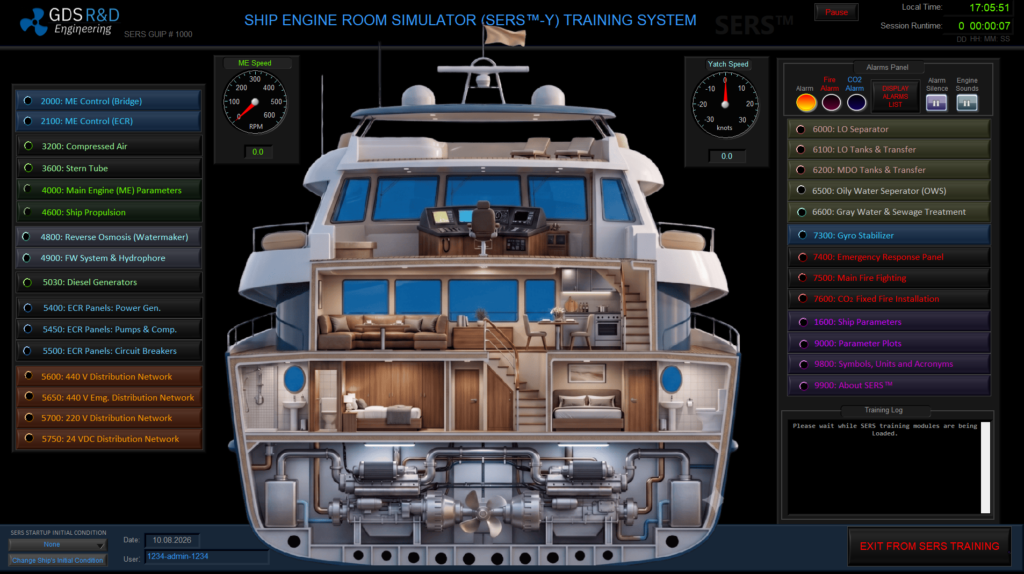
For this reason, the developing simulator module brings together propulsion and conventional engine-room systems with equipment that is particularly relevant to yacht operation and onboard services.
The current simulator environment includes dedicated interfaces for systems such as:
- Gyro Stabilizer
- Refrigeration Plant
- Fresh Water Maker / Reverse Osmosis System
- Diesel Generator Systems and Local Control
- Compressed Air
- Stern Tube Systems
- Fuel and Lubricating Oil Storage and Transfer
- Oily Water Separation
- Fresh Water and Hydrophore Systems
- Grey Water and Sewage Treatment
- Main Fire Fighting
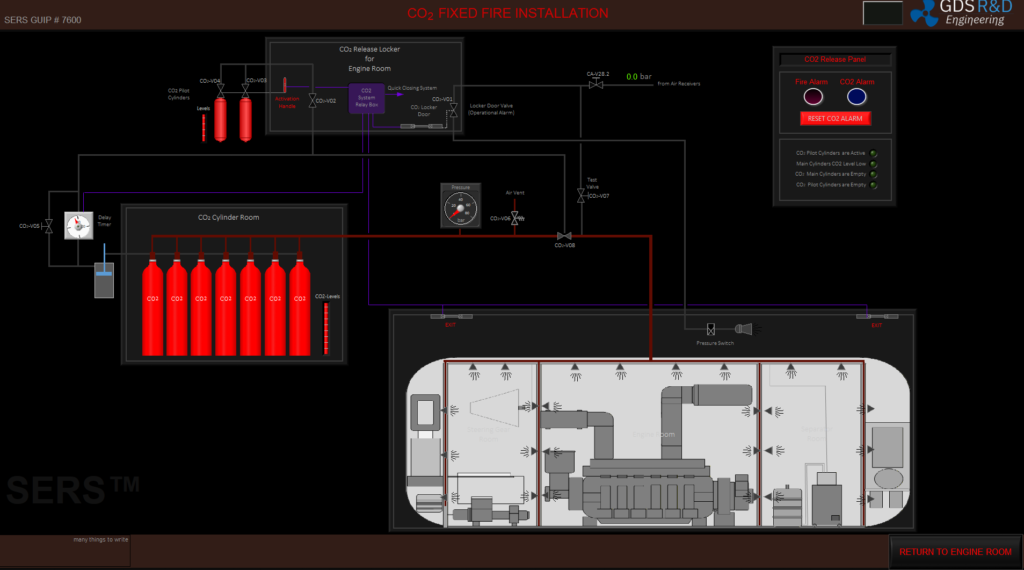
- CO₂ Fixed Fire Installation
- Emergency Response Systems
The module also incorporates ship and machinery parameters, alarm functions and parameter plotting capabilities through the central SERS™ interface.
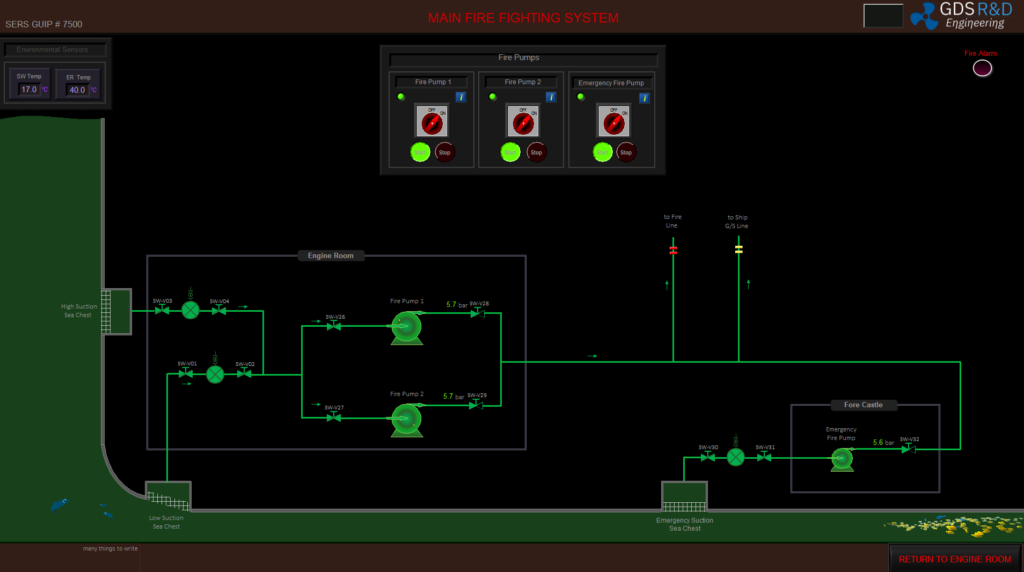
This broader approach reflects an important reality of yacht engineering: technical competence depends on understanding the interactions between propulsion, electrical power, auxiliary machinery, safety systems and hotel-service equipment.
Gyro Stabilizer Training
A dedicated Gyro Stabilizer module has been incorporated into the simulator.
The interface combines stabilizer control with vessel stability information, including heel and trim indications, enabling the stabilizer system to be introduced within the wider context of yacht operation.

This extends simulator-based yacht engineering training into an area that is highly relevant to passenger comfort and yacht operation, while still requiring an engineering understanding of machinery control, operating status and system response.
Refrigeration Plant
The yacht module also includes a complete Refrigeration Plant training interface.
The system represents the basic refrigeration cycle and provides dedicated cold-storage areas for different onboard requirements, including meat/fish, vegetables and beverage storage.
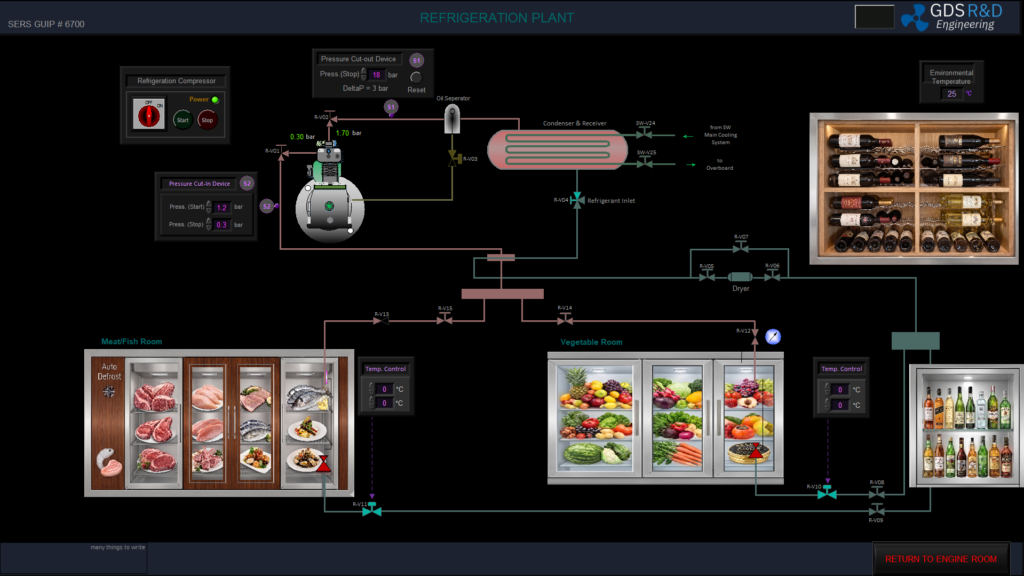
Control and monitoring elements including compressor operation, cut-in and cut-out pressure settings, condenser and receiver arrangements, refrigerant flow and temperature control are brought together in one training screen.
The objective is to allow trainees to approach refrigeration as an operational engineering system rather than only as a schematic studied in the classroom.
Fresh Water Production by Reverse Osmosis
Another completed major interface is the Fresh Water Maker System based on Reverse Osmosis.
The simulator screen includes seawater and freshwater pump control, membrane units, pressure monitoring, brine discharge and freshwater delivery toward the yacht’s freshwater tanks.
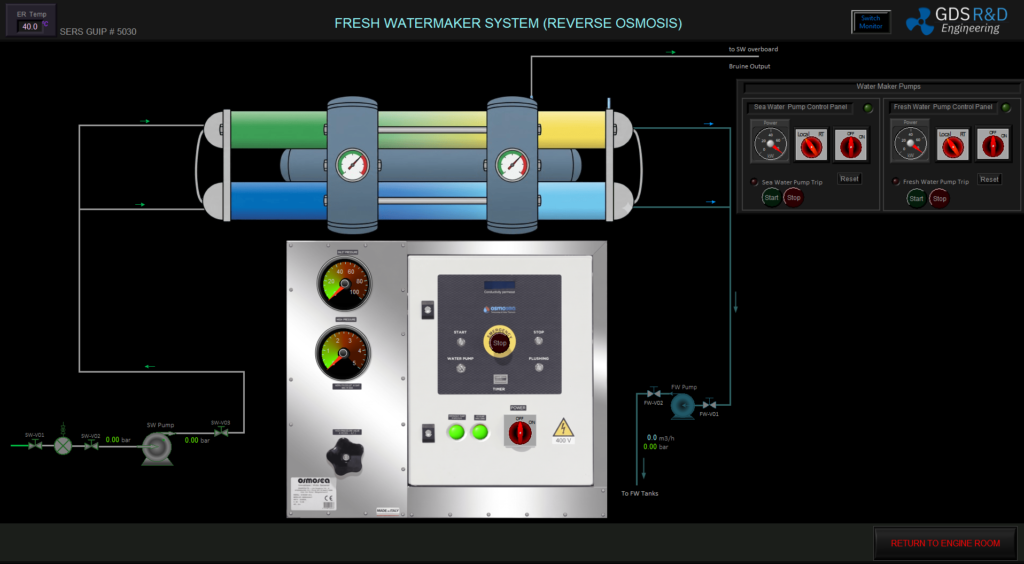
Freshwater production is a particularly important system in yacht operations because technical personnel must understand not only equipment operation but also pump sequencing, pressure conditions, seawater supply and product-water routing.
By integrating this system directly into the engine-room simulator, these operational relationships can be demonstrated and exercised within the same environment used for the rest of the yacht machinery.
Building Training Around Systems, Decisions and Faults
The objective of YACHTENGINE-SIM is not simply to reproduce machinery graphically.
The wider project was designed around simulator-based vocational learning, where trainees can work with realistic operating situations, troubleshooting tasks and emergency scenarios while developing practical decision-making and problem-solving skills.
The project also aims to integrate simulator exercises into structured yacht-engineering training programs rather than treating simulation as a stand-alone demonstration tool. This includes mapping exercises to learning outcomes, developing structured training activities and supporting competency-oriented assessment approaches.

The next stages of the project therefore extend beyond software development.
Pilot training activities are intended to place both trainees and instructors directly into scenario-based simulator sessions covering engine-room operations, troubleshooting, routine maintenance, fault diagnosis and emergency response. Feedback from these sessions will then be used to refine the training structure and simulator functionality.
From Simulator Development to Validation and Training Integration
With the core yacht module now close to completion, the project is moving from primarily technical development toward final refinement, training integration, pilot use and evaluation.
The project framework includes technical performance testing, usability evaluation, assessment of training effectiveness and consultation with maritime training and industry stakeholders. These stages are intended to examine simulator responsiveness, training usability and the effectiveness of the developed exercises before wider implementation.
The project also targets alignment of the training framework with relevant IMO STCW competency principles, with the final training approach intended to support structured and competency-based yacht engineering education.
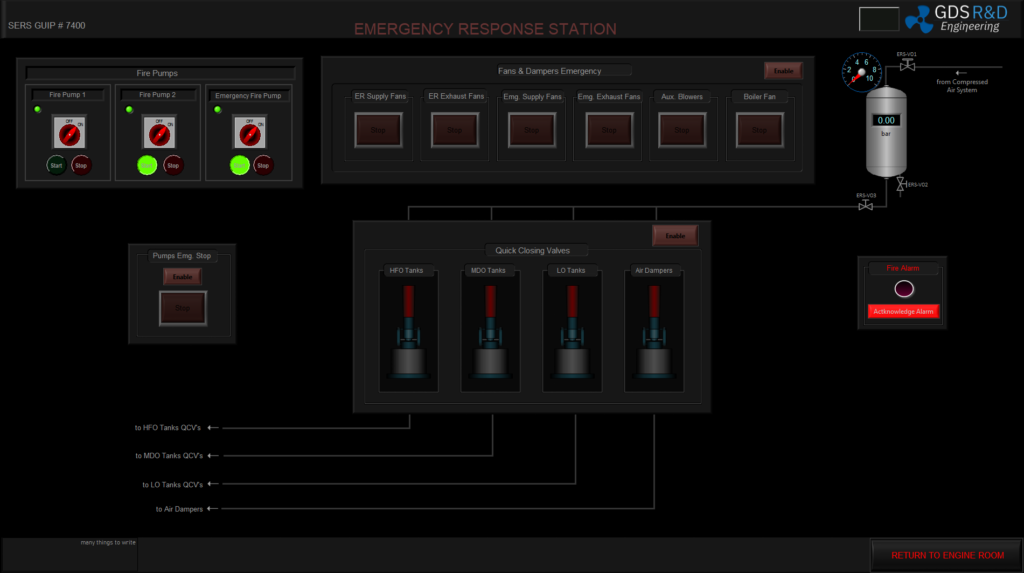
For GDS Engineering R&D, the progress achieved in YACHTENGINE-SIM represents an important extension of the SERS™ simulation platform into the yacht and superyacht training field.
The near-final module now combines a complete simulated yacht platform with propulsion machinery, diesel generators, electrical distribution, auxiliary systems, safety systems and yacht-specific service equipment within a single integrated training environment.
As the remaining development and validation work progresses, the focus will increasingly shift from building the simulator to using it as a structured engineering training tool.
The goal remains the same as when the project was initiated: to provide future yacht engineers and technical crew with an environment where they can understand systems, operate equipment, diagnose problems and develop engineering judgement before facing the same decisions onboard a real yacht.
With the Yacht Engine Room Simulator now approaching its final development stage, YACHTENGINE-SIM is moving one step closer to turning that objective into a practical training capability.