Ship Engine Room Simulator (ERS) SERS GDS Engineering R&D IMO STCW 2010, Engine Performance, Main Diesel Engine, Marine, Maritime, IMO Model Course 2.07. Certified by ClassNK. ITU Maritime Faculty. Yıldız Technical University. Competencies. Operation and Management Level. Education and Training. Assessment of Marine Engineers. Troubleshooting with Fault Tree Scnearious and Analysis Reporting. Objective Assessment. Nippon Kaiji Kyokai.High Voltage Training Functions 6600 VAC. Ship Propulsion Systems. Maritime Education and Training. Main Engine Performance. Sunken Diagrams. Energy Efficiency. Marine Engineering. Effect of Draft Change in the Ship Main Engine Performance Parameters. Management Level Training Exercices, Marine Engineering Education and Training. SERS Trademark

Capture GDS Vision in the Engine Room Simulator Development

In recent years, the maritime industry has seen a significant push towards technological advancement and stricter safety and operational standards. As vessels become more sophisticated and regulations evolve, the role of well-trained onboard maritime personnel becomes increasingly essential. In this context, the SIRE 2.0 program and GDS Ship Engine Room Simulator represent pioneering tools designed to equip maritime crews with deep technical skills necessary to meet new demands and improve the safety and efficiency of maritime operations.

Understanding SIRE 2.0 and Its Impact on Maritime Training

The Ship Inspection Report Programme (SIRE) has long been a fundamental tool in maintaining safety and operational standards across the maritime industry, particularly for tanker operations. Launched by the Oil Companies International Marine Forum (OCIMF), the program provides a comprehensive inspection system that evaluates the condition and operations of vessels. However, with the growing complexity of modern vessels and stricter environmental and safety regulations, the traditional SIRE program required enhancements to address these evolving needs. This led to the development of SIRE 2.0, an upgraded version that integrates data-centric inspection methodologies with a stronger focus on crew competency, operational excellence, and technical skills.

One of the key features of SIRE 2.0 is its focus on assessing the competency of crew members in handling complex equipment and operations. Rather than focusing solely on vessel condition, SIRE 2.0 evaluates the practical skills, knowledge, and decision-making abilities of onboard personnel. This ensures that crew members are not only familiar with equipment and operational standards but are also capable of responding effectively to critical situations.

The emphasis on crew competency in SIRE 2.0 aligns with the industry’s shift toward a human-centered approach in safety and operational excellence. This paradigm shift means that training programs must go beyond traditional instruction and delve into more practical, technology-driven skills, which is where simulators like the GDS Ship Engine Room Simulator come into play.

The Role of the GDS Ship Engine Room Simulator in Skill Development

The GDS Ship Engine Room Simulator is an advanced training tool that replicates the engine room environment of modern vessels, providing maritime personnel with hands-on experience in a controlled setting. This simulator covers a wide range of critical systems found in ship engine rooms, including propulsion, auxiliary machinery, electrical systems, and emergency protocols. By using the simulator, crew members can practice their skills, refine their decision-making processes, and gain confidence in handling complex systems without the risks associated with real-world errors.

The simulator allows trainees to engage in realistic scenarios, such as equipment failures, power management issues, and environmental challenges. This training is invaluable in helping them develop deep technical skills needed to respond effectively under pressure. Given the increasing complexity of ship machinery, which often integrates digital and automated controls, such simulator-based training ensures that personnel are well-prepared for both routine and emergency operations.

Developing Deep Technical Skills with SIRE 2.0 and the GDS Simulator

By integrating SIRE 2.0’s competency standards with the practical capabilities of the GDS Ship Engine Room Simulator, maritime training institutions can foster deep tech skills that are essential in today’s high-stakes maritime environment. Training programs using these tools can address various aspects, including:

Operational Readiness: By simulating real-life engine room conditions, the GDS simulator enables personnel to develop an intuitive understanding of systems and processes, which aligns with SIRE 2.0’s focus on crew readiness and situational awareness.

Crisis Management and Decision-Making: The simulator provides scenarios that replicate emergency situations, allowing trainees to practice crisis response, prioritize actions, and make critical decisions under pressure.

Technical Proficiency: The GDS simulator helps personnel develop advanced skills in troubleshooting and maintaining complex machinery, which is crucial for achieving SIRE 2.0’s standards for operational excellence.

Environmental Compliance: With a growing emphasis on environmental regulations, the simulator enables crew members to familiarize themselves with compliance standards and practice procedures that reduce environmental impact, such as optimizing fuel usage and managing waste effectively.

Safety Protocols: Through realistic training scenarios, the simulator reinforces safety protocols, ensuring that personnel can identify and mitigate risks, which is a core component of the SIRE 2.0 inspection program.

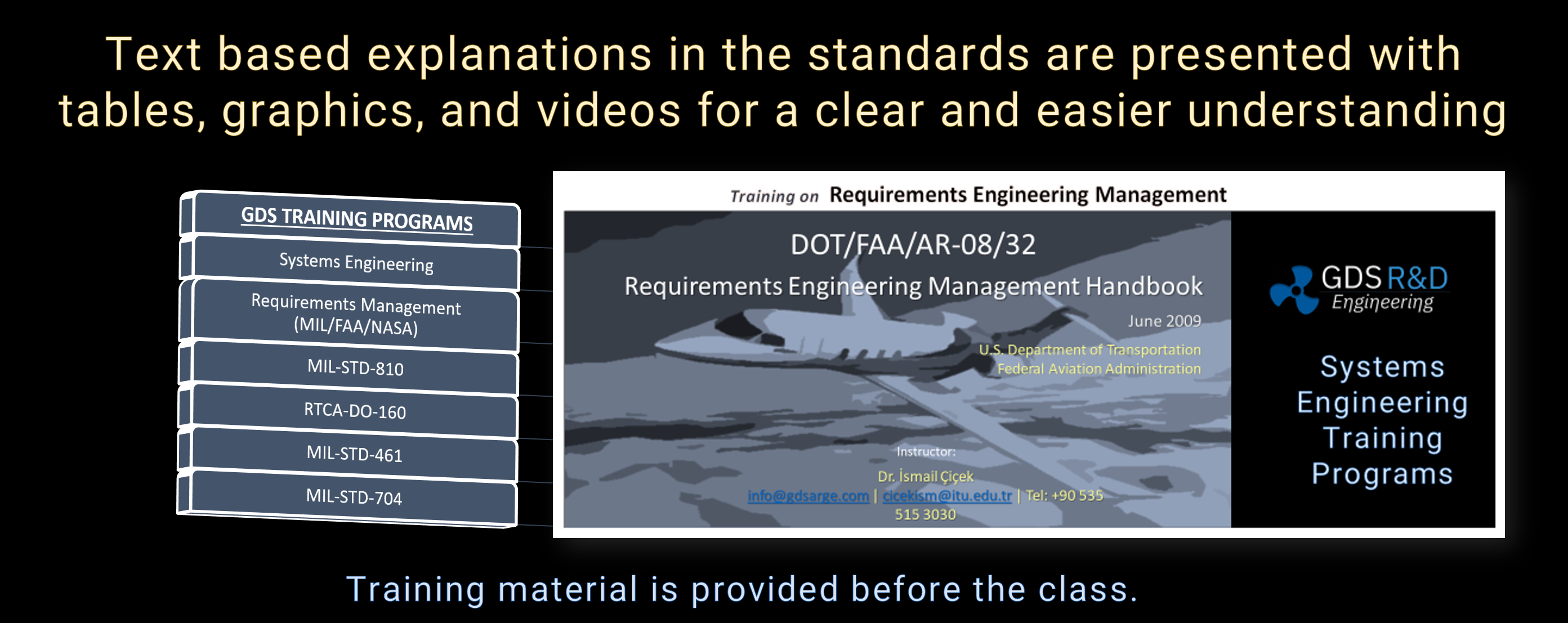
GDS Systems Engineering Training Programs. Online Training. Training helps reduce your design and operational risks. We provide MIL-STD-810H, RTCA-DO-160, Vibration and Shock, FAA Requirements Management courses. by Dr Ismail Cicek and a CVE certified by EASA. Tailoring of the MIL-STD-810H test methods and procedures. EUT. Equipment Under Test. Online Classes. US based intructor. US DOD. EASA. FAA. NASA. Miliary Stanrdards. Askeri Test Standartları. Çevresel Test Standart Eğitimi. Eğitim. Acceleration Testing. Aircraft Systems. RTCA-DO-160. Crash Hazard. Korozyon Testleri. Corrosion Tests. Environmental Testing of Products, provided by GDS Engineering R&D, Systems Engineering Products and Solutions. Dr. Ismail Cicek. Product Verification and Validation Courses for Integrated Systems. C-17 Military Aicraft. FAA/EASA. US DoD. Safety First. US Army. US Air Force and US Navy Tailoring Examples for Mission and Environmental Profile. Setting Test Limits and Durations are Explained. How to evaluate test results and mitigate the risk (Risk Assessment Matrix). Aircafft Equipment, Devices, Plugs, Machinary, Engines, Compressors, or Carry-on. European CE Time Schedule. DOT/FAA/AR-08/32. Requirements Engineering Management Handbook. U.S. Department of Transportation Federal Aviation Administration.

Requirements Management: Online Training with Focus on FAA Requirements Engineering Management Handbook

February 24, 2022 @ 9:00 am February 27, 2022 @ 5:00 pm

GDS Systems Engineering Training Programs. Online Training. Training helps reduce your design and operational risks. We provide MIL-STD-810H, RTCA-DO-160, Vibration and Shock, FAA Requirements Management courses. by Dr Ismail Cicek and a CVE certified by EASA. Tailoring of the MIL-STD-810H test methods and procedures. EUT. Equipment Under Test. Online Classes. US based intructor. US DOD. EASA. FAA. NASA. Miliary Stanrdards. Askeri Test Standartları. Çevresel Test Standart Eğitimi. Eğitim. Acceleration Testing. Aircraft Systems. RTCA-DO-160. Crash Hazard. Korozyon Testleri. Corrosion Tests. Environmental Testing of Products, provided by GDS Engineering R&D, Systems Engineering Products and Solutions. Dr. Ismail Cicek. Product Verification and Validation Courses for Integrated Systems. C-17 Military Aicraft. FAA/EASA. US DoD. Safety First. US Army. US Air Force and US Navy Tailoring Examples for Mission and Environmental Profile. Setting Test Limits and Durations are Explained. How to evaluate test results and mitigate the risk (Risk Assessment Matrix). Aircafft Equipment, Devices, Plugs, Machinary, Engines, Compressors, or Carry-on. European CE Time Schedule. DOT/FAA/AR-08/32. Requirements Engineering Management Handbook. U.S. Department of Transportation Federal Aviation Administration.

Reserved (Closed) training for an organization. Please review our training schedule or contact us for a group training.

DOT/FAA/AR-08/32 Requirements Engineering Management Handbook

3-days online training.

Training Schedule:

  • Training courses are provided online using ZOOM.
  • All registered users will receive the link for attandance 1 day before the course.
  • All registered users will receive a link to material site for course material before the class.
  • Schedule is as follows (UTC+3)
  • Day 1: 09:00 – 17:00
  • Day 2: 09:00 – 17:00
  • Day 3: 09:00 – 13:00

The FAA Handbook presents a set of recommended practices on how to collect, write, validate, and organize requirements. It attempts to bring together the best ideas from several approaches, organize them into a coherent whole, and illustrate them with concrete examples that make their benefits clear.
The Handbook is targeted to the domain of real-time, embedded systems and specifically to the avionics industry. It describes a set of recommended practices in which basic concepts can be practiced in isolation, but reinforce each other when practiced as a whole. These practices allow developers to progress from an initial, high-level overview of a system to a detailed description of its behavioral and performance requirements. Due to the growing importance of software in avionics systems, these practices emphasize techniques to ease the transition from system to software requirements.

Concrete examples are used throughout the Handbook to make the concepts clear, but there are many other formats that could be used to obtain the same objectives. It is expected that most organizations wanting to use these practices will want to modify them, perhaps significantly, to integrate them with their existing processes and tools.

Requirements Engineering Management Training (FAA/EASA/DOD/NASA)

Click here to read more about the training contents, daily program, and about the instructors.

Reserved for an Organization – (Please Review Calendar for other OPEN training programs

MIL-STD-704F: Online Training on Aircraft Electric Power Characteristics

June 17 @ 9:00 am June 19 @ 5:00 pm

This training is full! Review the training courses at GDS Systems Engineering Training Courses.

Organized by TRTEST Test ve Değerlendirme A.Ş., Ankara, Turkey.

Electrical/Electronic systems for US DoD aircraft must comply with MIL-STD-704F, the latest version of the standard. Equipment must pass this comprehensive testing to demonstrate compliance.

We provide a 2 day online training course with two experienced instructors on the subject.

We can open the course as an online and closed course or you can simply join to one of our upcoming training events.

Thank you for your interest.

For further information and to plan your training, please feel free to contact us at:
info@globaldynamicsystems.com

Reserved for an Organization – (Please Review Calendar for other OPEN training programs

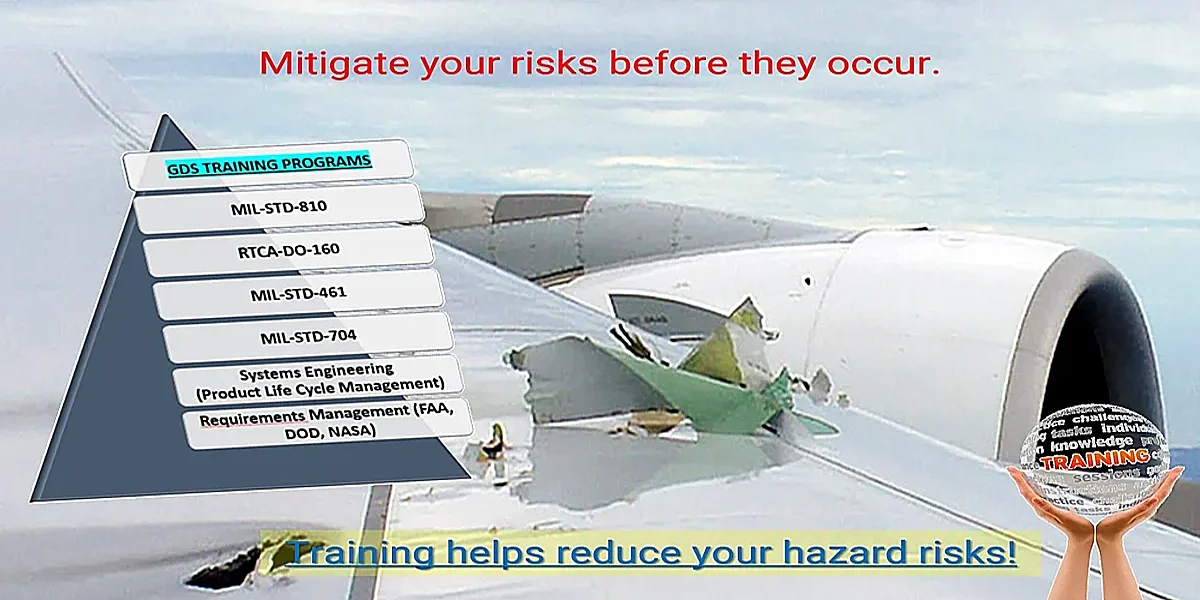
Mitigate your risks before they actually happen MIL-STD-810H Training STD-461 RTCA-DO-160G (1)

RTCA-DO-160G: Training on Environmental and EMI/EMC Testing of Airborne Equipment (FAA/EASA Test Requirements) | Online/Live | International (EN)

February 11, 2022 @ 8:00 am February 13, 2022 @ 12:30 pm CET

Cost: USD760.00

Mitigate your risks before they actually happen MIL-STD-810H Training STD-461 RTCA-DO-160G (1)
GDS Engineering R&D, Inc. is an official member of RTCA Organization.

GDS Engineering R&D, Inc. is an official member of the RTCA Organization.

RTCA-DO-160G Online Training, FAA/EASA Equipment Test Requirements. This training is an important step for testing and certifying your products in accordance with the FAA/EASA test requirements.

2.5 Days, Hands-on, “Online” or “Onsite” Training Class. Led by live, two instructors.

Training Schedule and Execution Type
  • Training Type: International / Online
  • Satus: Seats are avaiable now.
  • Online training using ZOOM.
  • Led by a live, U.S. based instructor (Dr Ismail Cicek) (PDF) (Download PDF)
  • A usual 2.5 days of training schedule is as follows:
      • 1st Day: 09:00 – 13:00
    • 2nd Day: 09:00 – 17:00 (Lunch Break between 12:30 and 13:30)
    • 3rd Day: 09:00 – 17:00 (Lunch Break between 12:30 and 13:30)
    • Time zone: Central Daylight Time (US CDT, UTC-5)
  • Ending time may vary+/-30 minutes depending on the length of the discussions.
  • Course Material: English
  • Comm. Language: English
  • Material: Registration includes all presentations and additional material (English) shared before the class.
  • Attandance: The link for online class is distributed to registered trainees upon registration.
  • Attendees will receive a Training Certificate.
  • Training includes knowledge check quizzes, a competition type fun way or learning.

Click to read detail information about this training:
https://www.globaldynamicsystems.com/systems-engineering-training-courses/training-on-rtca-do-160g-testing/

Dowload the PDF File: RTCA-DO-160G Training Description.PDF


Here is a Summary Information:

International Training with a focus on the test standard document
“RTCA-DO-160G Environmental Conditions
and Test Procedures for Airborne Equipment
© 2010, RTCA, Inc.”

This training is an important step for
testing and certifying your products in accordance with the FAA/EASA test requirements.

  • A good understanding of product testing in view of RTCA-DO-160G
  • Overview of Systems Engineering, V&V, and Concepts of Operations (CONOPS) document and relations with RTCA-DO-160 testing
  • Part 21 and FAA/EASA Regulations
  • Test Requirement Reference
  • Test Category Selections
  • Test Procedures, Scheduling, Test Implementation and Review of Test Reports
  • Test Sections (Environmental & EMI/EMC): All test sections are covered with detail discussions except several tests, such as Fungus Tesing and Waterproofness are discussed in summary with important aspects.
  • Discussions include design issues, test failures, and recommendations
  • A session with Risk Management Method includes how to resolve a test result that may not be a failure, i.e. anomalies., with a process that we recommend.
  • Importance of establishing Integrated Product Team (IPT) or with another name “Test Review Team” for reviewing test plans and results and identifying the next step when issues are encountered.
  • Design Recommendations are emphasized in each test section.
  • Additional or alternative (standards and tests) are recommended for certain cases.
Our Instructors share their experience and knowledge gained by working long years in the field with designing products and performing tests in accordance with such as RTCA-DO-160, MIL-STD-810, and MIL-STD-461. The slides are supported by many graphics and test videos for the efficiency and clarity of the information and each session is planned in accordance with the sections in RTCA-DO-160G.
About the Instructors

The main instructor of the training is Dr Ismail Cicek. An Avionics Chief Engineer (EE) who is also a Certified Verification Engineer (FAA/EASA) also assists the trainings. Our experienced test personnel also becomes avialable for demonstrations and discussions.

A Certified Verification Engineer (CVE) iaw FAA/EASA and with 18 years of experience. He has worked as the avionics systems chief engineer in product development of avionics systems. He is also experienced in the product testing per environmental and EMI/EMC standards and FAA/EASA certification processes.

Our experienced personnel also support our training programs. They are actively participating in the environmental testing of products.

Dr. Ismail Cicek studied PhD in Mechanical Engineering Department at Texas Tech University in Texas, USA. He study included random vibration. He has both industrial and academic experience for over 30 years.

He gained engineering and leadership experience by working in the United States Department of Defence projects and programs as systems development engineer for 15 years. He led the development of various engineering systems for platforms including C-5, C-17, KC-10, KC-135, and C-130 E/H/J.  Dr. Cicek’s experience includes unmanned aerial vehicle development where he utilized the Geographical Information Systems (GIS) and Malfunction Data Recorder Analysis Recorder System (MADARS) development for military transport aircraft. 

Dr Cicek worked as the lab chief engineer for five years at the US Air Force Aeromedical Test Lab at WPAFB, OH. He received many important awards at the positions he served, due to the excellent team-work and his detail oriented and energetic personality.  These included Terra Health’s Superior Client Award in 2009 and Engineering Excellence Award in 2010 as well as an appreciation letter from the US Air Force Aeronautical Systems Center (ASC), signed by the commander in charge.

Dr Cicek also established a test lab, called Marine Equipment Test Center (METC) and located at Istanbul Technical University, Tuzla Campus, for testing of equipment per military and civilian standards, such as RTCA-DO-160. Providing engineering, consultancy, and training services to many companies and organizations, Dr. Cicek has gained a great insight into the tailoring of standard test methods in accordance with military standards, guides, and handbooks as well as Life Cycle Environmental Profile LCEP) developed for the equipment under test.

Dr. Cicek also completed various product and research projects, funded in the USA, EU, and Turkey. He is currently teaching at Istanbul Technical University Maritime Faculty, Tuzla/Istanbul. He is the founding manager of the METC in Tuzla Campus of ITU. Meanwhile, he provided engineering services, consultancies, and training to many organizations for product development, engineering research studies such a algorith development, test requirements development, and test plans and executions.

Dr Cicek worked as the Principle Investigator and became a Subject Matter Expert (SME) at the US Air Force Aeromedical Test Lab (WPAFB/OH) for certifying the products to the US Air Force Platform Requirements. He also developed Joint Enroute Care Equipment Test Standard (JECETS) in close work with US Army Test Lab engineers and managers.

Read DAU Paper: “A New Process for the Acceleration Test and Evaluation of Aeromedical Equipment for U.S. Air Force Safe-To-Fly Certification”. Click to display this report.

Connect with Dr Ismail Cicek: Linkedin Page

Click here to read more about Dr Cicek’s professional studies.

Training Registration Request Form

Please fill out the following form for asking your question or with a registration request. Thank you for your interest in our training programs.

[contact-form-7 id=”7c573b2″ title=”Training Request Form 1″]

Online Training via ZOOM

ZOOM Link and Training Material will be shared with the registrants
View Venue Website
Maritime Studies. Man Overboard. Denize Adam Düşmesi. Maritime Accident Investigation Reports. Maritime Research. IMO GISIS. Database. Veritabanı Oluşturulması. EU Project. TUBITAK. ITU Maritime Faculty. İTÜ Denizcilik Fakültesi. Maritime Accident Investigation, Casualty Investigation Code, Man Over Board (MOB), Lessons Learned, Database, Data Format, Report Forms.

Maritime Investigation Reports Involving Man-Over-Board (MOB) Casualties: A Methodology for Evaluation Process

Turkish Journal of Maritime and Marine Sciences, Vol: 5 No: 2 (2019) 141-170.

Authors

Orhan Gönel and İsmail Çiçek

Abstract

Flag states must issue their maritime investigation reports in accordance with the International Maritime Organization (IMO) circulars with the inclusion of ‘lessons learned’ items from recorded accidents or incidents. To identify the root cause of an event, there must be enough detail of information about the investigated event presented in reports. The information included in reports may help identifying the procedural deficiencies or technical challenges. Considering the Man-Over- Board (MOB) events as a sub group of maritime accident  nvestigations, authors systematically reviewed over 100 reports containing MOB events in this study.

In this study, reports are reviewed and major differences in formats as well as level and type of information are recorded. A systematic methodology for reviewing and reporting the overall information retrieved from maritime accident reports is presented. To cover all information from reviewed reports, 113 information items are identified. An associated standard form is developed for use in extracting information from all investigation reports. Enabling the data collected systematically from reports, issued by the world maritime accident reporting states and agencies, and successively populated into a database for overall analysis, this form is called “Maritime MOB Events Investigation Form (MEI Form)”. This paper presents the content of the MEI Form and demonstrates the methodology of use for retrieving, formatting and analyzing the information from the MOB investigation reports using case examples.

Click to see published paper for more reading.

Keywords

Maritime Accident Investigation, Casualty Investigation Code, Man Over Board (MOB), Lessons Learned, Database, Data Format, Report Forms.

Highlights

  • A Form was developed and proposed for use in accident investigations.
  • Using the form and entry into a database, maritime accident investigation data is digitized.
  • Statistical Data for MOB Events were obtained and presented.
  • results provide useful data for having lessons learned items.
  • Provides a methodology for root-cause of MOB events.
  • Lessons learnt process is automated.
Global Dynamic Systems. GDS Systems Engineering Training Programs. Simulators. Engine Room Simulator (ERS). Ship. Electrical Systems Simulator. Physics Lab. UH60. Amphibious. Ground Vehicles. Military Training Programs. MIL-STD-810H Online Training. Environmental Testing of Military Products. Training helps reduce your design and operational risks. We provide MIL-STD-810H, RTCA-DO-160, Vibration and Shock, FAA Requirements Management courses. by Dr Ismail Cicek and a CVE certified by EASA. Ship Engine Room Simulator (ERS) SERS GDS Engineering R&D IMO STCW 2010, Engine Performance, Main Diesel Engine, Marine, Maritime, IMO Model Course 2.07. Certified by Class NK. ITU Maritime Faculty. Yıldız Technical University. Competencies. Operation and Management Level. Education and Training. Assessment of Marine Engineers. Troubleshooting with Fault Tree Scnearious and Analysis Reporting. Maritime. Marine Engineering.

GDS Engineering R&D, Inc. | Global Dynamic Systems, Inc.

In short, “GDS” develops simulator products for maritime education and training and provides Systems Engineering training courses in defense and aviation.

About Simulators

Especially for use in maritime training, GDS has developed a Ship Engine Room Simulator (SERS) and supports it as the main product, along with similar simulators. The main product of GDS, Ship Engine Room Simulator (SERS™), has been trademarked and certified by ClassNK, an international maritime certification agency. SERS has started to be used in important maritime education institutions such as Yıldız Technical University, OneYachts (Malta), and Istanbul Technical University (ITU) Maritime Faculty. In addition to SERS, GDS has developed other maritime training simulators, such as the Ship Electrical Systems Simulator,r and continues its work.

GDS also provides project-specific, knowledge—and experience-based consultancy services in the maritime sector. The TÜBİTAK project of ARKAS BIMAR and the study on Machine Learning are ongoing. He has conducted a study on the measurement and analysis of noise emitted into the sea for a ship belonging to Karadeniz Holding (Karpowership) and an internationally valid report study. Our services to the maritime sector continue with similar engineering and consultancy studies.

About Systems Engineering Training Programs

GDS personnel for the Aviation Sector provide training on the RTCA-DO-160G Environmental Test Standard and provide services on test plans and test management according to this standard.

With vast experience and expertise in defense systems development and certification in the USA, GDS also provides MIL-STD-810H training, which is very important in the Defense Sector. So far, GDS provided training to more than 1000 individuals and over 150 organizations globally.

GDS Personnel

GDS personnel also consist of academic staff at ITU Maritime Faculty and provide testing, consultancy, and engineering services within the scope of university-industry collaborations at ITU Maritime Test Application and Research Center (ITU DETAM). The ITU Marine Equipment Test Center (METC), known in English, can perform environmental tests such as vibration, temperature, icing, dropping, stacking, internal pressure, pulling, notch, sealing, and salt fog.

GDS is led by Dr Ismail Cicek, who has more than 30 years of experience in the Maritime Education and Training, Defense, and Aviation sectors.

GDS continues to contribute to global studies with its products and knowledge-experience potential.

GLOBAL DYNAMIC SYSTEMS (GDS)
TRAINING COURSES
Worldwide, Online, for ‘Groups’ or ‘Individuals’

Training on
MIL-STD-810H
ENVIRONMENTAL TESTING

Training on
EMI/EMC Testing
(per RTCA-DO-160 & MIL-STD-461)

Training on
Vibration and Shock
Testing

Training on
Systems Engineering
(DoD/FAA/NASA/EASA)

Training on
RTCA-DO-160G
ENVIRONMENTAL TESTING

Training on
MIL-STD-461G EMI/EMC Testing
(incl. MIL-STD-464)

Training on
Requirements Management
(FAA/EASA/US DoD/NASA)

Training on
MIL-STD-704F
Aircraft Electrical Interface


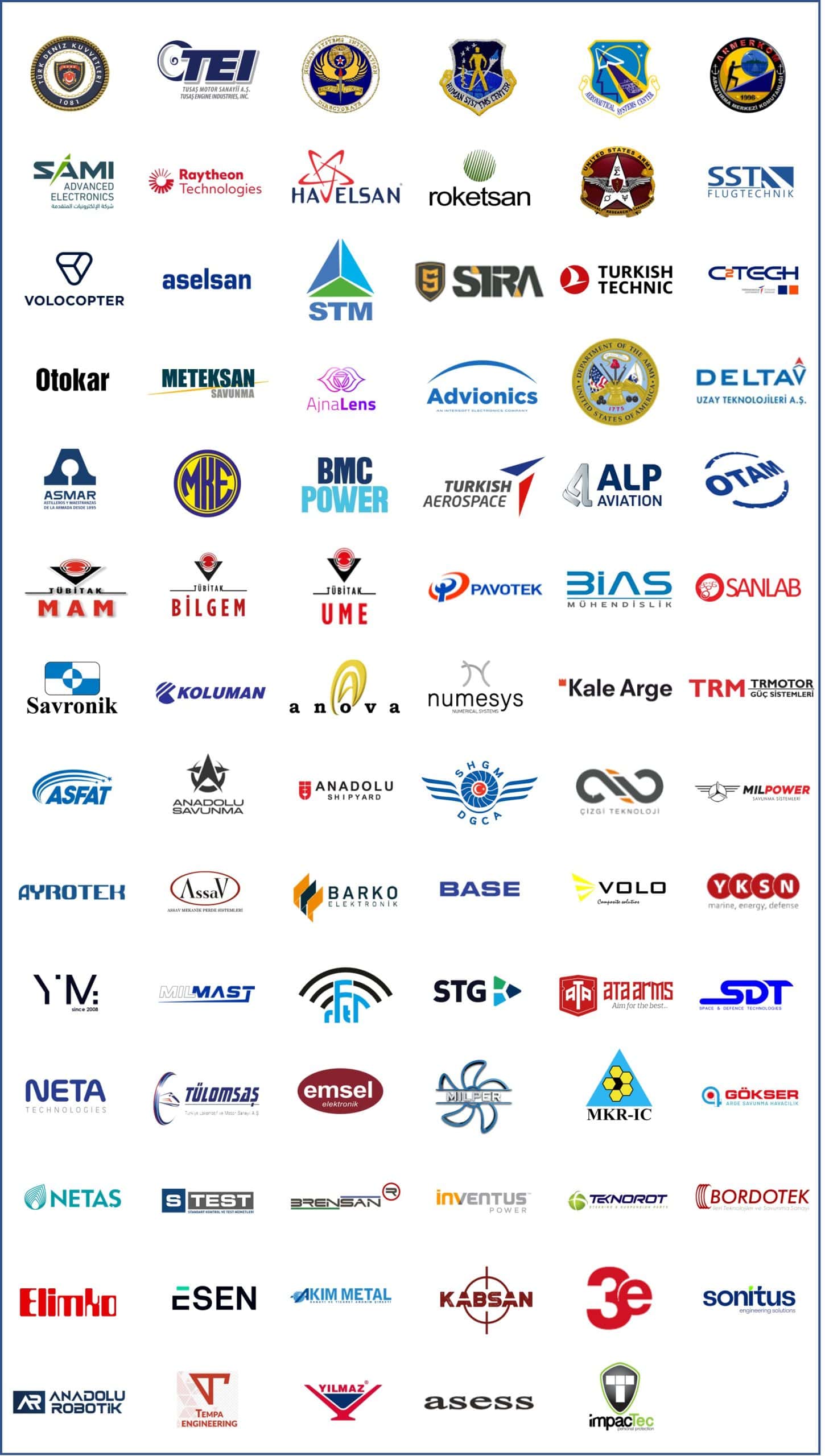
OUR REFERENCES

We have provided training and test consultancy services to more than 120 companies and organizations and over 1000 individual trainees so far.

References of GDS Simulator Users
&
Solution Partners
in
Maritime Training and Research